Promotions and discounts have always been at the heart of customer acquisition. But in today’s market, they play a much more nuanced role. Customers still expect immediate value, yet loyalty programs are now responsible for turning that first transaction into long-term engagement.
For enterprise marketers planning loyalty programs, this poses a clear challenge: how do you use promotions effectively without turning your program into a discount engine?
The answer lies in understanding how customer expectations have evolved and how promotions fit into a broader loyalty ecosystem.
All the statistics in this article are from Antavo’s Global Customer Loyalty Report 2026. Make sure to download it for more regional, generational and industry-based findings on loyalty.

Customers join for savings, but stay for something more
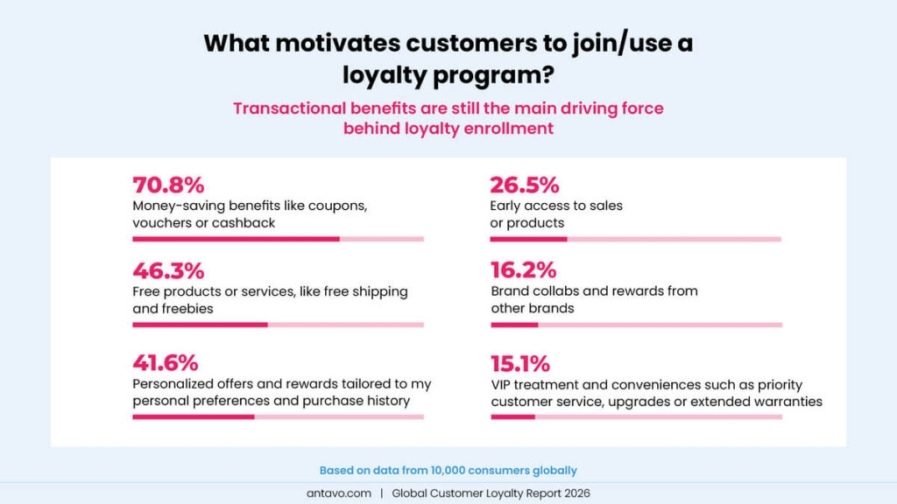
Despite the evolution of loyalty strategies, one thing has remained constant. Customers are still primarily motivated by financial value.
70.8% of customers join for money-saving benefits like coupons, vouchers, or cashback, making financial value the strongest entry point.
At the same time, demand for loyalty programs continues to grow. 43.2% of consumers say they are more likely to join a loyalty program than last year, and 65.9% now see loyalty programs as part of their everyday lives.
This shift signals something important. Loyalty programs are no longer optional. They are expected.
However, this does not mean that discounts alone can sustain engagement.
Where loyalty programs fall short
Many programs struggle because the value exchange weakens over time. The biggest friction points highlight this clearly:
- 49.1% say it takes too long to earn rewards
- 41.1% are frustrated by expiring points
- 38.9% find rewards unattractive
When rewards feel out of reach, customers disengage. This is reflected in the fact that 27% of points go unspent, while a significant portion of members stop participating early.
This aligns with a broader principle seen across loyalty strategies. Financial incentives are effective for acquisition, but they are not enough to drive long-term behavior change.
Promotions are powerful, but no longer differentiating
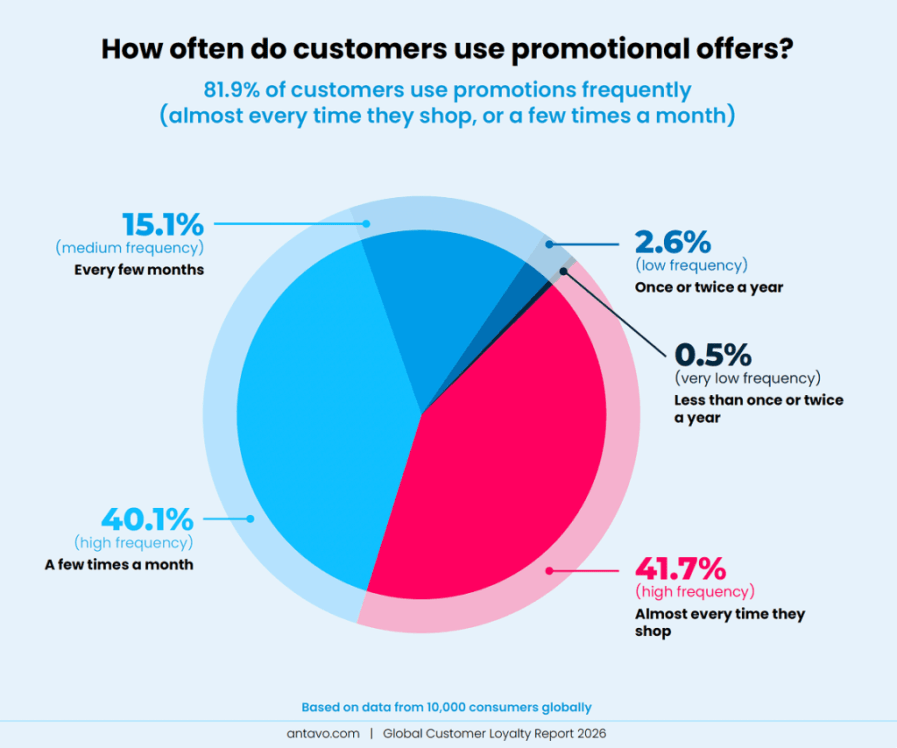
Promotions still play a major role in shaping customer behavior. 68.6% of customers say promotions influence their shopping decisions, and 81.9% use them frequently, either every time they shop or multiple times per month.
At first glance, this seems like a strong argument for increasing promotional activity. In reality, it signals something else, due to their status as “something to be expected”.
What customers actually prefer in promotions
Consumers show clear preferences when it comes to promotional formats:
- 67.3% favor discount codes
- 47.8% prefer BOGO offers
- Bundles, free samples, and seasonal deals follow closely
These formats are familiar, easy to understand, and provide instant value.
But what matters more is how customers perceive promotions today.

Customers no longer view promotions as occasional perks. They are part of an ongoing value exchange. Customers expect to receive something in return for engagement, whether that is signing up, identifying themselves, or interacting with the brand.
Why promotions work best inside loyalty programs
The biggest shift is not happening on the customer side, but on the marketer side.
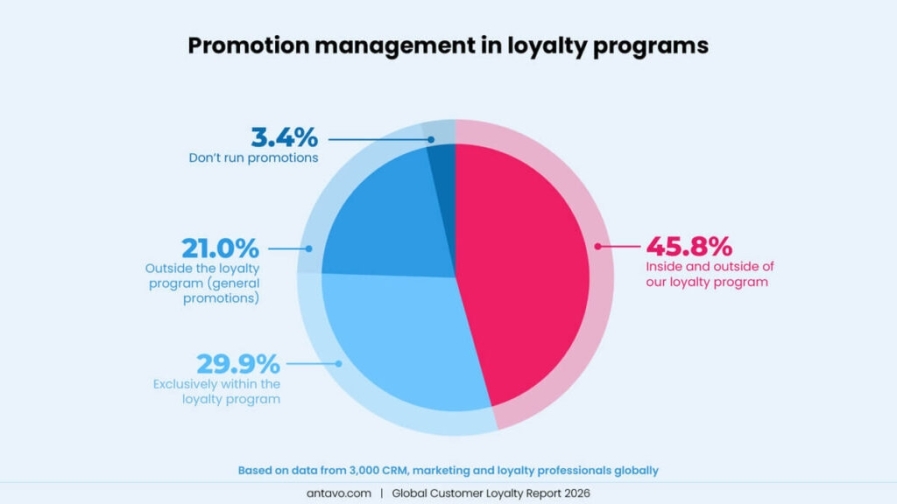
Instead of running promotions as standalone campaigns, brands are embedding them into loyalty programs.
Today, 96.6% of loyalty program owners run promotions, and many already operate them within their loyalty ecosystem.
The advantage of embedding promotions
When promotions are part of a loyalty program, they become more than just discounts:
- Customers can be required to identify themselves or become members
- Offers can be personalized using first-party data
- Engagement becomes measurable and repeatable
- Margins can be better controlled
This is why 59.8% of marketers say they would move more promotional budget into loyalty programs.
Moving from campaigns to systems
One of the most important shifts in loyalty program planning is how promotions are used.
They are no longer isolated campaigns designed for short-term revenue spikes. Instead, they are part of a broader system focused on the customer lifecycle.
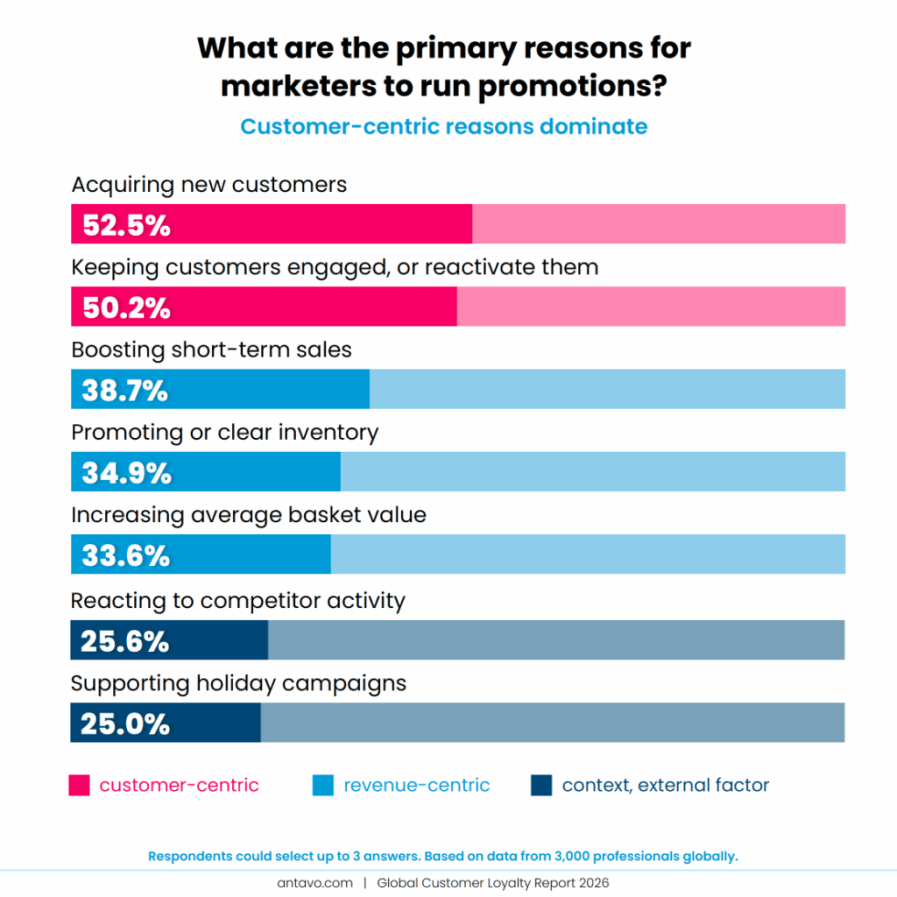
According to the Global Customer Loyalty Report 2026:
- 52.5% use promotions to acquire customers
- 50.2% use them to retain or reactivate customers
- Only 38.7% prioritize short-term sales
This signals a clear evolution in mindset, where promotions are becoming tools for lifecycle management.
What this looks like in practice
- Instant discounts to drive enrollment and first purchase
- Personalized incentives to maintain engagement
- Targeted offers to reactivate inactive members
This is especially important when you consider that 74% of loyalty members “quiet quit” within two months.

Key Takeaways & Actionable Insights
- Financial value gets customers through the door, but won’t build loyalty.
- The effectiveness of promotions is about relevance, timing, and context.
- Promotions act as triggers, not retention strategies. They should not sit outside your loyalty strategy but instead be embedded within the program to create a controlled, data-driven value exchange.
- Promotions are no longer the end goal. When combined with a loyalty program, they serve as the entry point to a deeper, more strategic relationship with your customers.
FAQ on promotions in loyalty programs
How should I balance promotions and long-term rewards in my loyalty program?
Start by using promotions to drive acquisition and early engagement. Then gradually introduce structured benefits like tiers, experiential rewards, and personalized offers to build long-term loyalty.
How do I prevent promotions from hurting my margins?
Embed promotions within your loyalty program. This allows you to target offers, control eligibility, and measure performance, instead of offering blanket discounts to everyone.
What types of promotions work best in a loyalty program?
Discount codes, BOGO offers, and personalized incentives perform best. However, their effectiveness increases significantly when they are tied to member behavior or lifecycle stages.
When should I trigger promotions for maximum impact?
Focus on key moments in the customer lifecycle. For example, onboarding, post-purchase engagement, inactivity, or tier progression. Timing matters more than frequency.
Closing thoughts for promotions and loyalty programs
Promotions can be a powerful tool to grab customers’ attention and kickstart a relationship, but they won’t substitute a loyalty strategy. They also need sophisticated tech to function without a hitch.
Antavo’s Promotion feature (part of the Loyalty Engine product) was built to empower marketers to seamlessly define, configure, test, launch and analyze a wide variety of promotions. Even more, targeted promotions can be combined to create a more complex experience.
As for planning the loyalty program that houses your promotion strategy, Antavo’s AI-powered loyalty platform is built on the principle of turning loyalty into an operating system for customer engagement.
- The Planner helps teams translate engagement ideas into loyalty program structures.
- The Engine runs loyalty mechanics in real time.
- The Optimizer uses AI to interpret performance data and reveal what actually drives behavior.
Together, they allow loyalty teams to run programs that evolve continuously instead of repeating the same campaigns.
And that’s when loyalty stops generating activity and starts generating growth.
If you are interested in what Antavo has to offer, be sure to book a call! And don’t forget to download our report.
Tamas is the Head of Content at Antavo and a Certified Loyalty Marketing Professional – CLMP. Tamas is known for having a keen eye for loyalty and customer retention strategies and trends. Tamas is also a true gamer at heart and has an impressive collection of cyberpunk books.