But there’s a practical distinction worth drawing, and it changes how you apply the idea.
Search intent is about optimizing content to match what the search results reward. Keyword intent is the same concept applied one step earlier. Think of it as the filter you use during keyword research to decide whether a keyword belongs in your strategy at all.
If the intent doesn’t align with something your site can realistically serve and convert, the keyword doesn’t belong in your plan, regardless of how attractive the volume looks.
There are four common keyword intent buckets. Here’s what they mean for your keyword strategy.
Informational keywords
Informational keywords are searches for answers, explanations, or how-to guidance. Think “how to grow tomatoes,” “why are my plant leaves turning yellow,” or “when to plant bulbs.”
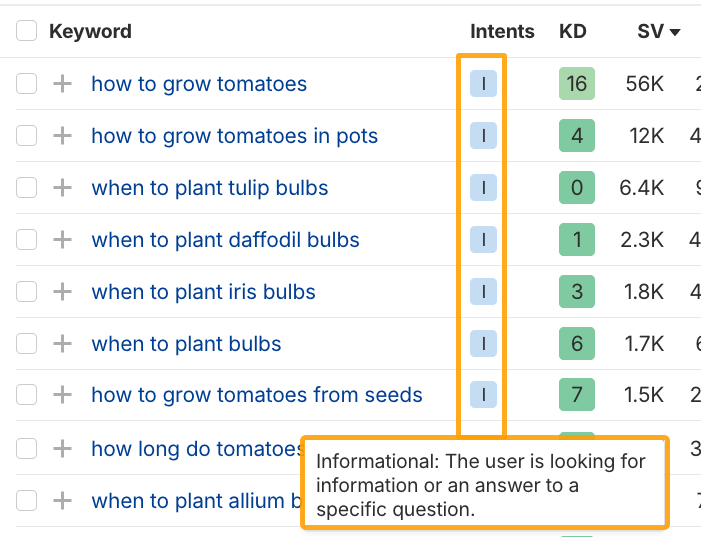
They make up the majority of search volume in most niches and form the backbone of most content strategies. They’re worth targeting when traffic potential is high, topical authority matters to your strategy, and there’s a natural way to introduce your product in context.
Skip informational keywords when:
- The intent is too broad: “what is gardening” might get searches, but the audience it attracts is too diffuse to be useful. You’d be creating content for everyone and converting no one.
- Traffic potential is low: if the top-ranking page for a keyword earns minimal traffic, there’s no prize worth competing for, regardless of how well the topic fits your site.
- There’s no credible product angle: if you can’t naturally introduce your product or service within the content without it feeling forced, you’re publishing for the sake of it. That dilutes your topical focus without moving the needle on revenue.
Commercial keywords
Commercial investigation keywords sit between research and purchase. Queries like “best garden hose,” “raised bed vs in-ground gardening,” or “top fertilisers for vegetables” signal that the searcher is evaluating options but isn’t ready to buy yet.
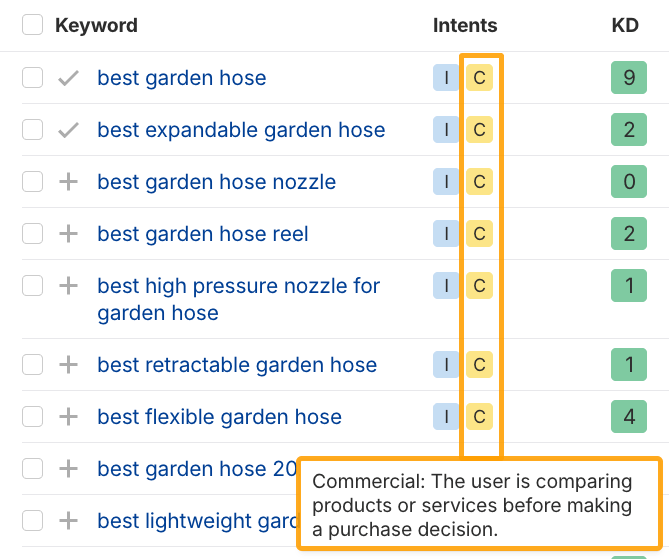
These are where most of the strategic value lives for ecommerce or affiliate marketing websites.
Whether these keywords make sense to target in your keyword strategy depends entirely on the products you sell or promote.
Ahrefs’ Business Potential score is the most useful framework for assessing these. It rates keywords by how naturally you can present your product as the solution.

Transactional keywords
Transactional keywords signal immediate purchase intent, like “buy garden hose online,” “greenhouse kits for sale,” or “Miracle-Gro potting mix price”.
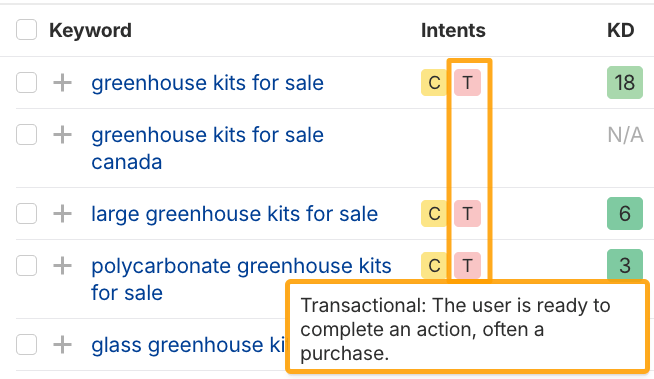
They convert well but are competitive and expensive to rank for organically. Because they sit closest to the point of purchase, they attract the most competition, both from other organic results and from paid advertisers willing to bid aggressively for the same eyeballs.
Worth targeting if you can rank; worth bidding on in paid if you can’t.
Navigational keywords
Navigational keywords are searches for a specific brand or destination, such as “Thompson & Morgan website,” “RHS plant finder,” or “Gardeners’ World magazine”.
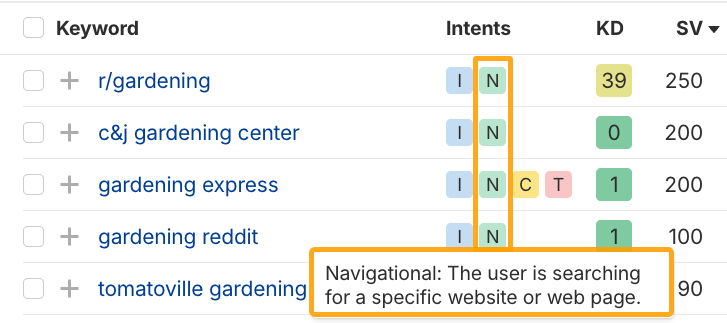
The only navigational terms worth owning are your own brand terms, like “Ahrefs login,” “Ahrefs pricing,” or “Ahrefs free trial.” These are people already looking for you specifically, and making sure you rank prominently for them is about protecting your presence.
The standard classification for keyword intent doesn’t adequately account for two very common categories that behave fundamentally differently in practice (and that Ahrefs explicitly recognizes as distinct filters in Keywords Explorer).
The first is local intent.
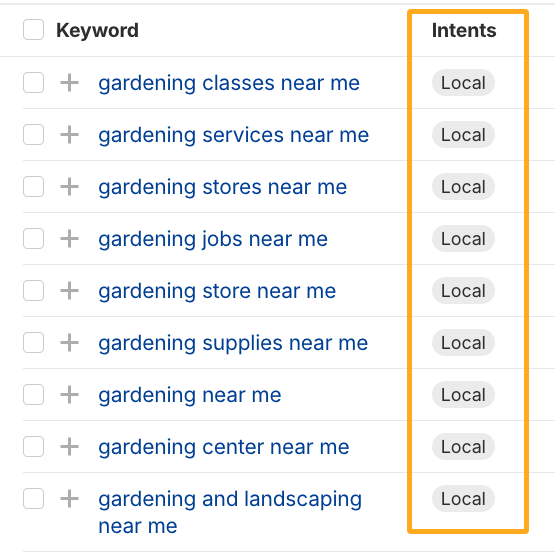
Local intent keywords aren’t just transactional with a location modifier. Keywords like “dentist near me” or “coffee shop Shoreditch” trigger a fundamentally different type of search results page than a standard organic query:
- Map pack results
- Google Business Profiles
- Local directory listings
- Local Service Ads
Standard content-based SEO is largely irrelevant here. A keyword with local intent needs a local SEO response, not a blog strategy. That means optimising your Google Business Profile, building local citations, and earning reviews rather than creating content.
The other type of keyword intent that’s typically missing is branded intent. These keywords include a brand or organizational entity by name. It could be your brand, a competitor’s, or a completely unrelated organization in your industry.
For example, in the gardening niche this might include a competitor like “Epic Gardening,” a retailer like “Home Depot gardening,” or an unrelated brand that shares your audience like “Martha Stewart gardening book.”
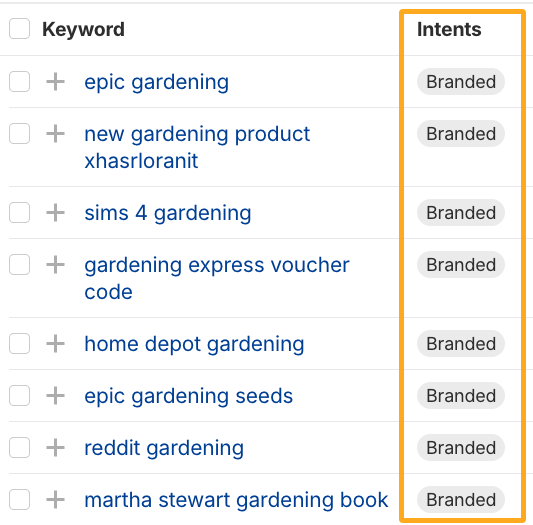
These keywords aren’t always navigational, in the traditional sense. For instance:
- {Brand} alternative: Is a commercial investigation query.
- {Brand} pricing: Is a transactional intent query.
- {Brand} vs {Brand}: Is a comparative commercial intent query.
There are many similar keywords containing brand names that all carry commercial or transactional signals. Showing up for these terms often requires a competitive approach and may even be a valid option for paid search ads.
Some keywords don’t fit neatly into one category. For instance, “project management software” has both informational and commercial signals.

“Best deals on running shoes” sits between informational, commercial, and transactional, depending on the searcher’s proximity to purchase.

If you come across such keywords in your research, you can either choose one intent to optimize for. Or, you can create separate pieces of content covering the same keyword from a different intent.
For example, say you sell costumes. Many keywords have mixed intent:
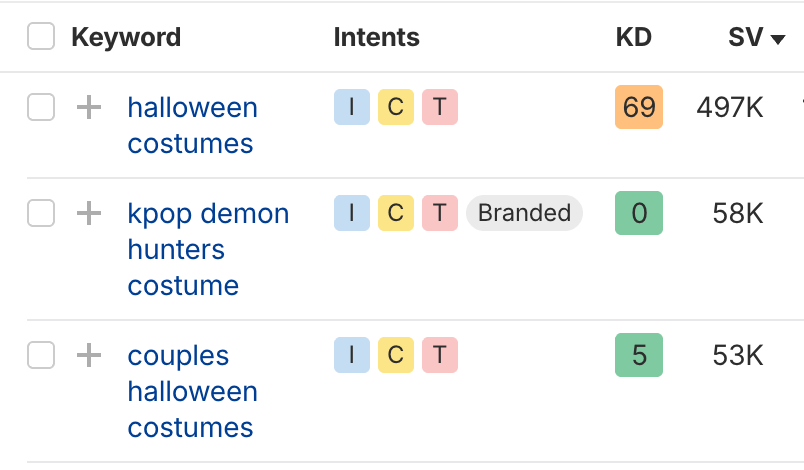
You can target these on your ecommerce pages, where people can fulfil commercial and transactional intent (which is in alignment with the purpose of your ecommerce website). For most brands, that’s a common pathway.
However, you could also consider creating relevant blog content, such as tips for making a DIY Halloween costume or lists of couples’ costume ideas with links to specific products in your store.
This way, you cover all keyword intents with content tailored to searchers at different stages of their buying journey.
How to identify keyword intent with Ahrefs
There are a few ways you can use Ahrefs to help you identify the intent of any keyword (either individually or at scale).
When you’re building out a keyword list in Keywords Explorer and aren’t quite sure if a keyword meets the intent you’d like to target, try expanding the SERP results and using the AI intent identification feature:

It gives you a percentage breakdown of the search results and how many of the pages that rank fit a specific intent.
You can also choose between these intents for any keyword in AI Content Helper. The content optimization report gets customized based on which intent you select for a keyword:

You can also monitor intent drift for your priority keywords in Rank Tracker. Open the SERP overview for your target keywords, compare time periods, and hit “Identify intents” to track shifts in search intent over time.

And finally, if you’d like to identify more nuanced keyword intent across a whole list of keywords at scale, you can try using the Ahrefs MCP with your preferred LLM. Our team has found better success using Claude than ChatGPT, but your mileage may vary.
By connecting the MCP to an LLM, you can prompt it directly (something like “from this list of keywords, group them by intent type and flag any with high traffic potential”), and it’ll query Ahrefs data to do the heavy lifting in seconds rather than you manually working through each one.
In addition to scalability. Another advantage of using the MCP is that you can prompt it to identify deeper, more subtle layers of keyword intent (often called micro-intents).
It’s particularly useful when you’re researching a new niche and want a broad intent map before you start filtering in Keywords Explorer.
Keyword intent is your first filter, not your last
Before you look at keyword search volume, assess keyword difficulty, or plan a content calendar, ask whether the intent behind a keyword matches something your site can realistically serve to searchers and convert.
If it doesn’t, no amount of traffic potential makes it worth pursuing.
That’s the discipline keyword intent analysis actually requires. It’s a strategic filter that shapes everything that follows your keyword research process.