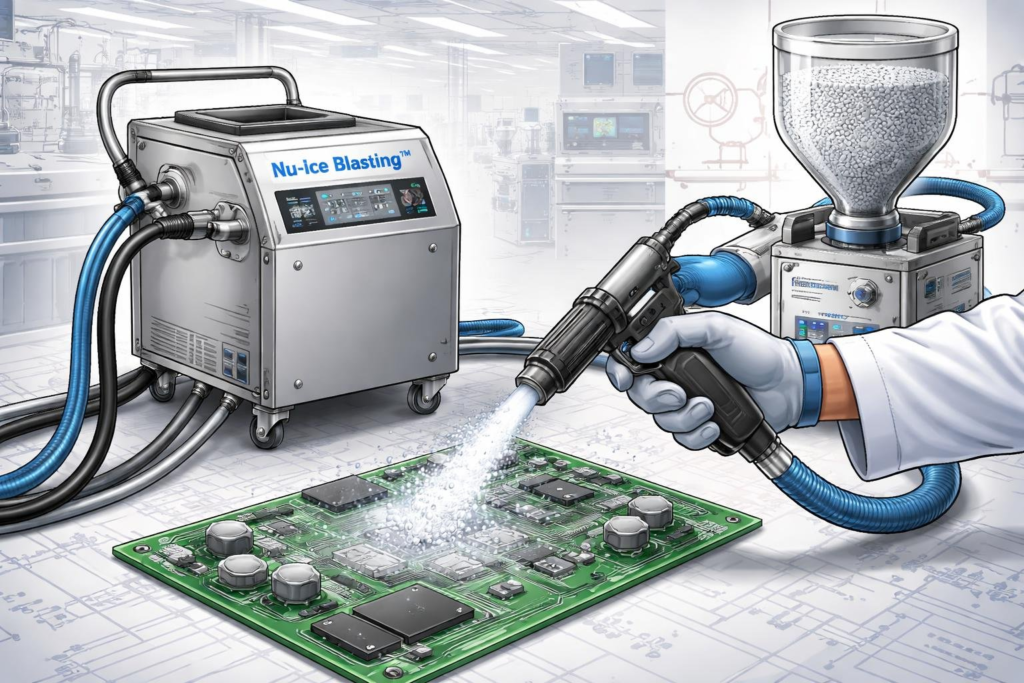
In electronics manufacturing and repair environments, cleaning delicate components presents ongoing challenges, including flux residue buildup, production downtime, and the risk of damaging sensitive surfaces. Traditional cleaning approaches—such as liquid solvents, water-based washing, or abrasive techniques—can introduce moisture, static risks, or physical wear to microscopic solder joints and circuit traces. As industries seek safer alternatives, dry ice cleaning circuit boards has emerged as a precision-focused method designed to remove contaminants while protecting fragile assemblies. Nu-Ice Blasting™, an industrial dry ice blasting equipment manufacturer, develops systems that use solid CO₂ pellets accelerated by compressed air to dislodge residues without introducing water or secondary waste. This approach provides manufacturers with an alternative to abrasive, wet, or chemical cleaning methods when maintaining sensitive electronic components.
Dry ice blasting is an industrial cleaning method that uses compressed air to accelerate solid carbon dioxide (CO₂) pellets toward a contaminated surface. The pellets are propelled through a blasting hose and nozzle, allowing operators to direct the cleaning stream with precision. When the dry ice pellets strike the surface, they help dislodge residues such as oils, adhesives, or manufacturing buildup. A defining characteristic of the process is sublimation: upon impact, the dry ice pellets transition directly from a solid state to CO₂ gas. Because the cleaning media converts into gas rather than liquid, the process does not introduce moisture and does not leave secondary blasting media behind, helping reduce post-cleaning cleanup requirements.
Kinetic Impact
Compressed air accelerates dry ice pellets through the blasting system and toward the target surface. The velocity of the pellets helps loosen contaminants and break the bond between the residue and the underlying material.
Thermal Shock
Dry ice is extremely cold compared to most industrial surfaces. When the pellets contact the contaminated area, the temperature differential can cause residues to contract or become brittle, weakening their adhesion to the surface.
Sublimation Expansion
After impact, the dry ice pellets rapidly sublimate from solid CO₂ into gas. This expansion helps lift loosened contaminants away from the surface, supporting the removal process while leaving no blasting media behind.
A dry ice blasting system is composed of several integrated components that work together to deliver controlled cleaning performance. An air compressor supplies the compressed air required to propel dry ice pellets through the system at high velocity. The dry ice hopper stores the pellets and feeds them into the machine during operation. A metering system regulates the amount of dry ice introduced into the air stream, helping operators control the cleaning intensity and media consumption. From there, the mixture of compressed air and pellets travels through a blasting hose, which directs the flow toward the nozzle. The nozzle shapes and focuses the stream, allowing the operator to target specific areas of the surface being cleaned.
Nu-Ice Blasting™ is a manufacturer of industrial dry ice blasting equipment designed for precision cleaning applications across multiple industries. Founded in 1999, the company develops and manufactures its systems in the United States, focusing on equipment that supports non-abrasive cleaning processes using solid CO₂ pellets. Nu-Ice Blasting™ machines are engineered to deliver dry ice through controlled compressed-air systems that remove residues without introducing water or secondary blasting media. The technology is commonly evaluated in manufacturing environments where surface sensitivity, contamination control, and downtime reduction are important operational considerations. Within electronics maintenance and production environments, flux removal dry ice blasting can be used to dislodge manufacturing residues from delicate assemblies while avoiding liquid cleaning agents. As an equipment manufacturer, Nu-Ice Blasting™ focuses on producing dry ice blasting systems that enable operators to perform controlled industrial cleaning without relying on chemical or abrasive methods.
Nu-Ice Blasting™ equipment incorporates several integrated components that support controlled delivery of dry ice during cleaning operations. Systems typically include a blasting gun designed to direct compressed air and dry ice pellets toward the target surface. Operators can pair the gun with interchangeable nozzles, allowing the airflow and pellet stream to be shaped for different cleaning scenarios or surface geometries.
Many systems also integrate a moisture separator, which removes water vapor from the compressed air supply before it enters the blasting unit. This helps maintain consistent airflow conditions during operation. In addition, an aftercooler may be used in conjunction with the compressed air system to reduce air temperature and condense excess moisture before it reaches the equipment. Together, these components support stable airflow delivery and controlled pellet acceleration through the blasting hose and nozzle.
Dry ice blasting machines manufactured by Nu-Ice Blasting™ are designed as compact industrial cleaning systems that integrate air delivery, pellet storage, and metering components within a single unit. Equipment dimensions vary by model, but systems are generally designed for mobility within manufacturing or maintenance environments. Units typically include a dry ice hopper capable of holding several pounds of pellets to support continuous operation during cleaning tasks.
Operational performance depends on the available compressed air supply. Systems generally operate within a defined airflow range and pressure range, allowing operators to adjust output based on the cleaning requirements of the surface being treated. Equipment specifications also include defined dry ice consumption rates, which correspond to the metering system settings and airflow conditions. These parameters allow operators to regulate pellet usage while directing compressed air and dry ice toward the cleaning area.
Preparation and Setup
Before operation, the dry ice blasting unit is connected to a suitable compressed air supply and the hopper is filled with dry ice pellets. Operators check air pressure levels, hose connections, and nozzle selection to ensure the system is configured for the intended cleaning task.
Safety Requirements
Standard industrial safety procedures apply when operating dry ice blasting equipment. This typically includes appropriate personal protective equipment, ensuring proper ventilation in enclosed spaces, and verifying that compressed air connections and equipment components are secured before operation.
Typical Workflow Steps
Once the system is prepared, compressed air carries dry ice pellets from the hopper through the metering system and blasting hose toward the nozzle. The operator directs the nozzle at the surface being cleaned, adjusting air pressure and pellet feed as needed. The process continues until the targeted area has been treated.
Dry ice blasting equipment manufactured by Nu-Ice Blasting™ is used across a wide range of industrial and commercial environments where surface contamination must be addressed without introducing water or additional blasting media. In manufacturing and production facilities, dry ice blasting equipment is often applied to machinery, molds, and production equipment during routine maintenance. The process can be integrated into cleaning procedures where minimizing disassembly and limiting moisture exposure are operational considerations.
In food processing and sanitation environments, dry ice blasting equipment may be used to clean production lines, conveyors, or processing machinery. Because the process relies on solid CO₂ pellets that sublimate into gas, it can be incorporated into maintenance procedures where water-based cleaning is not preferred during certain maintenance intervals.
The equipment is also evaluated in historical restoration and delicate surface cleaning, where surface sensitivity is an important factor. Additional industries that use dry ice blasting equipment include automotive manufacturing, aerospace maintenance, electrical equipment servicing, and specialty industrial cleaning environments. In these sectors, the equipment is integrated into maintenance workflows where controlled removal of residues or buildup is required.
Dry ice blasting is recognized for several operational characteristics that differentiate it from traditional cleaning methods. Because dry ice pellets sublimate directly into CO₂ gas, the process does not generate secondary blasting media that must be collected after cleaning. The interaction between pellets and surfaces is also considered non-abrasive, which allows the method to be evaluated for use on materials that may be sensitive to aggressive mechanical cleaning.
Another consideration is that the process is dry and chemical-free, since it does not rely on water or solvents during operation. These factors are often relevant in industrial environments where moisture control, contamination management, and post-cleaning handling procedures are part of routine maintenance workflows. In specialized electronics maintenance, electronic component dry ice cleaning may be evaluated within these operational parameters.
Dry ice blasting systems can be configured with a range of accessories that support different cleaning environments and equipment layouts. Interchangeable nozzles allow operators to adjust the shape and focus of the blasting stream, while various hose lengths and materials help accommodate different working distances and facility configurations. The compressed air supply is a critical component of system integration, and many setups include aftercoolers and moisture separators to condition the air before it enters the blasting unit. Proper dry ice storage is also important, as pellets gradually sublimate over time. Routine maintenance typically includes checking hoses, fittings, and seals to maintain consistent airflow and pellet delivery.
What is dry ice blasting?
Dry ice blasting is an industrial cleaning method that uses compressed air to propel solid carbon dioxide (CO₂) pellets toward a surface. When the pellets strike the surface, they help loosen contaminants and then sublimate directly into gas, leaving no blasting media behind.
Frequently Asked Questions (FAQs)
What types of equipment can be cleaned using dry ice blasting systems?
Dry ice blasting equipment is used in many industrial environments, including manufacturing facilities, food processing plants, and maintenance operations. It can be applied to machinery, molds, production equipment, and electrical housings where moisture-free cleaning processes may be required.
What safety considerations are involved when operating dry ice blasting equipment?
Operators generally follow standard industrial safety procedures. These may include wearing appropriate personal protective equipment, maintaining adequate ventilation when working with CO₂, and ensuring that compressed air lines, hoses, and system components are properly secured before operation.
What infrastructure is required to operate a dry ice blasting machine?
Dry ice blasting equipment requires a compressed air source and a supply of dry ice pellets. Facilities also typically provide ventilation, adequate working space for the equipment, and proper storage conditions to limit sublimation of dry ice before use.
How does dry ice blasting compare to abrasive cleaning methods?
Dry ice blasting uses solid CO₂ pellets rather than abrasive media such as sand or grit. Because the pellets sublimate into gas upon impact, the process does not introduce additional blasting media that must be collected or disposed of after cleaning.
Does dry ice blasting create environmental waste?
The cleaning media used in the process is solid carbon dioxide, which transitions directly to gas when it contacts the surface being cleaned. Since the pellets sublimate, the method does not leave behind residual blasting media, reducing secondary cleanup requirements.
Can dry ice blasting be used around sensitive equipment?
Dry ice blasting is evaluated in environments where water or abrasive cleaning materials may not be suitable. Because the process does not involve liquid solvents or water, it can be considered for applications where dry cleaning methods are necessary.
As manufacturing technologies continue to evolve, maintaining sensitive equipment without introducing moisture or abrasive media remains an ongoing consideration for many industries. Dry ice blasting equipment developed by Nu-Ice Blasting™ provides a cleaning approach based on the controlled use of solid CO₂ pellets and compressed air. By combining precision airflow, pellet metering, and specialized blasting components, these systems are designed to support industrial maintenance processes across a range of operational environments. From production facilities to technical maintenance settings, equipment designed around dry ice blasting offers a method that operates without water or chemical cleaning agents. As industries evaluate different maintenance technologies, systems manufactured by Nu-Ice Blasting™ continue to be integrated into workflows where controlled surface cleaning, minimal secondary waste, and dry operation are important technical considerations.