If you’re doing SEO, you need to track whether it’s actually producing results.
Publishing content and targeting keywords is only half the job. The other half is monitoring how your pages perform in search engines and whether they bring in organic traffic.
Tools like Google Analytics, Google Search Console, and SEO platforms such as Ahrefs or Semrush make it easy to monitor organic search results. They show which keywords drive traffic, how your pages rank in search results, and whether your SEO strategy is improving visibility over time.
And even with AI changing search, organic search still matters. Google AI Overviews often pull from pages already ranking in Google search, and other AI systems frequently cite content that performs well in organic search results.
Key Takeaways:
- Organic search still drives traffic and influences what AI systems cite.
- Google Analytics and Google Search Console help track organic search traffic and user behavior.
- Ahrefs or Semrush are useful for monitoring keyword rankings and position tracking.
- The most important metrics to monitor organic results include keyword rankings, organic traffic, impressions, click-through rate, and backlinks.

Link building cheat sheet
Gain access to the 3-step strategy we use to earn over 86 high-quality backlinks each month.
Does Organic Even Still Matter With AI?
Yes. Organic search still matters.
Most AI answers are built on top of the existing web, and that usually means organic search results.
For example, Google’s AI Overview often pulls information from pages already ranking in Google search. If your content ranks well organically, it has a much better chance of being cited in the AI answer as well.
Other AI systems like ChatGPT and Perplexity work a bit differently, but the principle is similar. They pull information from many sources across the web, and those sources are usually pages that already perform well in search engines or appear on authoritative sites.
That means organic search is still the foundation.
If your content ranks in search results, you can get traffic directly from organic search traffic. But it can also lead to additional visibility when AI systems cite those same pages in generated answers.
And when AI pulls from third-party content like listicles or comparison articles, the same rule applies. If your brand appears in content that ranks well in search engines, it has a higher chance of being mentioned in AI responses too.
So while search is evolving, organic search performance still drives visibility across both traditional search engines and AI search systems.
The Only Tools You Need To Monitor Organic Results
You don’t need a huge stack of tools to monitor organic results.
In most cases, Google Analytics and Google Search Console are enough to understand how much organic traffic your site gets, which search queries bring users to your pages, and how your content performs in Google search results.
The limitation is that Google’s tools only show your own data and provide a fairly limited set of metrics. They don’t include competitor insights or reliable keyword position tracking.
That’s why it helps to add a third-party SEO tool like Ahrefs or Semrush to track keyword rankings, analyze competitors, and get a fuller view of your organic search performance.
GA + GSC
Google Analytics and Google Search Console are the foundation for monitoring organic search performance.
Google Analytics shows how much organic traffic your site receives and what visitors do after they arrive. You can see which pages generate the most traffic, how users move through your site, and metrics like bounce rate that indicate whether your content matches user intent.
This helps you understand how organic search traffic actually contributes to your digital marketing results.
Google Search Console focuses on what happens before users click. It shows which search queries trigger your pages in Google search, how often they appear in search results, and how many clicks they generate. It also provides data on keyword rankings, impressions, and overall organic search performance.
Together, these tools give you a clear picture of how your content performs in organic search results and where your SEO strategy needs improvement.
Ahrefs or Semrush
Ahrefs and Semrush do essentially the same job.
Both are SEO tools designed to give you deeper insights into organic search results than what Google’s tools provide.
While Google Analytics and Google Search Console show how your own site performs, Ahrefs and Semrush help you track keyword rankings, competitor visibility, backlinks, and overall search traffic trends.
The main difference between them is their data sources and databases. Each platform crawls the web independently, so the numbers you see for keyword volume, backlinks, or traffic estimates might differ slightly.
One tool might show a keyword ranking at position 8 while the other shows it at 10, simply because they collect data from different datasets.
In practice, the functionality is very similar. Both tools allow you to track keyword rankings over time, analyze competitors in search results, discover new keyword opportunities, and monitor backlinks that influence organic search rankings.
5 Must-Track Organic Results Metrics
Keyword Rankings
Keyword rankings are simply where your page appears in search results for a specific keyword.
If someone searches a keyword and your page shows up in position 3, that’s your ranking. If next week it drops to position 7, your ranking went down. If it climbs to position 1, you improved.
This is usually the first signal that your SEO efforts are working. Rankings tend to move before traffic does, so watching them helps you catch progress early.
Tracking them is pretty straightforward.
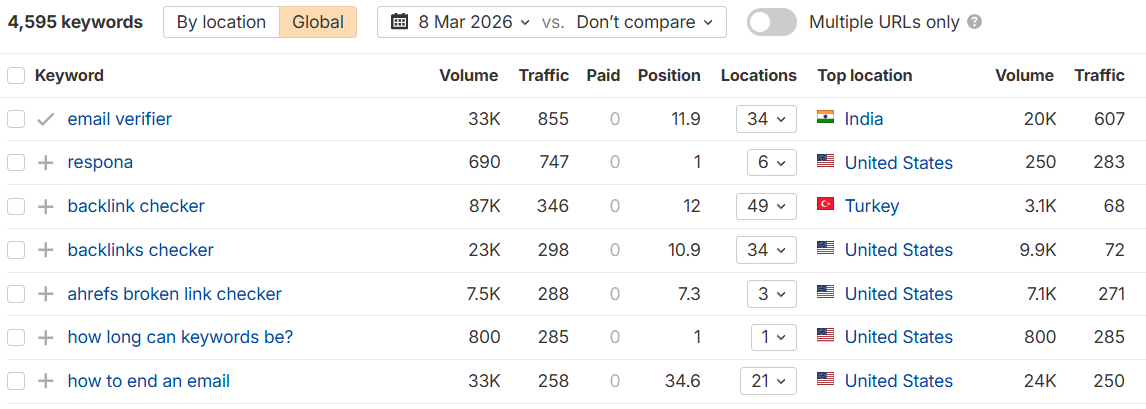
First, decide which keywords actually matter for your site. These should be keywords tied to your product, your content, or topics your target audience searches for. No need to track hundreds of random keywords. Start with the ones that align with your SEO strategy.
Second, add those keywords into a rank tracker like Ahrefs or Semrush. Both tools have position tracking features where you enter the keywords and the tool monitors where your pages appear in search results.
Third, choose the location you want to track. Rankings can change depending on the country or city, and sometimes between desktop and mobile.
Once everything is set up, the tool will check your rankings automatically and show how they move over time.
When reviewing rankings, focus on a few simple patterns:
- keywords moving up in the search results
- keywords dropping unexpectedly
- pages stuck near the bottom of page one or top of page two
That last group is often the easiest opportunity. A small improvement to the content, better internal links, or a few backlinks can sometimes push those pages higher.
Organic Traffic
Organic traffic is the number of visitors that reach your site through organic search results.
In other words, someone searches something in Google search, clicks your page in the search results, and lands on your site. That visit counts as organic search traffic.
This is one of the most important metrics to track because it shows whether your SEO strategy is actually bringing people to your site.
You can track organic traffic in Google Analytics or Search Console.
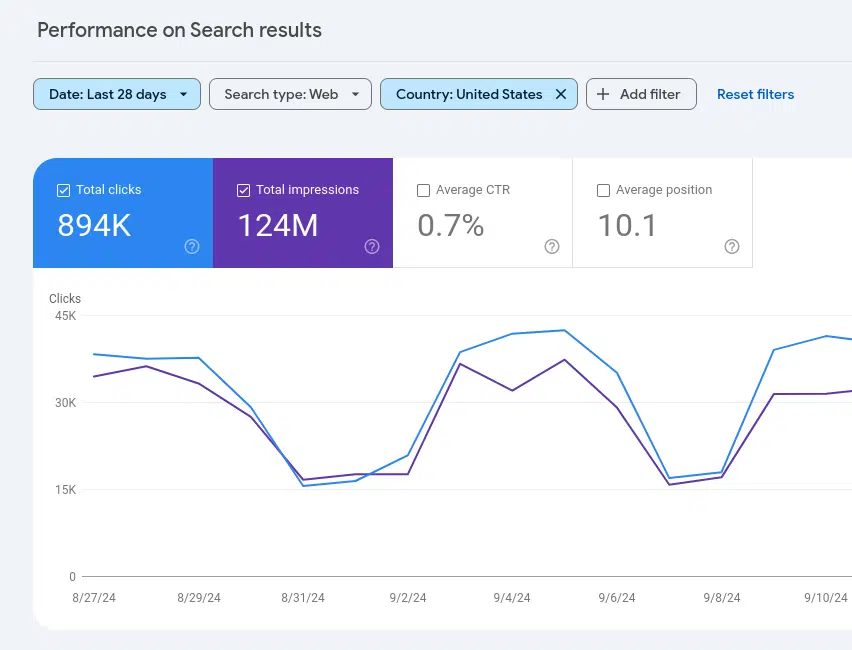
Go to Reports → Acquisition → Traffic acquisition, then filter by organic search. This will show how much traffic comes from search engines and which pages bring in the most visitors.
Once you’re there, a few things are worth paying attention to:
- which pages generate the most organic traffic
- whether traffic is growing over time
- which pages suddenly gain or lose traffic
If a page suddenly jumps in traffic, it usually means it improved its ranking for a keyword or started appearing for new search queries.
If traffic drops, it may mean rankings fell, search demand changed, or a competing page replaced yours in the search results.
Organic traffic also helps you understand which content actually drives discovery. Some pages may rank for dozens of keywords and quietly bring in a steady stream of visitors, even if those keywords don’t look impressive on their own.
Organic Impressions
Organic impressions show how often your page appears in search results, even if nobody clicks it.
For example, if your page shows up in Google search results 1,000 times for a keyword but only 50 people click it, that’s 1,000 impressions and 50 clicks.
You can track this in Google Search Console.
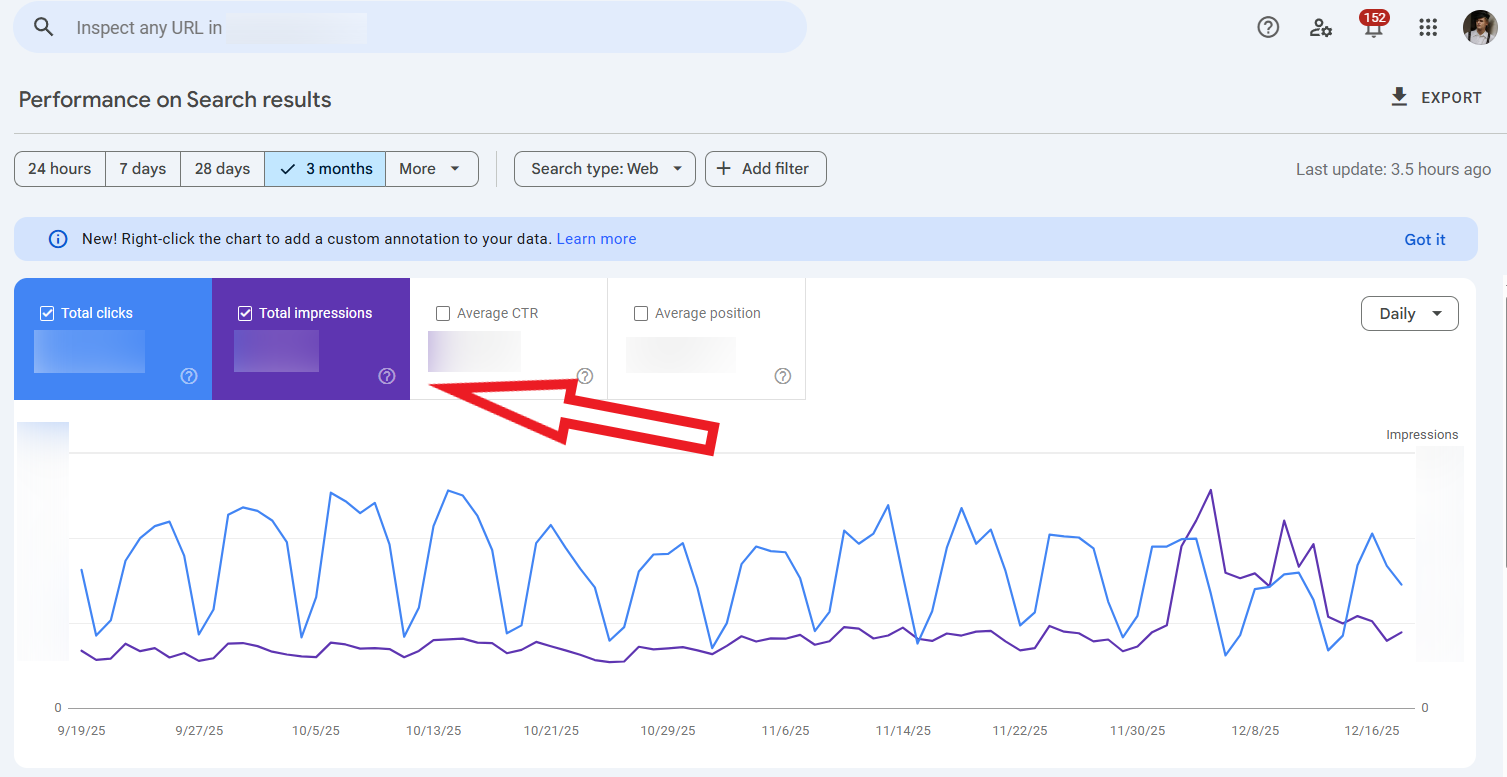
Go to Search Results inside Search Console and you’ll see impressions, clicks, click-through rate, and average ranking for your pages and keywords.
Impressions are useful because they tell you where you’re already visible in search engines, even if traffic hasn’t started yet.
A few common patterns to watch for:
- High impressions + low clicks
Your page appears often in search results but the title or description may not be compelling enough. - Rising impressions over time
This usually means your content is starting to rank for more keywords or moving up in search results. - Impressions for unexpected keywords
Sometimes Google ranks your content for search queries you didn’t target. Those can turn into good content opportunities.
In other words, impressions show the early signals of SEO performance. Before traffic grows, impressions usually increase first as search engines start testing your page in more search results.
Click-Through Rate
Click-through rate (CTR) shows how many people click your page after seeing it in search results.
It’s calculated by dividing clicks by impressions.
For example:
- 1,000 impressions
- 50 clicks
That means your click-through rate is 5%.
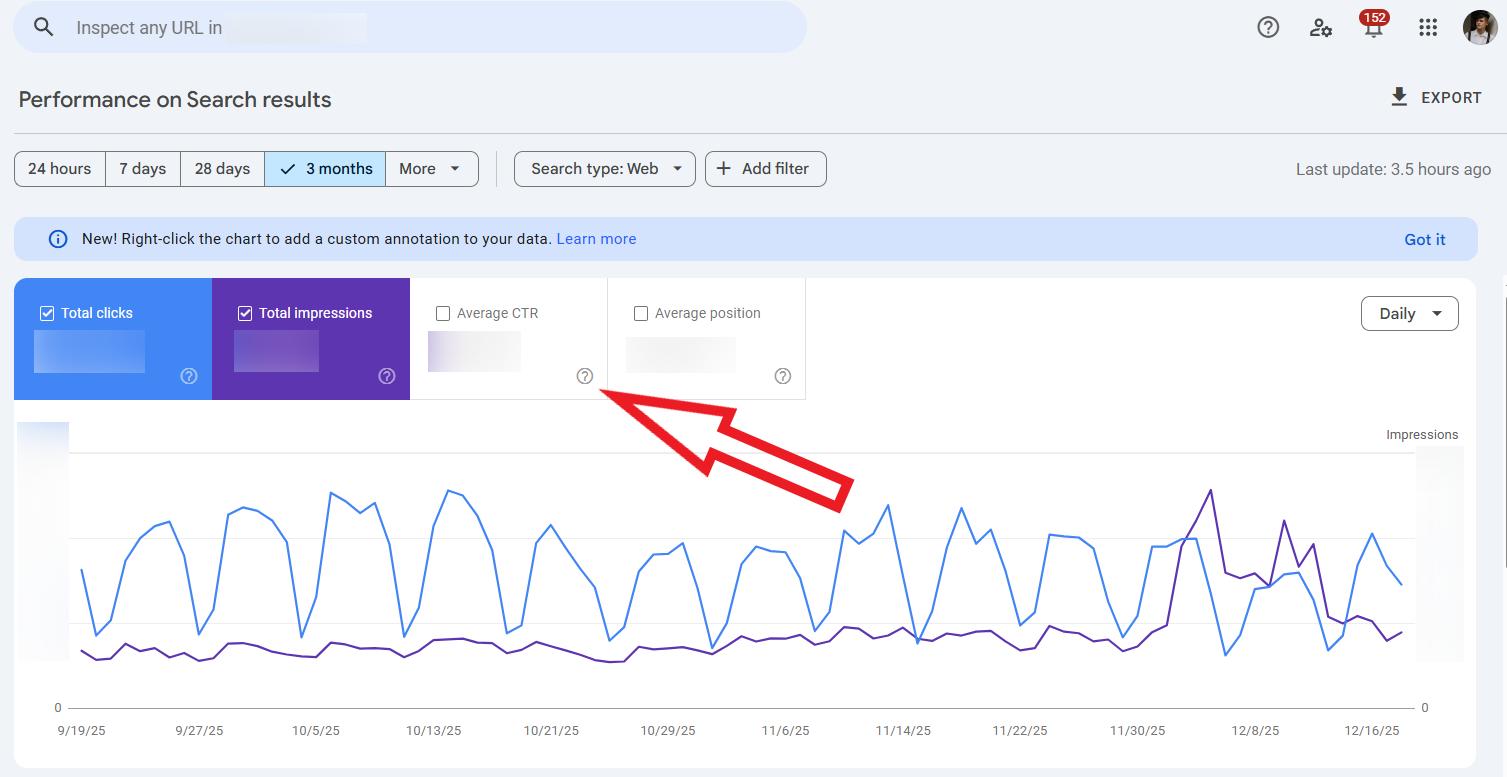
You can find this metric in Google Search Console under the Search Results report.
CTR matters because ranking alone doesn’t guarantee traffic. A page might rank well in search results but still bring in little traffic if users don’t click it.
When looking at CTR, a few patterns are worth paying attention to:
High impressions but low CTR
Your page appears in search results often, but the title or meta description might not be compelling enough.
Strong rankings but weak clicks
Sometimes your keyword ranking is good, but the page still doesn’t attract clicks. Improving the headline or making the page more relevant to the search intent can help.
High CTR on certain queries
This usually means your page matches the search intent well and stands out in the search results.
Improving CTR is often one of the easiest SEO wins. Small adjustments to your title tag, meta description, or the way your content is framed can bring significantly more traffic without changing the ranking.
Backlinks and Referring Domains
Backlinks are still one of the strongest signals search engines use to decide which pages deserve to rank.
When another site links to your content, it signals to search engines that your page is a credible source. The more relevant websites linking to you, the easier it becomes to improve your position in search results. That’s why link building continues to be a core part of search engine optimization.
Referring domains matter just as much.
If one website links to you ten times, that’s still only one referring domain. Search engines care more about how many different sites link to you, because it shows broader trust across the web. Ten different websites linking to your content is far more powerful than one site linking repeatedly.
The easiest way to track backlinks is through tools like Ahrefs or Semrush.
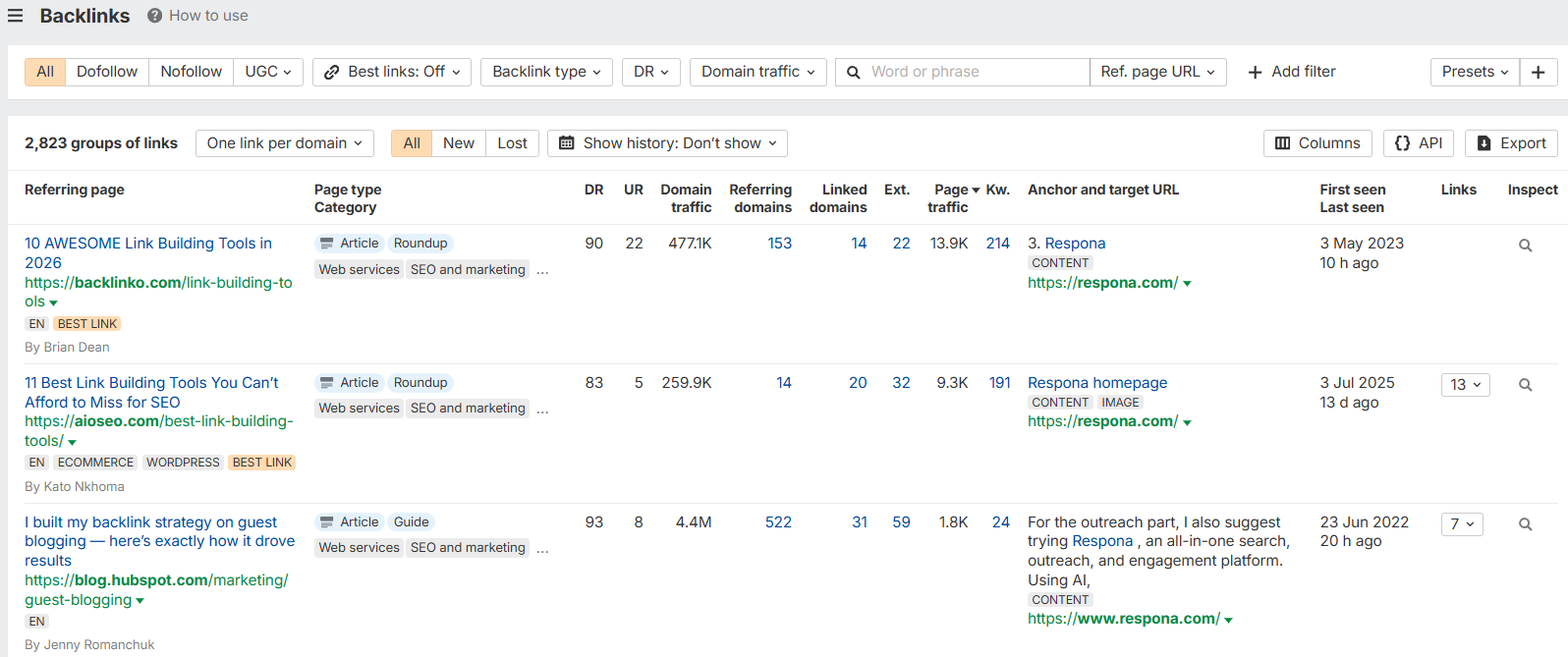
Inside either tool, you can enter your domain and view:
- total backlinks
- total referring domains
- new links gained over time
- lost links
- which pages attract the most links
Both platforms also show which websites link to your competitors. This is especially useful because it reveals link opportunities you might want to pursue as part of your SEO strategy.
A good habit is to check backlink growth monthly and watch for patterns:
- Are new referring domains increasing?
- Did you lose important links?
- Which content attracts the most backlinks?
These signals help explain changes in organic ranking and organic search performance.
This is also where listicle placements and editorial mentions come into play.
Many of the pages that rank in organic search results are high-authority listicles and comparison articles.
When your brand appears on those pages, you gain both a backlink and exposure on content that already performs well in search engines.
If you want to accelerate that process, that’s exactly what our done-for-you link building service focuses on.
We secure placements for your brand on relevant listicles, comparison pages, and editorial articles on authoritative websites.
These placements strengthen your backlink profile, improve organic search visibility, and help your content compete more effectively in search results.
Link building cheat sheet
Gain access to the 3-step strategy we use to earn over 86 high-quality backlinks each month.
Now Over to You
Organic search is still the foundation of online visibility.
Even with AI changing how results are displayed, most AI systems still rely heavily on organic search results when deciding what to cite. Google AI Overviews frequently pull from pages already ranking in search results, and other AI systems look at sources that consistently show up across the web.
That means monitoring organic results still matters just as much as ever.
The good news is you don’t need dozens of complicated tools. Google Analytics and Google Search Console give you most of the data you need, and a tool like Ahrefs or Semrush fills in the gaps with competitor insights, backlink tracking, and position tracking.
Once those are in place, focus on the metrics that actually tell you what’s happening:
- keyword rankings
- organic traffic
- impressions
- click-through rate
- backlinks and referring domains
Tracking these consistently will show you whether your SEO strategy is working and where you need to adjust.
And if you want to speed up the process of building authority and improving rankings, strong backlinks are still one of the most effective levers.
That’s exactly what our done-for-you link building service focuses on.
We secure placements on high-quality listicles, comparison articles, and editorial content across authoritative websites in your industry.
These placements strengthen your backlink profile, improve your ability to rank in organic search results, and increase your visibility across search engines.
Frequently Asked Questions (FAQ)
What does it mean to monitor organic results?
Monitoring organic results means tracking how your website performs in organic search results over time. This includes metrics like keyword rankings, organic traffic, impressions, click-through rate, and backlinks.
Why is organic search still important with AI?
Most AI systems still rely heavily on content that ranks in organic search results. Google AI Overviews frequently pull from top-ranking pages, and other AI platforms often reference content that already performs well in search engines.
What tools are best for monitoring organic results?
Google Analytics and Google Search Console provide the most important organic search data for free. Tools like Ahrefs or Semrush help track rankings, backlinks, and competitor performance.
How often should you check SEO metrics?
Most teams review key SEO metrics monthly. Rankings and backlinks can be checked more frequently, while organic traffic trends are easier to evaluate over longer periods.
What is the most important organic metric to track?
There isn’t a single most important metric. Keyword rankings, organic traffic, impressions, click-through rate, and backlinks all work together to show how well your SEO strategy is performing.