
Interoperability Across Healthcare Systems
Effective EHR integration for pediatric practices depends on standardized data exchange and clear ownership of clinical information.
Key considerations include:
- Support for integration of HL7 and SMART on FHIR standards to enable structured data exchange
- Integration with laboratories, pharmacies, immunization registries, and hospital networks
- Standardized data mapping to prevent duplication and reconciliation errors
- Consistent patient identity matching across systems
- Audit continuity when data flows between providers
Integration design should prioritize reliability and traceability rather than one-off interface builds.
Cloud vs. On-Premise Deployment Models
Infrastructure decisions influence governance, cost, and scalability.
Cloud deployment offers:
- Remote accessibility
- Rapid scalability
- Reduced upfront infrastructure investment
- Managed reliability and uptime
On-premise deployment provides:
- Direct infrastructure control
- Internal governance alignment
- Suitability for highly regulated environments
Hybrid models allow sensitive workloads to remain on-premise while leveraging cloud scalability for analytics, portals, and interoperability services.
The optimal model depends on compliance posture, integration landscape, and internal IT governance.
Data Security and Compliance Architecture
Security is foundational in pediatric EMR software development services due to the sensitivity of minors’ health data and family access pathways.
A robust security posture includes:
- Encryption of data in transit and at rest
- Role-based access control with least-privilege principles
- Multi-factor authentication for privileged access
- Comprehensive audit logs and access traceability
- Secure session management and timeout controls
- Backup, disaster recovery, and resilience planning
Compliance alignment should support HIPAA requirements and any regional regulatory obligations while maintaining operational usability.
Scalability and Performance Planning
Pediatric systems must scale without architectural redesign as practices expand.
Design considerations include:
- Support for multi-location deployment
- Performance stability during peak visit periods
- Modular expansion for telemedicine, reporting, or analytics modules
- Infrastructure capable of handling increasing data volume and concurrent users
Cloud-native or modular architectures are typically best suited for long-term growth.
Also Read: How to Develop a White-Label Telemedicine Platform?
Workflow-Centered UX Design
User experience in pediatric systems is a throughput decision, not merely a usability preference.
Effective UX should:
- Support rapid documentation during high-volume clinic sessions
- Reduce navigation complexity for common pediatric workflows
- Present safety prompts clearly without interrupting workflow
- Provide role-specific interfaces for clinicians, staff, and families
- Support mobile access for parent engagement
Well-designed workflows reduce training time and minimize adoption resistance.
AI and Automation Readiness
Artificial intelligence is not a prerequisite for launch, but systems should be designed to support future intelligence layers.
Practical applications include:
- Identifying upcoming immunization needs and follow-up gaps
- Operational forecasting for appointment demand
- Automated reminders and administrative workflow reduction
- Decision-support insights that highlight potential care gaps
AI deployment must remain explainable, governed, and carefully tuned to avoid alert fatigue or workflow disruption.
Also Read: The Impact of AI in Healthcare Industry
Implementation Pattern: Pediatric Analytics Supporting Preventive Care
Large pediatric systems increasingly use structured growth, immunization, and visit data to improve preventive care follow-through. When data is standardized and reporting workflows are consistent, care teams can identify gaps earlier and coordinate outreach more effectively.
The value comes from data structure and workflow alignment rather than analytics alone. Without standardized capture and governance, predictive insights cannot be trusted.
Getting these technology choices right ensures that custom pediatric EHR software remains secure, interoperable, and adaptable as care delivery evolves. Systems designed with integration standards, governance controls, and scalability in mind are far more resilient than those built around immediate functional needs alone.
Ready to Modernize your Pediatric Practice?
Appinventiv delivers secure, scalable healthcare software tailored to your needs.

Challenges in Building Pediatric EMR and EHR Systems
Most pediatric EHR initiatives do not fail because of missing features. They struggle because workflow logic, governance, integration sequencing, and operational ownership are misaligned. In pediatric EMR software development, the risks are subtle but structural.
Below are the challenges that materially affect delivery outcomes.
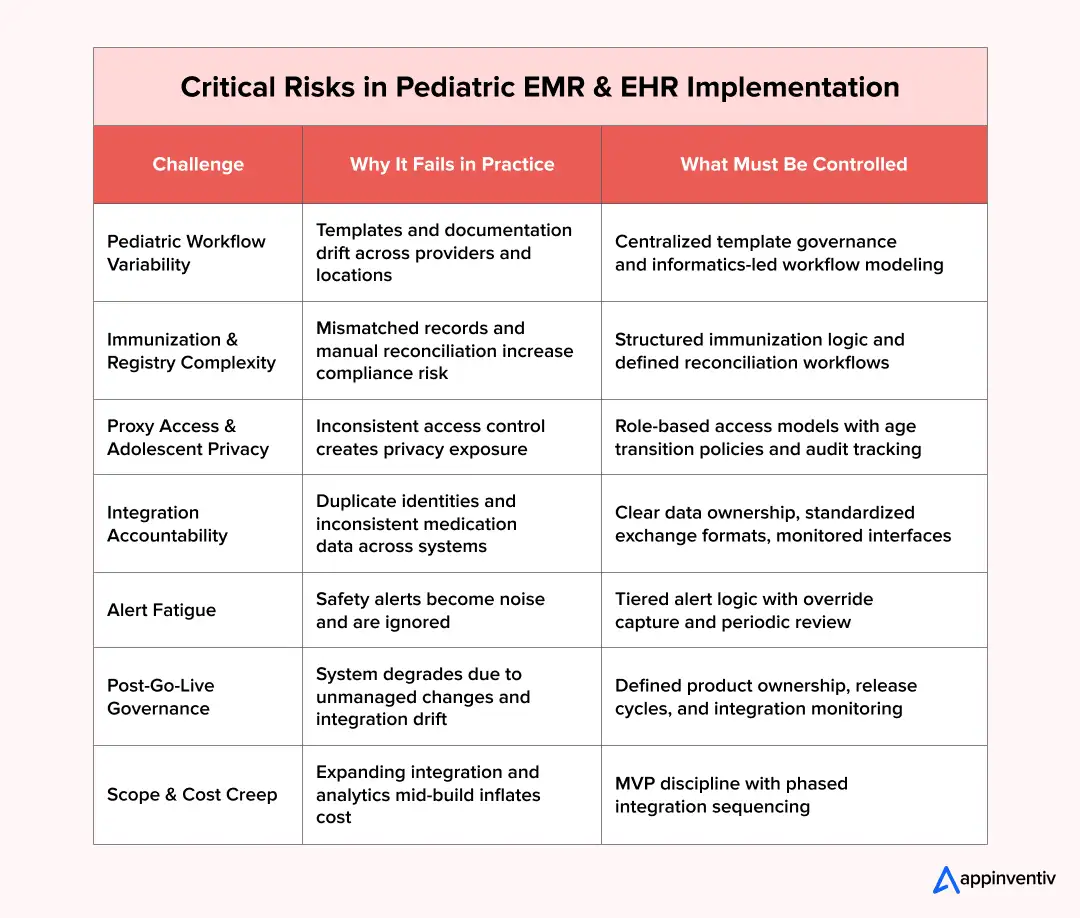
1. Pediatric Workflow Variability Is Underestimated
Pediatric care is not a single workflow. It spans newborn care, immunization-only visits, developmental screenings, chronic disease management, adolescent confidentiality transitions, and parent communication cycles. Many initiatives treat pediatrics as “primary care with growth charts,” which creates hidden fragmentation.
Where programs struggle:
- Visit templates drift between providers.
- Growth tracking is captured inconsistently.
- Immunization documentation varies by location.
- Edge cases are handled outside the system.
What differentiates successful builds:
- Workflow modeling by visit category before design begins.
- Clinical informatics involvement in data modeling.
- Explicit documentation standards governed centrally.
- Clear ownership of template change control.
Without workflow discipline, custom pediatric EHR software becomes configurable chaos.
2. Immunization and Registry Logic Becomes Operationally Fragile
Immunization workflows are one of the most underestimated components of EHR integration for pediatric practices. Schedules evolve, catch-up logic varies, and registry interfaces have specific formatting and reconciliation rules.
Common failure patterns:
- Manual reconciliation when registry data conflicts with internal records.
- Incomplete documentation causes compliance exposure.
- Staff rely on external reference tools instead of the system.
How high-performing programs approach it:
- Immunization lifecycle logic embedded into the data model.
- Registry compatibility is defined early in the integration scope.
- Exception handling workflows for mismatches.
- Structured fields enforce clear documentation requirements.
Immunization reliability is not a feature. It is a compliance and workflow stability requirement.
3. Proxy Access and Adolescent Privacy Are Poorly Governed
Pediatric systems introduce access complexity that adult systems do not. Parents, guardians, and adolescents may require differentiated access levels over time. Without structured access governance, organizations risk privacy exposure.
Typical issues:
- Overexposure of sensitive adolescent information.
- Inconsistent proxy rules across providers.
- Manual workarounds for consent transitions.
What sets enterprise implementations apart:
- Role-based access models that account for age transitions.
- Explicit policy alignment between legal, clinical, and IT teams.
- Audit visibility into access changes and overrides.
- Controlled workflows for revoking or modifying proxy permissions.
This is where pediatric EHR data security becomes more nuanced than standard access control.
4. Integration Is Designed as a Technical Task Instead of a Governance Decision
Connecting labs and pharmacies is straightforward in theory. The complexity emerges in data ownership, reconciliation rules, and exception handling.
In pediatric EMR and EHR integration with hospital systems, challenges often include:
- Duplicate patient identity across systems.
- Inconsistent medication lists.
- Partial data synchronization.
- Unclear responsibility for correcting mismatches.
Organizations that succeed treat integration as:
- A governance discussion before a technical build.
- A master data ownership decision.
- A reconciliation workflow with defined escalation paths.
- A monitored process with audit traceability.
Integration is not simply about HL7 or FHIR; it is about accountability.
5. Alert Fatigue Undermines Safety Goals
Weight-based dosing alerts, immunization reminders, and compliance prompts are essential. However, when poorly tuned, they generate alert fatigue.
Observed risks:
- Clinicians override alerts reflexively.
- Important warnings become indistinguishable from noise.
- Productivity declines.
Mature pediatric electronic medical record software development includes:
- Tiered alerting logic.
- Clear differentiation between advisory and critical alerts.
- Override justification capture.
- Ongoing review of alert effectiveness.
Safety mechanisms must support workflow rather than disrupt it.
6. Change Management Is Treated as Training Instead of Cultural Transition
Resistance rarely stems from interface difficulty. It stems from disrupted routines and unclear expectations.
Common patterns:
- Shadow documentation outside the system.
- Inconsistent template usage.
- Partial adoption across locations.
Effective programs:
- Pilot with representative clinics.
- Tie training to real patient scenarios.
- Measure adoption metrics post-go-live.
- Enforce governance for template and workflow consistency.
In custom pediatric EHR software initiatives, cultural alignment matters as much as system design.
7. Long-Term Ownership Is Undefined
Post-launch sustainability is often overlooked. Systems degrade when ownership of updates, template control, integration monitoring, and compliance review is unclear.
Programs weaken when:
- No structured release cadence exists.
- Clinical changes are applied inconsistently.
- Audit logs are collected but not reviewed.
- Integrations break silently.
Enterprise-ready pediatric healthcare software development requires:
- Defined product ownership roles.
- Scheduled governance reviews.
- Integration monitoring dashboards.
- Controlled enhancement cycles.
The difference between a successful system and an unstable one often emerges after go-live.
8. Cost Escalation from Scope Creep and Integration Drift
Budget overruns rarely occur because features are expensive. They occur because the scope is undefined.
In pediatric programs, scope creep often appears through:
- Expanding integration targets mid-build.
- Adding complex analytics before workflow stabilization.
- Underestimating migration cleanup requirements.
- Retroactively fixing data model limitations.
Clear MVP boundaries, phased releases, and documented integration sequencing protect pediatric EHR development costs from uncontrolled expansion.
The Real Differentiator
The challenge is not building functionality, it is aligning:
- Pediatric clinical logic
- Data structure
- Access governance
- Integration accountability
- Operational ownership
When those layers are designed together, pediatric EMR and EHR system development becomes a stable infrastructure. When they are designed separately, the system becomes a recurring remediation project.
Cost Considerations for Custom Pediatric EMR and EHR System Development
There is no single price tag for pediatric EMR and EHR system development. The final investment depends less on how many features you list and more on how deeply the system must integrate with clinical workflows, external platforms, and compliance controls.
A focused build for a single pediatric clinic will sit at the lower end of the range. A multi-location system with registry integrations, structured governance, and reporting layers will move significantly higher. In most cases, projects fall between $30,000 and $400,000+, depending on complexity.
Factors That Affect the Cost
Several factors influence the pediatric EHR development cost.
Feature Set
A basic system with essentials like growth charts and immunization tracking costs less. Add more features, such as telemedicine, advanced analytics, and detailed reporting, and the price goes up.
System Integration
Connecting your EMR to labs, pharmacies, or health registries adds complexity. More connections mean higher costs.
Customization
Tailoring workflows and user roles to meet how your clinic operates takes extra development time. That costs more.
Security & Compliance
Meeting HIPAA, GDPR, and other regulations isn’t cheap. But cutting corners here isn’t an option.
Development Time and Team Expertise
Complex systems take longer to build. More hours from experienced developers mean a higher price tag.
Typical Investment Bands
A custom pediatric EMR/EHR investment depends on the depth of integration and the strength of compliance controls.
| Scope Level | Estimated Range |
|---|---|
| Core pediatric workflows, limited integrations | $30,000–$80,000+ |
| Portal, registry integration, structured reporting | $80,000–$150,000+ |
| Multi-site, advanced integrations, analytics layer | $150,000–$400,000+ |
Ongoing Costs
Plan for ongoing expenses such as hosting, integration maintenance, security updates, and regulatory adjustments. Many organizations allocate 15–20% of the initial build cost annually for maintenance and support.
ROI Perspective
The return from custom pediatric EHR software typically appears in:
- Reduced manual reconciliation
- Fewer documentation inconsistencies
- Lower audit remediation effort
- Improved workflow stability
The real financial benefit often comes from avoiding rework and compliance exposure rather than immediate revenue increases.
A disciplined scope definition and phased rollout protect both budget and long-term system reliability.
Ready to Modernize your Pediatric Practice?
Appinventiv delivers secure, scalable healthcare software tailored to your needs.

How Appinventiv Can Help Build Your Custom Pediatric EMR and EHR Solution?
Delivering reliable pediatric EMR and EHR system development requires more than coding expertise. It demands a structured approach to clinical workflows, interoperability, and compliance.
Appinventiv brings over a decade of experience in healthcare software development services, having delivered projects for organizations such as Dr. Reddy’s, Health-e-People, Soniphi, DiabeticU, and YouComm. Our work spans patient engagement platforms, interoperable healthcare systems, and secure clinical applications.
Focused Pediatric Execution
We design custom pediatric EHR software aligned with real clinical workflows, including growth tracking, immunization management, medication safeguards, and structured documentation standards.
Compliance and Security Built-In
Our pediatric electronic medical record software development follows a security-first model, with role-based access controls, encryption, and audit-ready logging to support HIPAA-aligned environments.
Integration-Ready Architecture
We structure EHR integration for pediatric practices to ensure compatibility with labs, registries, pharmacies, and hospital systems, reducing long-term integration risk.
If you are evaluating custom EMR and EHR solutions for pediatric clinics, we focus on building systems that remain stable, secure, and scalable as your organization grows.
Let’s discuss your pediatric EMR roadmap.
FAQs
Q. What are the key functionalities of pediatric EMR software?
A. Pediatric EMR software should have features that are built specially for kids. Including:
- Growth charts, immunization tracking, and dosing calculators based on age and weight.
- Should be able to easily pull up patient history and manage vaccination schedules.
- Secure parent portal that lets families check records and communicate with your office.
- Should handle scheduling and billing
- Templates for different visit types, like well-child checkups or sick visits.
Q. How do you ensure HIPAA compliance in pediatric EHR systems?
A. HIPAA compliance starts with strong data security. The pediatric EHR systems should:
- Use encryption, maintain audit trails, and require secure authentication for all users.
- Set up role-based access so staff only see what they need to.
- Run regular security audits and maintain robust data backup protocols.
These steps protect patient privacy and keep you compliant with HIPAA requirements.
Q. Why is weight-based dosing critical in pediatric EMRs?
A. Unlike adults, pediatric medication is calculated per kilogram. A custom EMR automates this by pulling weight directly into the e-Prescription module, eliminating manual calculation errors that account for nearly 37% of pediatric medication mistakes.
Q. How does a custom EMR handle adolescent privacy?
A. High-end systems utilize “Sensitive Data Filters.” These allow parents to see immunization records while automatically restricting access to confidential visits (e.g., behavioral health) once the child reaches the legal age of consent in their state.
A. How can AI and analytics improve pediatric EHR functionality?
A. AI can spot patterns you might miss otherwise. It can flag potential health risks and handle routine tasks, freeing up your staff.
Analytics tools show you trends in your practice. This helps you make better decisions about patient care.
Q. What technology stack is best for pediatric EHR software development?
A. For the back-end, frameworks like .NET, Node.js, or Python work well. React or Angular are solid choices for the front-end.
Follow FHIR/HL7 standards. Cloud solutions like AWS or Azure give you scalability and security. React Native works great for building mobile-friendly parent portals.
Q. How much does it cost to develop a pediatric EMR and EHR system?
A. Expect to spend anywhere from $30,000 to $400,000, depending on what you need. It will cost less with basic features and increase as per the complexity. Additionally, you need to pay for ongoing maintenance.
Q. How long does it take to develop and deploy a pediatric EMR system?
A. Most projects take 6 to 12 months from start to finish. The timeline depends on how complex your system is and how many features you want.
A simpler system moves faster. Highly customized solutions with AI or telemedicine take longer.