
If you’ve been researching mobile fundraising options for your nonprofit, you’ve probably encountered the debate: text-to-give vs text-to-donate—which one is better?
In our view, the difference is negligible and unimportant, since these aren’t your only options. The real question you should be asking is: how can we leverage texts as an ongoing, engagement-driven channel that supports fundraising, stewardship, and long-term donor relationships?
In this guide, we’ll explain why today’s text fundraising landscape has moved beyond text-to-give vs text-to-donate and how you can tap in. We’ll cover:
Why Text-to-Give and Text-to-Donate Are Outdated
Text-to-give and text-to-donate were innovative fundraising tools when they first emerged. They made mobile giving easier and introduced donors to the idea of supporting causes via text message. Today, however, donors are used to one-off text appeals, making dedicated text fundraising campaigns less effective.
Receiving texts from nonprofits and brands is the norm now, and consumers don’t want every text they receive to feel like an ad. It’s just like any other nonprofit communication channel—if all you do is ask for money, supporters will feel drained and opt out.
Traditional text-to-give and text-to-donate campaigns are isolated, one-off fundraising moments that don’t align with the needs of today’s donors. To build lasting relationships and drive revenue long-term, nonprofits need to take a different approach to texting.
Traditional Approaches (The Old Way)
Before we explore today’s nonprofit texting strategies, let’s define the traditional models.
What is Text-to-Give?
Text-to-give traditionally refers to fundraising campaigns in which donors text a keyword to a nonprofit’s short code, and a platform automatically charges a donation amount to their mobile carrier bill. However, organizations often use the term to refer to any kind of fundraising transaction that happens via text.
How It Works
The traditional process involves using a dedicated text-to-give platform that provides your nonprofit with a phone number and a text-to-give keyword. Your nonprofit would promote the keyword to donors by saying something like, “Text GIVE to 55555 to donate!”
To participate, the donor would then:
- Text the specified keyword to your organization’s short code.
- Receive a confirmation text with a suggested donation amount.
- Confirm the donation amount.
- Automatically receive the charge on their regular phone bill.
You may create different keywords for different campaigns, such as “GIVE” for a general fundraiser and “SAVELIVES” for a disaster relief campaign.
Where It Falls Short
It’s no longer typical to add extra charges to your phone bill, making text-to-give (in the most traditional sense of the word) clearly outdated. Even if you use the definition loosely, though, it comes with several drawbacks. One-off text-to-give campaigns are severely limited. You can’t text donors first, collect data beyond donation information, have two-way conversations, or personalize your appeals. Once the transaction is over, so is your chance for connection.
What is Text-to-Donate?
Text-to-donate technically refers to fundraising campaigns in which donors text in a keyword and receive a link to your nonprofit’s mobile-optimized donation page. Instead of charging the donation to their phone bill, donors can give as they normally would online with a direct link. Most text fundraising campaigns use this process, even if nonprofits call them “text-to-give.”
How It Works
Your nonprofit sets up a phone number and keyword with your text-to-give provider, then promotes it to your support base. When donors participate, they:
- Text the keyword (such as “DONATE”) to your nonprofit’s short code.
- Receive an instant, automated reply with a link to your donation page.
- Follow the link and complete their gift using a mobile-optimized form.
Here’s an example of what this looks like in practice:

Where It Falls Short
Sending a donation page link is more effective than charging donors’ phone bills, but it still comes with plenty of drawbacks. Isolated text-to-donate campaigns have the same problem as text-to-give: they’re purely transactional. You can’t engage in text conversations, share updates, or interact one-on-one with supporters. The donor makes their gift, and that’s it.
What is the Difference Between Text-to-Donate and Text-to-Give?
Technically, text-to-give charges a donor’s phone bill while text-to-donate sends a donation link. In practice, however, the terms are often used interchangeably, and the distinction matters less than the strategy behind it. Both approaches are typically part of short-term, dedicated campaigns where engagement isn’t the priority. Your nonprofit promotes a keyword, donors text it to your organization’s short code, and they donate once.
Should I Use Text-to-Give or Text-to-Donate?
Neither, at least not as your primary strategy. Both text-to-give and text-to-donate are limited, outdated approaches that don’t account for the changing needs of today’s donors. Take a holistic, long-term approach instead by prioritizing two-way text engagement and fundraising.
If your nonprofit thinks only in terms of launching a one-time “text-to-give campaign” or running a “text-to-donate push” every once in a while, you’re limiting what text fundraising can accomplish. Broaden your strategy to include SMS marketing, donor stewardship, and ongoing fundraising communications. Treat texting as its own channel instead of an occasional tool.

The Modern Approach: Text Engagement & Fundraising
The most successful nonprofits don’t rely on isolated text donation moments. They combine engagement and fundraising text messaging throughout the year, creating a holistic, ongoing marketing strategy that weaves together donor engagement messages and strategic fundraising asks.
This type of text fundraising approach paves the way for:
- Long-term engagement, since you can text supporters a variety of updates, check-ins, thank-you messages, and other texts.
- More compelling fundraising appeals personalized with donor data.
- Donor stewardship in the form of recognition, appreciation, and other involvement opportunities.
- Less donor fatigue, since they aren’t asked to donate every time they receive a text from your nonprofit.
- Two-way conversations that strengthen supporter relationships.
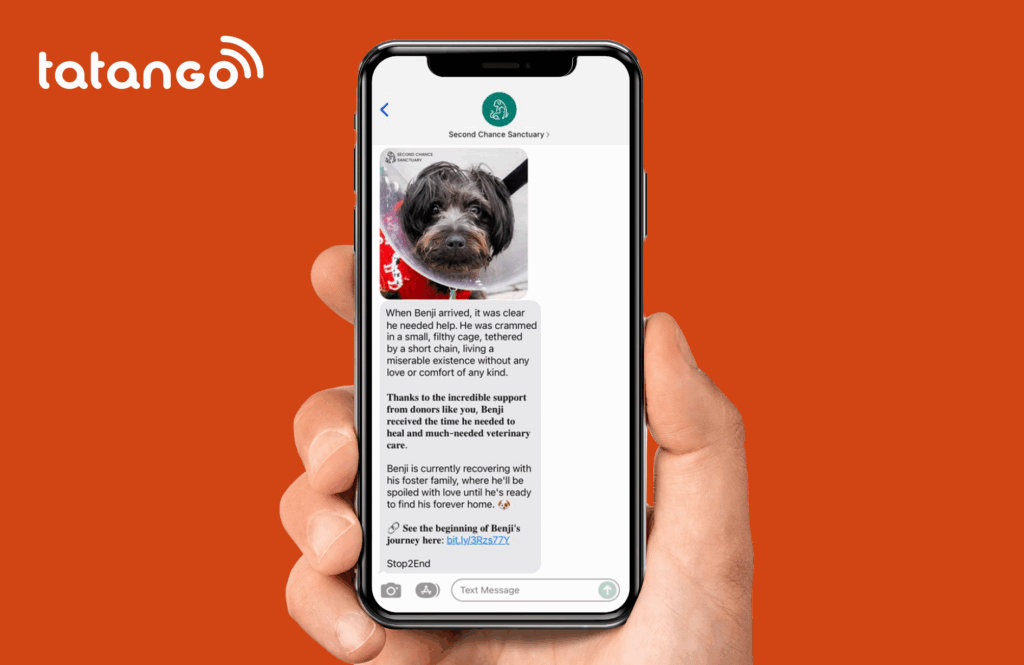
Just take a look at the example below, which uses a text to thank donors, update them about their impact, tell a compelling story, and drive further engagement by sharing a link to the nonprofit’s website.
How It Works
In order to text supporters a variety of messages, you need the right text fundraising software and your donors’ consent. Choose a solution that offers both bulk and two-way texting, engagement analytics, and smart segmentation. Then, start collecting opt-ins from donors. You can add a checkbox to your donation forms to opt in or create an opt-in keyword (like “JOIN”) to get supporters’ written consent.
Once donors opt in, you can text them all kinds of mission-relevant messages. For instance, your strategy might include:
- Welcome messages
- Impact updates
- Surveys and polls
- Event reminders
- Volunteer calls to action
- Strategic fundraising appeals
- Thank-you messages
- Program updates
Unlike traditional text-to-give models, this approach is flexible and scalable, so you can adjust your strategy to meet your nonprofit’s unique needs. Analyze text engagement metrics often to determine what’s working well and how you can shift your strategy.
Why It’s Better Than Text-to-Give or Text-to-Donate
Modern text fundraising has more long-term engagement and revenue potential than any standalone text-to-give or text-to-donate campaign.
You don’t have to take our word for it—the proof is in the data. According to the 2025 Nonprofit Text Messaging Insights Report:

- Nonprofits raise an average of $4.38 for every $1 spent on texting.
- The average donation made in response to fundraising texts was $71.
- Engagement text raised $3.03 for every dollar spent.
- Engagement texts drove strong click-through rates of 3.28%.
- Balanced programs significantly outperformed purely transactional campaigns.
When texting becomes a consistent channel instead of a one-time event, performance improves.

How to Move Beyond Text-to-Give vs Text-to-Donate
If your nonprofit is ready to modernize its text fundraising strategy, here’s how to start:
- Invest in purpose-built text fundraising software. Choose a platform designed specifically for nonprofit engagement and fundraising, like Tatango’s texting service for nonprofits.
- Build a strategic messaging plan. Define the frequency, segmentation strategy, fundraising cadence, and engagement content you want to send via text.
- Grow your opt-in list. Build your list through website forms, events, email campaigns, and social media. Review TCPA guidelines to make sure you’re prepared for compliant texting.
- Test and optimize your messages. A/B test send times, language, personalization, and calls to action to maximize your texts’ ROI.
- Integrate SMS with other channels. Text messaging should amplify email, direct mail, social media, and event fundraising. Ensure your channels interact and support the same goals with consistency.
Securing Text Donations Without Text-to-Give
The difference between text-to-give vs text-to-donate is largely technical, so don’t focus on that. Create modern text fundraising strategies so you can build a sustainable channel that supports engagement, stewardship, fundraising, and retention year-round.
Looking for more insight before you dive into a new strategy? Explore these additional resources from our team: