
Key takeaways:
- Open banking-driven “Smart Data” initiatives are projected to contribute up to $10 billion annually to the Australian economy.
- Enterprises that follow a phased rollout covering readiness assessment, compliance alignment, API integration, cybersecurity, and scaling achieve faster deployment and lower operational risk.
- Constant CDR updates, accreditation complexity, and modernising legacy banking systems continue to be the biggest challenges during open banking adoption.
- Building open banking solutions in Australia typically ranges from AUD 70,000 to AUD 700,000+, with accreditation, API infrastructure, and security controls acting as primary cost drivers.
When Up Bank crossed 1 million customers in Australia, it did so without branches, paper forms, or legacy distribution models. Its growth has been powered by API-driven architecture and data portability, aligned with the Consumer Data Right (CDR) framework (details later).
Up Bank, an independent brand of Bendigo & Adelaide Bank, continues to attract digitally native customers at scale, reflecting sustained demand for digital-first banking experiences. This shift is not about consumer convenience alone. It reflects structural change in how financial data is accessed, governed, and monetised under open banking in Australia.
According to the Mastercard 2025 report, this move toward “Smart Data” is projected to unlock up to $10 billion in annual gains for the Australian economy as the regime matures. Lately, Aussie boards are no longer asking whether open data will influence their operating model. They are asking how quickly they can modernise without increasing compliance exposure or cyber risk.
For enterprises evaluating open banking for businesses in Australia, the decision touches architecture, accreditation, vendor governance, audit readiness, and long-term cost ownership. This blog is written for that decision context. This will help you gain an in-depth understanding of how to implement open banking in Australia securely and successfully.
Preparing for CDR and Open Banking Expansion?
Build compliant, scalable, and audit-ready open banking infrastructure with Appinventiv.
- CDR-aligned API-first architecture design
- Security and consent management frameworks
- End-to-end implementation and compliance advisory

Understanding the Importance of Open Banking in Australia
Open banking in Australia enables accredited entities to access customer-permissioned financial data through secure, standardised FinTech APIs under the Consumer Data Right framework.
It transfers control of financial data to consumers while imposing defined compliance obligations on participants.
How Open Banking Enables Secure Financial Data Sharing
Security is built into the model through:
- Standardised API specifications
- Consent-based authorisation
- Strong customer authentication
- Mandatory accreditation and conformance testing
Unlike legacy screen-scraping approaches, open banking APIs in Australia operate within regulated, auditable channels.
Role of Consumer Data Right
Open banking in Australia operates within the broader Consumer Data Right regime. The Regulatory Framework and CDR Requirements are not a procedural add-on. They shape architecture, vendor selection, logging mechanisms, and incident response design.
The Australian Competition and Consumer Commission (ACCC) has emphasised that compliance is not static. In its guidance, the ACCC notes that data recipients must maintain ongoing accreditation and meet security criteria continuously.
This means:
- Continuous risk assessments
- Defined consent expiry handling
- Real-time audit logging
- Security control evidence retention
The CDR Framework
CDR also extends beyond banking, with expansion into energy and other sectors underway. Enterprises planning open banking software development must anticipate cross-sector interoperability rather than treating banking as a silo. Because for your business, the infrastructure built today for banking will eventually serve as the blueprint for other sectors:
- Banking: Active since 2020, covering transaction and product data.
- Energy: Fully integrated as of 2024.
- Non-Bank Lending: Scheduled for full integration by mid-2026 (Treasury, 2024).
How Open Banking Works in Australia
Open Banking operates as a high-trust, API-first ecosystem where financial data is exchanged through a “Consent-to-Exchange” protocol. This mechanism replaces insecure methods like screen scraping with a regulated pipeline that ensures data is only transferred between accredited entities after explicit, time-bound consumer authorisation.
The technical integrity of the system is maintained by the Consumer Data Standards (CDS), which mandate the use of Financial-grade API (FAPI) security profiles. This architecture ensures that even at the point of exchange, sensitive credentials remain private, and data is only used for the specific purposes, such as credit assessment or financial aggregation, outlined in the consumer’s consent dashboard.
Data Sharing Mechanism
The process is built on a “Push-Pull” API model where the consumer remains the central authority.
Consent-based Access: Consumers must provide explicit, time-bound consent before any data is moved. Access is granted only after explicit customer consent. Systems must track:
- Data scope
- Duration
- Revocation
- Renewal
API-driven Exchange: Accredited Data Recipients (ADRs) request data from Data Holders (Banks) using standardised RESTful APIs.
Secure Authentication: The CDR uses Financial-grade API (FAPI) profiles, ensuring that authentication occurs directly between the consumer and their bank, never exposing credentials to the third party.
Types of Financial Data Shared
- Account Information: Name, account type, and balance.
- Transaction History: Up to seven years of historical data, including merchant details and spending categories.
- Product and Pricing: Data about the financial products themselves, enabling automated comparisons.
Key Participants in the Ecosystem
- Data Holders: Banks and financial institutions that currently hold the consumer information.
- Accredited Data Recipients (ADRs): Entities authorised by the ACCC to receive and use data to provide services.
- Consumers: Individuals or businesses who own the data and grant consent for its sharing.
Regulatory Framework Governing Open Banking in Australia
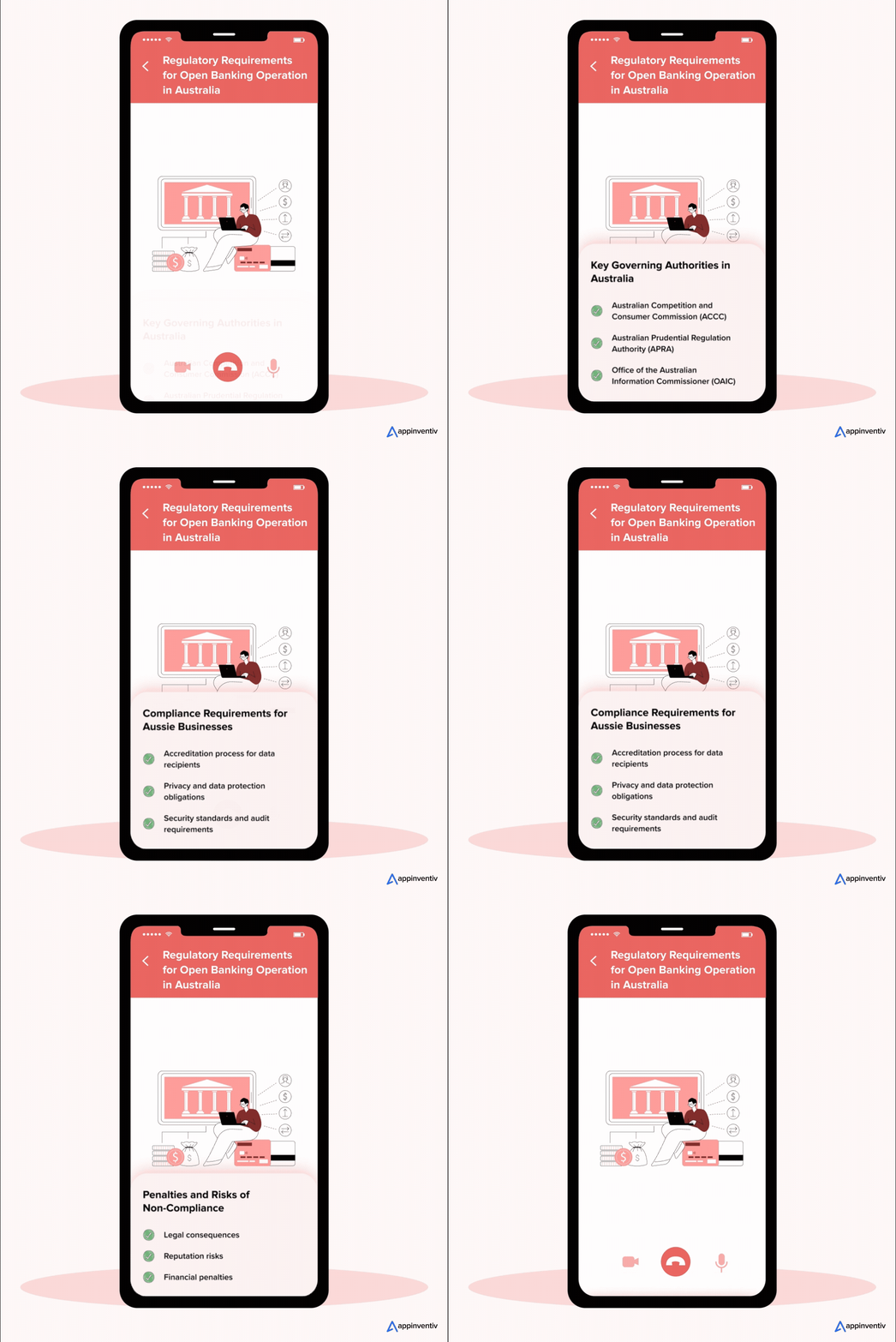
The open banking ecosystem in Australia is overseen by a triad of federal authorities that ensure the regulatory framework and CDR requirements are strictly maintained to protect both consumers and the integrity of the financial system. Here are some indispensable regulatory requirements that power open banking platform development in Australia:
Oversight Authorities Shaping Open Banking
Enterprises implementing open banking regulations in Australia operate under oversight from:
- Australian Competition and Consumer Commission
- Australian Prudential Regulation Authority
- Office of the Australian Information Commissioner
Rather than acting as separate compliance checkpoints, these authorities influence architecture decisions around encryption, access controls, and operational transparency.
Accreditation and Compliance Readiness
Becoming an ADR involves a rigorous assessment of your internal governance, cyber security maturity, and insurance coverage. This is not a one-time hurdle but an ongoing operational commitment.
The accreditation process requires demonstration of:
- Cybersecurity posture aligned with enterprise standards
- Data governance and lifecycle tracking
- Operational resilience planning
- Incident response and breach notification protocols
Accreditation often becomes the longest timeline driver in the implementation of open banking in Australia.
“Banks have now had a few years to understand and implement their CDR obligations… the number of CDR participants increased by 55% in the first half of 2025,” noted ACCC Deputy Chair Catriona Lowe, highlighting the accelerating pace of regulatory scrutiny (ACCC, 2025).
Operational Risks of Non-Compliance
The ACCC has demonstrated its willingness to issue significant infringement notices for data quality issues and delayed implementation. Recent penalties for major banks, some exceeding $750,000, serve as a warning to enterprises that the regulator prioritises data integrity and system availability.
Also Read: 10 Use Cases and Benefits of How AI is Used in the FinTech Industry in Australia
What Are the Business Benefits of Open Banking Adoption
For enterprises, the Open Banking Australia initiative provides a unique opportunity to reduce “time to yes” in credit decisions and personalise customer journeys with unprecedented precision. Besides, the initiative offers several other advantages to Aussie organisations, such as:
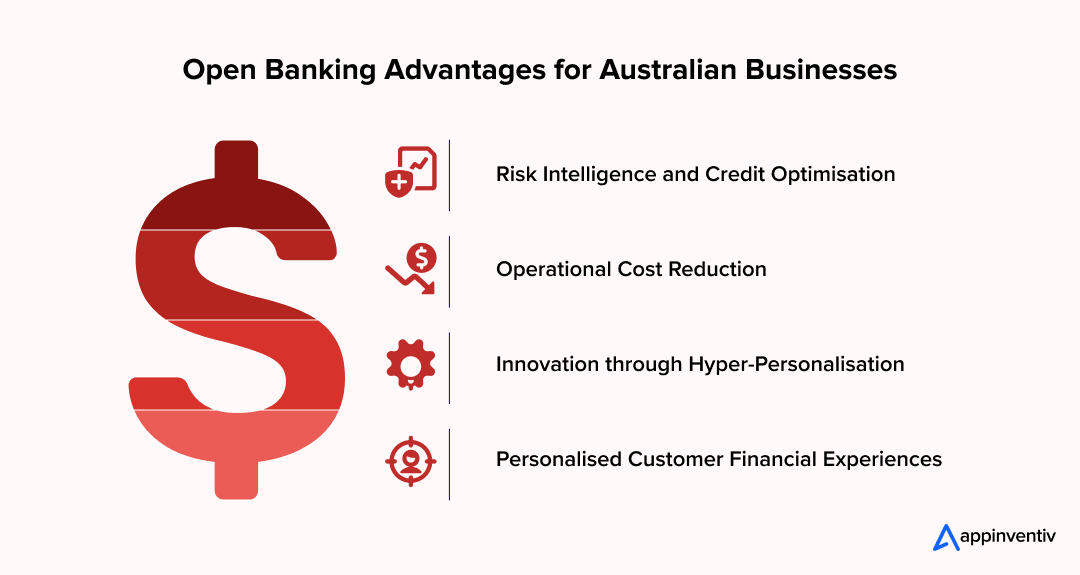
Risk Intelligence and Credit Optimisation
Real-time access to transaction data allows for automated income and expense verification. This eliminates the need for manual document uploads, reducing the abandonment rate in digital applications and improving portfolio performance.
Operational Cost Reduction
By automating data retrieval and verification, enterprises can achieve significant efficiency gains. Many Australian firms are targeting significant improvements in operational throughput by replacing manual processes with the integration of open banking API in Australia.
Innovation through Hyper-Personalisation
With a 360-degree view of a customer’s financial health, businesses can offer proactive insights, such as better interest rate options or automated budgeting tools, fostering deeper brand loyalty.
Personalised Customer Financial Experiences
Access to real-time financial datasets enables dynamic product recommendations and faster onboarding pathways. This capability significantly reduces customer acquisition friction.
What Are the Use Cases of Open Banking Across Australian Industries?
The open banking use cases for enterprises extend far beyond simple balance checks. We are seeing a move toward deep integration in high-value sectors.
1. Banking and Lending
Lenders are replacing manual document collection with direct data access. This allows for “instant” credit decisions by pulling real-time income and expense data. Fintech lenders are already using this to shorten mortgage approval times from weeks to minutes.
2. Retail and E-commerce
With the advent of PayTo and future “Action Initiation” rules, retailers can facilitate account-to-account payments. This bypasses traditional card schemes, reducing merchant fees and providing instant settlement.
3. Insurance and Wealth Management
Automated claims processing and risk-based pricing become possible when an insurer can verify a customer’s financial history and asset ownership in real-time, reducing fraud and administrative overhead.
4. Fintech Startups
For fintechs, Open Banking is a growth engine. Personal Finance Management (PFM) apps use transaction data to provide hyper-personalised budgeting. More critically, alternative lending platforms are using real-time data to assess “thin-file” borrowers who lack a traditional credit score but have stable cash flow.
How to Implement Open Banking for Australian Businesses
A successful open banking platform development in Australia requires a phased approach that balances technical velocity with rigorous risk management. Here is a step by step process to open banking software development:
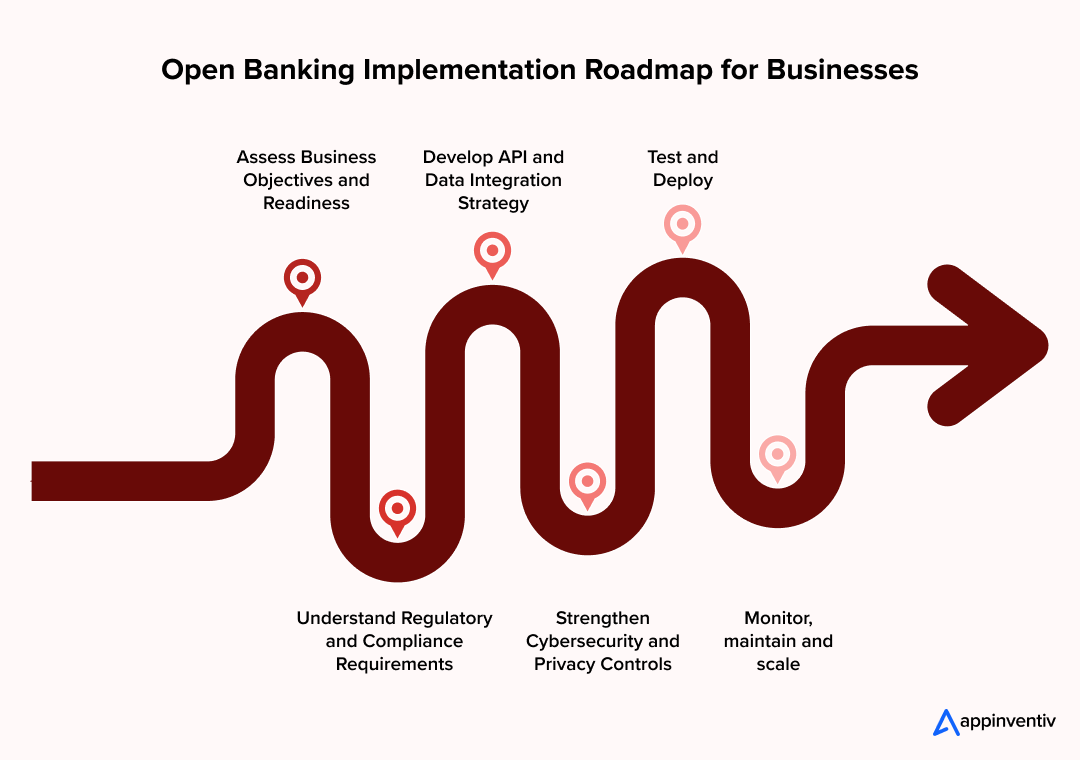
Step 1: Objective and Readiness Assessment
The first step starts with identifying the commercial tension. Are you solving for customer onboarding friction or seeking to build a new revenue stream? Audit your legacy systems to determine if they can support high-frequency API calls.
Step 2: Regulatory and Compliance Requirements
Choose your accreditation pathway – Direct ADR or a sponsored model. This choice dictates your liability and the total cost to build open banking platform infrastructures.
Step 3: API and Data Integration Strategy
Develop a middleware layer that interacts with the CDR Register. Your open banking API strategy in Australia must ensure high availability and comply with the strict technical standards set by the Data Standards Body.
Step 4: Strengthening Cybersecurity and Privacy
Implement “Privacy by Design.” Ensure your consent management dashboard is intuitive and that data deletion protocols are automated in accordance with CDR rules.
Step 5: Development, Testing, and Deployment
Engineering must follow a secure SDLC. Open banking software development requires rigorous “Conformance Testing” with the ACCC’s sandbox environments to ensure your system correctly interprets data from all 100+ Australian data holders.
Step 6: Monitor, Maintain, and Scale
Post-launch, the focus shifts to API performance monitoring and compliance reporting. As the CDR expands into energy and non-bank lending by mid-2026, your infrastructure must be flexible enough to ingest these new data sets.
Also Read: How to Develop a FinTech App in Australia 2026 — Features & Cost
Need a Full Open Banking Delivery Partner?
Deploy secure and compliant solutions from strategy to scale.
✔ Strategy, architecture, and engineering under one delivery model
✔ FinTech software development and modernisation services
✔ Post-launch monitoring and regulatory support

Technology Infrastructure Required for Open Banking
Technology choice in open banking is rarely isolated. API exposure, consent orchestration, identity management, and data security must operate as a coordinated system, not disconnected components. Let’s uncover a little more about technology infrastructure choices needed for secure and scalable open banking app development in Australia:
API Management Platforms
Scalable API gateways enables traffic control, authentication orchestration, and data routing between regulated participants.
Cloud Infrastructure and Sovereignty Controls
Australian enterprises increasingly deploy hybrid cloud models to balance scalability with sovereignty compliance.
Identity and Consent Management Systems
Consent orchestration engines integrate identity verification, permission tracking, and regulatory reporting.
AI and Analytics Integration
AI models in Australia enhance fraud detection, behavioural risk monitoring, and financial insight generation across connected banking ecosystems.
Is Your Stack Ready for Open Banking?
Modernise legacy systems while ensuring regulatory and security readiness.
✔ Legacy modernisation with secure middleware integration
✔ Sovereign cloud and enterprise-grade security controls
✔ Scalable open banking platform development in Australia

Challenges Aussie Businesses May Face While Adopting Open Banking and How to Overcome Them
Successfully navigating the open banking Australia landscape requires addressing deep-seated architectural and regulatory hurdles. Below are the primary tensions identified in current enterprise deployments and the pragmatic frameworks used to resolve them.
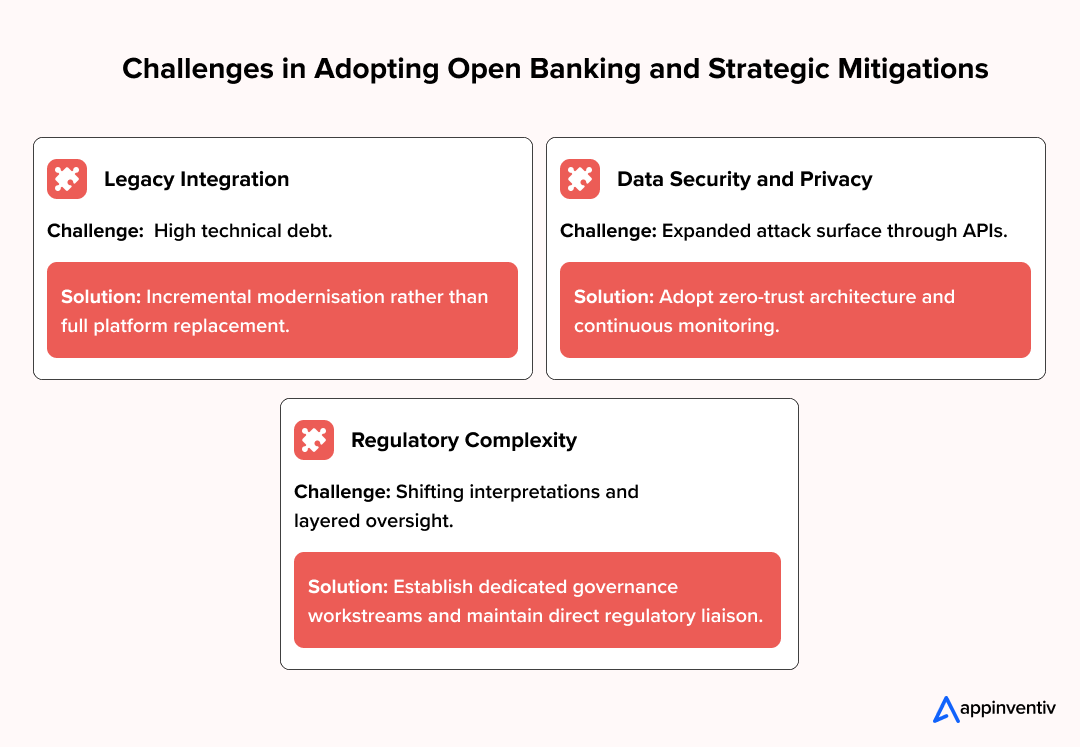
Regulatory Complexity
Challenge: The CDR framework is a living regulatory body with frequent updates to the CDS and security profiles. For businesses, keeping pace with these changes while managing the rigorous ACCC accreditation process and ongoing audit requirements creates significant operational overhead and legal risk.
Solution: Adopting a “Compliance-as-Code” methodology allows regulatory logic to be decoupled from core business features. By utilizing modular policy engines, an enterprise can update its data-sharing rules and consent models in response to ACCC shifts without requiring a full redeployment of the application.
Data Security and Privacy Concerns
Challenge: The transition from screen scraping to API-driven sharing centralises risk. Enterprises face the dual burden of protecting sensitive financial data from sophisticated cyber threats while ensuring absolute compliance with OAIC privacy principles and the “Right to be Forgotten” (data deletion) mandates.
Solution: Implementation of Financial-grade API (FAPI) security profiles is the baseline. This is reinforced by automated consent lifecycle management systems that trigger “hard” data deletion workflows the moment a consumer revokes access, ensuring no “residual” data debt remains on the platform.
Integration with Legacy Systems
Challenge: Many Australian financial institutions operate on COBOL-based or monolithic core systems that were never designed for the high-concurrency, low-latency demands of modern open banking software development. Directly exposing these systems to CDR traffic can lead to instability or performance bottlenecks.
Solution: The use of a “Legacy Wrap” or high-performance “Integration Layer” acts as a buffer. This middleware, typically hosted in local Australian cloud regions to ensure data sovereignty, caches non-sensitive product data and manages API traffic spikes, shielding the core system while maintaining the 99.9% uptime required by the regulator.
How Businesses Can Prepare for Open Banking Success: Implementation Checklist
Transitioning from strategic intent to operational reality requires a structured governance framework that balances technical velocity with uncompromising compliance. The following checklist outlines the critical milestones for enterprise leaders ensuring their CDR integration is both resilient and commercially viable.
- [ ] Regulatory Readiness: Have you mapped the specific CDR rules to your current data privacy policies?
- [ ] Accreditation Strategy: Is a direct ADR status necessary, or is a representative model more cost-effective?
- [ ] Technical Debt Audit: Can your legacy systems support the required API latency and security standards?
- [ ] Consent Management: Is your UX designed to build trust while meeting all disclosure requirements?
- [ ] Risk Framework: Does your board have a clear view of the liability shift involved in receiving third-party data?
- [ ] Monetization Strategy: Define clear KPIs, such as reduced “time-to-yes” in lending or lower merchant fees via PayTo, to ensure the project delivers a tangible ROI.
How Much Does it Cost to Build Open Banking Solutions in Australia?
The cost to build an open banking platform in Australia varies based on enterprise size, accreditation requirements, and integration complexity. On average, the cost of Australia open banking platform development ranges between AUD 70,000 and AUD 700,000 or more, depending on several critical components.
Key drivers for open banking app development costs in Australia include:
- Accreditation and governance preparation
- Security infrastructure and identity management
- API development and orchestration
- Legal and compliance advisory
- Ongoing audit and monitoring obligations
Estimated Budget and Timeline Ranges
| Platform Type | Estimated Cost Range | Delivery Timeline |
|---|---|---|
| Basic Platform | AUD 70,000 – AUD 150,000 | 3-6 Months |
| Mid-Sized Firms | AUD 150,000 – AUD 350,000 | 6–9 Months |
| Enterprise Organisations | AUD 350,000 – AUD 700,000+ | 10–12+ Months |
Enterprises investing in reusable API frameworks often reduce long-term integration costs across future digital services.
Emerging Trends & Future of Open Banking in Australia
The trajectory of the CDR indicates a fundamental shift from simple data visibility to proactive financial orchestration. By 2026, the ecosystem is moving beyond its initial boundaries, creating new paradigms for how Australian enterprises engage with customer capital and operational data. Some key trends shaping the future of open banking in Australia include:
Expansion of Consumer Data Right
The most immediate shift is the extension of the CDR to non-bank lenders. Scheduled for full operationality by mid-2026, this expansion will bring a vast new data set, including asset finance, personal loans, and buy-now-pay-later (BNPL) products, into the regulated sharing economy. This allows for a more holistic view of a consumer’s total debt position, significantly improving risk assessment for commercial lenders.
Growth of Embedded Finance
Embedded finance is transitioning from a trend to a primary distribution engine. In Australia, this will manifest as non-financial platforms, such as logistics providers or vertical SaaS tools, offering contextual credit and insurance at the point of need, powered by open banking API integrations.
The Role of Action Initiation and AI
The next regulatory frontier is “Action Initiation,” which enables consumers to authorise third parties to initiate payments or switch service providers on their behalf. When combined with Artificial Intelligence, this allows for “Self-Driving Finance,” where AI agents in Australia can automatically move funds between accounts to avoid overdraft fees or switch energy providers the moment a better rate is detected.
How Appinventiv Can Help with the Implementation of Open Banking in Australia
As a leading provider of digital product engineering services with 10+ years of experience across the APAC region, we provide the development depth required to build next gen open banking platforms in Australia.
Our presence on the QLD Government ICTSS.1303B Panel and the Federal ICT Professional Services Arrangement reflects our commitment to sovereign security and local delivery excellence.
Delivering CDR-Ready Architectures
We specialise in building secure, scalable systems that align with both state and federal expectations.
- Sovereign Cloud & Security: We align developments with IRAP and ISM standards, ensuring all CDR data is handled within highly secure, Australian-hosted environments.
- DLT & Future-Proofing: For enterprises looking toward “Action Initiation” and smart contracts, we leverage Distributed Ledger Technology (DLT) to create immutable audit trails for data sharing and automated trade settlements.
- Proven Performance: Our FinTech software development services in Australia are backed by a 99.50% Security Compliance SLA, ensuring your platform is always audit-ready.
Recognised among APAC’s High-Growth Companies by Statista and the Financial Times for two consecutive years, our focus remains execution certainty, regulatory alignment, and scalable architecture under open banking in Australia.
Let’s plan your open banking strategy with our FinTech experts.
Q. What is open banking in Australia?
A. It is a regulated system under the Consumer Data Right (CDR) that allows consumers to securely share their financial data from banks with accredited third-party providers via standardised APIs to access better financial products.
Q. How to integrate open banking API?
A. Integration requires establishing a secure connection to a Data Holder’s API using the Consumer Data Standards (CDS), implementing OIDC for authentication, and ensuring your system can handle the JSON-based data payloads within a CDR-compliant environment.
Q. What are the benefits of CDR compliance?
A. Compliance allows you to access high-quality, real-time data directly from banks, reducing reliance on risky screen scraping, improving the accuracy of financial assessments, and building consumer trust through a government-regulated framework.
Q. How much does it cost to build open banking solutions?
A. The cost to build open banking platforms in Australia typically ranges from AUD 70,000 to over AUD 700,000, depending on whether you are building a full data holder platform, an ADR consumer-facing app, or a middle-layer integration.
Q. How long does open banking integration take?
A. The time it takes to integrate open banking for Aussie organisations can take 3 to 12+ months, including the time required for ACCC accreditation, technical build, and mandatory security audits.