Bing Webmaster Tools now lets publishers see how their content appears in AI-generated answers across Microsoft Copilot and Bing, making it the first major search platform to offer dedicated AI appearance reporting.
Microsoft announced the AI Performance dashboard on February 10, 2026. The feature is available now in public preview for any verified site.
The report tracks citation visibility specifically. It doesn’t measure clicks, rankings, or traffic from AI answers. Instead, it answers a question publishers have been asking since generative search took off: Is my content actually being referenced?
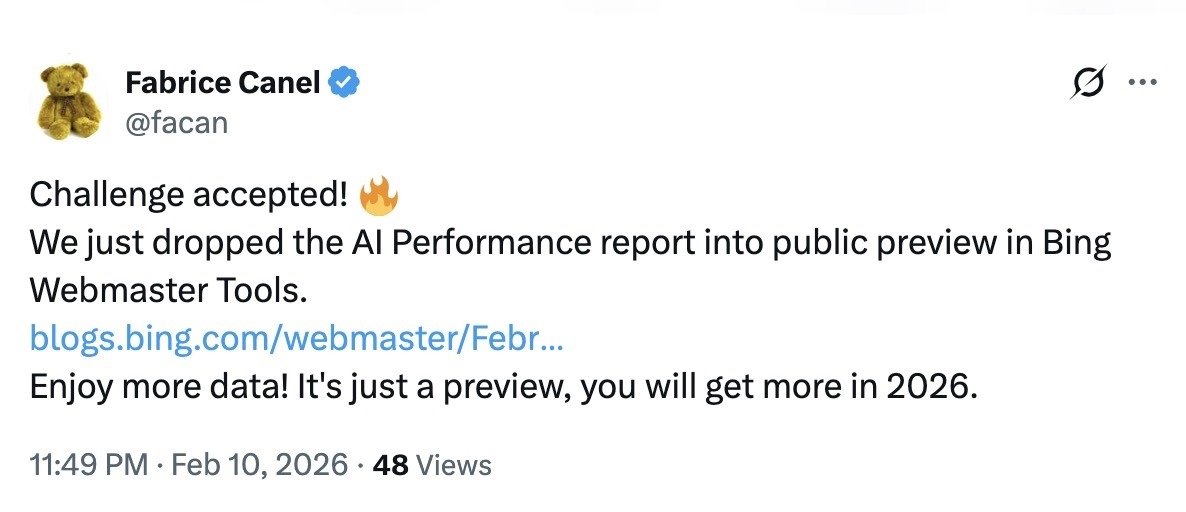
Fabrice Canel, Product Manager at Microsoft, confirmed on X that more data is coming: “It’s just a preview, you will get more in 2026.”

What the AI Performance Dashboard Shows
The dashboard introduces five core metrics focused on AI citation activity:
- Total citations: How many times your site is cited as a source in AI-generated answers during a selected period
- Average cited pages: The daily average number of unique URLs from your site referenced across AI experiences
- Grounding queries: Sample phrases the AI used when retrieving content that was cited in its answers. These aren’t necessarily what users searched for, but the queries the AI system used to find and pull your content. Microsoft describes them as “the key phrases the AI used when retrieving content that was referenced in AI-generated answers,” and notes the data shown represents a sample of overall citation activity.
- Page-level citation activity: Citation counts by URL, so you can see which specific pages are referenced most often
- Visibility trends over time: A timeline view showing how citation activity rises or falls across AI experiences
The report covers citations across Microsoft Copilot, AI summaries in Bing, and select partner integrations, though Microsoft hasn’t clarified exactly which partners are included.

AI Citations Without Click-Through Data
The dashboard doesn’t include click-through data. You can see that your content is being cited, but you can’t see how many users actually clicked through from those AI answers to your site.
As Search Engine Land reported, publishers still can’t tell if AI visibility is delivering measurable business value.
Citation frequency also doesn’t indicate ranking, prominence, or how much a page contributed to a specific answer. A page could be cited once in passing or serve as the primary source for an AI response, and the data doesn’t distinguish between the two.
Still, this is more granular AI-specific data than anything currently available in Google Search Console (GSC). Google includes AI Overviews and AI Mode in its overall Performance reporting, but it doesn’t offer a dedicated report or citation-level URL counts.
How to Use Bing’s AI Citation Metrics
Bing’s move sets a precedent. It’s the first time a major search platform has treated AI citations as a distinct, trackable metric rather than folding them into traditional search performance data.
For SEOs, this report offers a few practical opportunities:
- Cross-reference your top-cited pages with your top-traffic pages: They may not match. Pages that rank well in traditional search aren’t necessarily the ones AI systems cite. Look at what your most-cited pages have in common: structure, depth, how claims are supported, and how recently they were updated. Those patterns tell you what AI systems value from your site specifically.
- Use grounding queries to find content gaps: The grounding queries report shows the phrases AI used to retrieve your content. If those phrases don’t map to topics you’ve deliberately targeted, you may be getting cited incidentally rather than strategically. If you see grounding queries related to topics you cover but specific pages aren’t being cited, that’s a signal to improve structure, add supporting evidence, or update outdated information on those pages.
- Compare cited vs. indexed-but-not-cited pages: If a page is indexed but never shows up in the citation data, it may not be structured or authoritative enough for AI systems to reference. Start with the basics: clear headings, evidence-backed claims, and up-to-date information.
- Set a baseline: The report includes time-series data from day one. Log in, export your current numbers, and track changes over time so you can measure the impact of any optimizations you make.
Geertrui Laleman, senior AI search optimization specialist at Semrush, analyzed the grounding query data and found that 39% of the queries used to ground AI responses were conversational questions or longer multi-word phrases.
“While longer, natural-language queries are increasingly common in AI-driven search, this shows that the same pattern carries through into the validation stage,” Laleman said. “For our content strategy, that means ensuring our pages include clear, direct responses to these longer queries, not just to satisfy users, but to serve as a reliable reference point for the AI itself.”
Further reading: How to Optimize for AI Search Results in 2026
Microsoft framed the launch as an early step toward GEO tooling, and the SEO community has largely responded by calling on Google to follow.
How the SEO Community Is Responding
The response has been largely positive, with most conversation centering on the contrast with Google’s reporting.
Leigh McKenzie, director of online visibility at Semrush, noted on LinkedIn that citations broken out by grounding queries, page-level visibility, and time-series data from day one “puts this ahead of anything we’ve seen from Google so far.”

Wil Reynolds, founder and vice president of innovation at Seer Interactive, confirmed the grounding queries feature was live, posting on X: “Bing is now giving you grounding queries in Bing Webmaster Tools!! Just confirmed, now I gotta understand what we’re getting from them, what it means and how to use it.”

Nikki Pilkington, SEO consultant and SEO content specialist, put the Google comparison bluntly in a LinkedIn post: “Google Search Console: We’ve given users a new favicon and custom citations. Bing Webmaster Tools: Hold my beer…”

The main pushback is on reach. Copilot and Bing’s AI features serve a fraction of the users that Google and ChatGPT do, so the data reflects a narrow slice of AI search behavior. That’s a valid limitation, but it’s also the only first-party AI citation data available right now.
Track AI Visibility Beyond Bing
Bing’s report covers the Microsoft ecosystem. To see how your brand appears across AI search platforms more broadly, use Semrush’s AI Visibility Toolkit.
The Visibility Overview dashboard shows which prompts you appear in AI responses for, where competitors appear and you don’t, and which sources LLMs reference.

The Brand Performance dashboard gives specific recommendations for improving your AI visibility based on your current data.

Start with Bing’s citation data to understand what’s working on your site. Then use the AI Visibility Toolkit to see how that translates across the broader AI search landscape.

![What the data shows [Study]](https://mgrowtech.com/wp-content/uploads/2026/09/sharing-image_4-350x250.png)