[ad_1]
If event planners are honest, spreadsheets aren’t a tool. They’re a coping mechanism.
Event integrations exist because event data lives in too many places at once: registration systems, customer databases, membership systems, event apps, badge printing tools, and communication platforms. When those systems don’t stay in sync, planners step in manually. Lists get exported. Columns get cleaned. Files get re-uploaded.
At first, spreadsheets feel reassuring. They’re visible. They’re editable. They give teams a sense of control.
That control is temporary.
As soon as a registration changes, a cancellation comes through, or a membership status updates, the spreadsheet is already out of date. The work starts again. As the event gets closer, the margin for error shrinks, pressure builds, and confidence drops.
This is exactly the problem event integrations are meant to solve.
Spreadsheets Are a Symptom, Not a Strategy
Spreadsheets don’t appear because planners enjoy manual work. They appear because event systems are not designed to stay aligned as data changes.
In practice, spreadsheets become the glue holding fragmented tools together. They are how planners absorb risk when technology doesn’t. Every spreadsheet represents a gap between systems that should already be connected.
Registration data doesn’t quite match what lives in the CRM. Membership status is managed somewhere else. Badge details need verification. Attendance records need reconciliation. Instead of systems handling those updates automatically, people do.
As events approach, this setup becomes fragile. Late registrations pile up. Access rules begin to matter. Onsite check-in depends on accurate data. A single mistake can ripple across the entire experience.
At that point, spreadsheets stop being a backup and start becoming a liability.
What Event Integrations Actually Do (And Why Most Teams Undersell Them)
At a practical level, an event integration connects two or more tools so they can automatically share data instead of relying on manual exports, spreadsheets, or copy-paste work.
Within event operations, this usually means connecting the event platform to systems that already manage important information, such as where attendee records live, how eligibility is determined, or how member status is tracked. When those systems are connected, updates made in one place are reflected everywhere else without someone stepping in to fix it. These connections keep registration details, attendee status, and profile information consistent across tools.
This mirrors how many organizations run CRM and membership systems side by side, where integrating CRM and association management systems prevents data silos when each system plays a different operational role.
In practice, this kind of alignment shows up most clearly in how everyday event data is handled. A common example is attendance data. An event platform captures session check-ins and participation during the event. The integration comes into play after the event, when that attendance data needs to be sent to another system, such as a membership or learning platform that maintains participation history or supports CEU and credit reporting.
Without connected systems, this usually means exporting reports and manually uploading them elsewhere. When systems are connected directly, attendance data flows where it needs to go without extra steps. The integration doesn’t decide outcomes. It removes manual handoffs.
This is why teams often undersell integrations. They think they’re just about moving data, when in reality they’re about keeping systems aligned so people don’t have to intervene.
Tired of exporting, cleaning, and re-uploading event data?
Watch the EventMobi Product Tour to see how the Integrations Hub automatically shares attendee and event data with your existing systems.
Why Manual Data Work Breaks Down as Events Get Closer
Manual processes can feel manageable early on. When registration first opens and volumes are low, exporting a list or fixing a column doesn’t feel risky.
That changes quickly.
Late registrations come in. Attendee details change. Membership status affects eligibility or pricing. Onsite teams rely on accurate data for check-in, badges, and access control. Suddenly, every update matters.
The issue isn’t effort. It’s dependency.
Multiple systems rely on the same information, and humans are expected to keep them aligned under time pressure. When systems aren’t connected directly to one another, planners become the integration layer themselves.
This is where mistakes happen, and where confidence erodes fastest.
The Real Benefits of Integration for Event Teams
The benefits of integration show up in everyday operations.
When registration data is connected to a CRM, marketing and sales teams stop asking for updated lists. When membership status flows directly into registration, eligibility stays accurate without manual checks. When systems remain aligned, planners spend less time troubleshooting and more time running the event.
There’s also a less obvious benefit: reduced mental load.
When planners trust their data, decisions happen faster. Fewer double-checks are needed. Even as complexity increases, the work feels manageable rather than chaotic.
That sense of control is what teams are really after.
One-Way vs Two-Way Integrations: Where Teams Get Burned
Not all event integrations behave the same way, and misunderstanding this difference is one of the most common reasons teams lose confidence in their setup.
At a high level, the distinction comes down to how data moves and who is responsible for decisions when things change.
One-Way Integrations Move Data, Not Decisions
One-way integrations send data in a single direction, often on a schedule. They work well when information is relatively stable, such as pushing finalized registration data into another system after registration closes.
In these scenarios, one-way integrations offer something many planners value: control over the end result. A human stays in the loop. Data can be reviewed, verified, and corrected before it is used elsewhere. For some teams, especially early in the planning process, that manual checkpoint feels reassuring.
The challenge is that events rarely stay static.
Registrations remain open longer than expected. Attendee details change. Membership status updates. Access rules shift close to the event. When those changes happen, one-way integrations leave gaps that planners have to close manually. The integration moves the data once, but it does not adapt as reality changes.
This is where spreadsheets tend to creep back in. Not because the integration failed technically, but because it was never designed to support ongoing decision-making.
Two-Way Integrations Support Change as It Happens
Two-way integrations keep systems synchronized as updates occur. When data changes in one place, it is reflected everywhere that depends on it.
This matters when:
- Registration stays open close to the event
- Attendee status affects access, pricing, or eligibility
- Multiple teams rely on the same data at the same time
With two-way integrations, planners are no longer responsible for manually reconciling changes across systems. The integration supports decisions in motion, not just data at rest.
Most event teams do not start by asking for two-way integrations. They arrive there after being burned by late changes and manual cleanup. What once felt like a reasonable level of control becomes a source of stress when the pace of change increases.
At that point, many planners assume they have reached the end of the integration journey. The data syncs. The systems talk. Problem solved.
But data syncing is not the finish line. It is the foundation.
Why Data Sync Is Not the Finish Line
Once systems are reliably synchronized, the conversation changes.
Planners stop asking whether data is updated and start asking what should happen next. The focus shifts away from maintenance and toward outcomes.
Sync creates stability, not impact
Data synchronization is foundational. It ensures systems agree with one another and reduces the risk of errors. But by itself, sync doesn’t improve the event experience or team workflows. It simply removes friction.
That stability is important, but it’s not the end goal.
Alignment enables action
When systems reflect reality, teams can rely on data to drive decisions and actions. Manual steps that once felt inevitable begin to disappear, not because technology became more complex, but because the right systems are finally connected and trusted.
This is the point where integrations move beyond maintenance and start enabling better workflows, faster responses, and more coordinated event operations.
When Integrations Trigger Real-Time Actions
Most teams think about integrations as a way to keep systems aligned. The most compelling use cases emerge when connections are designed around event moments and trigger action outside the event platform.
Example 1: VIP Arrival Triggers a Text Message
An event platform like EventMobi already handles onsite check-in. The connection comes into play when that check-in needs to notify someone else.
VIP status is managed in a customer or membership system and shared with the event platform through a two-way connection between the two. When the VIP checks in onsite, that moment becomes a trigger.
A text message is automatically sent through an SMS service to alert a host, executive, or liaison.
Example 2: Key Event Moments Trigger Internal Team Alerts
Attendee role or status is managed in an external system and shared with the event platform. When a key moment occurs, such as a VIP or speaker checking in, an alert is triggered.
That alert is sent to an internal team through a messaging or collaboration tool, such as Slack, Microsoft Teams, or an SMS-based operations channel.
Example 3: Status Changes Update the Event Experience
Status or eligibility is managed in an external system and shared with the event platform. When that status changes, the event experience responds.
Access updates. Visibility changes. Entitlements adjust. No manual intervention required.
From Babysitting Data to Trusting It
When systems stay aligned, there’s no need to constantly check whether something updated or whether a list is current. Data reflects reality, even as changes happen late in the process.
Trust changes how teams operate
This shift aligns with how both associations and corporate teams approach data maturity, where effective data management and governance support confident decisions instead of constant verification.
That trust changes how teams work. Decisions come faster. Stress drops. Events feel manageable again.
This is the deeper value of integrations.
How Event Teams Actually Approach Integrations
Most teams start with spreadsheets. When that stops working, they often experiment with custom integrations built specifically for their setup.
Those custom builds work for a while, but they’re expensive to maintain and risky to change. Over time, even small updates turn into big projects.
Eventually, teams look for off-the-shelf integrations designed for event workflows. Not because they want more tools, but because they want fewer points of failure close to the event.
How EventMobi Supports Integrations
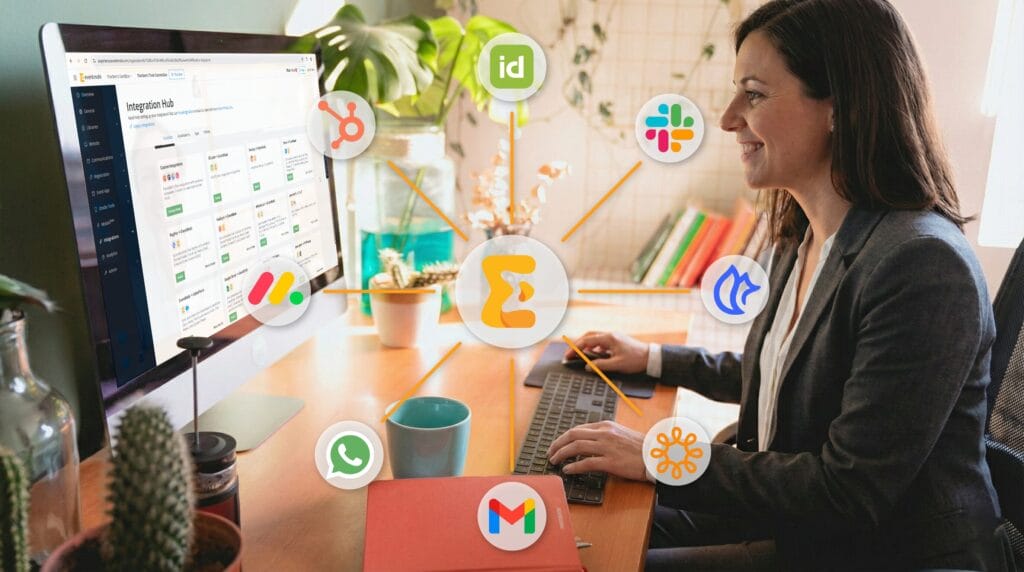
EventMobi powers the entire event experience, from registration and check-in to attendance, engagement, onsite operations, and post-event reporting. The EventMobi Integrations Hub effortlessly connects event data with external systems using prebuilt connectors.
Integrations are quick to set up and don’t require custom development or ongoing maintenance. Once connected, systems stay aligned automatically as event data changes.
Struggling with disconnected event tools and manual data imports?
Book your EventMobi demo today to see how the Integrations Hub connects your CRM, marketing, and event data, so everything stays accurate and up to date.
Event Integrations FAQs
An event integration connects two or more tools so they can automatically share data instead of relying on manual exports, spreadsheets, or copy-paste work. For planners, this usually means keeping registration, attendee data, access rules, and engagement tools in sync as changes happen.
No. Mid-size events often benefit just as much, sometimes more. Smaller teams feel the impact of manual work faster, especially when registration stays open close to the event or attendee data changes frequently.
Not necessarily. Most modern integrations are designed for non-technical users. The harder part is deciding which system should be the source of truth and which data actually needs to sync.
One-way integrations send data in a single direction, often on a schedule. Two-way integrations keep systems synchronized as changes happen, which reduces manual cleanup when registrations, cancellations, or access rules change late.
Spreadsheets usually work until registration stays open close to the event, attendee details change frequently, or multiple tools depend on the same data. At that point, spreadsheets become a risk rather than a safety net.
Start with identity and core fields like name, email, attendee type, and registration status. Once that’s stable, teams can expand into access rules, segmentation, or automation.
Yes. Many integrations run continuously or on defined schedules, allowing updates to flow even as changes happen late. This is especially important for onsite check-in, badges, and access control.
Trying to integrate everything at once. Successful teams start with essential data, validate results, then expand gradually.
Visibility matters. Teams need to see what synced, when it ran, and where issues occurred so they can act early instead of discovering problems onsite.
They shouldn’t. Good integrations support how your team already works. The goal is to remove friction, not force new processes.
Both, but control comes first. Automation without visibility creates anxiety. Integrations work best when planners trust that their data reflects reality as the event changes.
The post The Ultimate Guide to Event Integrations appeared first on EventMobi.
[ad_2]
Source_link