[ad_1]
Avoid confusion during a crisis by sharing a repeated link.
During the Los Angeles wildfires last year, Brenda Duran, director of external affairs for Los Angeles County Justice, Care and Opportunities department, who was deployed to assist with wildfire response, said one of the most effective tools to provide clarity was a single, centralized destination people could rely on and reach through every social channel.
“There was a dedicated microsite that was developed very quickly after the emergency that was a one stop shop of information,” Duran said, who will also be speaking on a panel at Ragan’s Social Media Conference next month.
The city’s microsite became the backbone of the county’s social response. Instead of trying to explain everything in-platform, social posts consistently pointed people to one place that was updated as conditions changed.
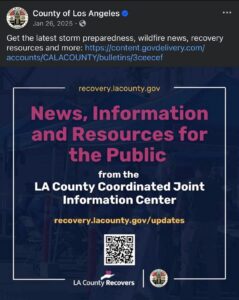
“Developing that really quick and then amplifying it on social was extremely beneficial,” she said.
When information shifts quickly, trying to explain every detail in social posts can create confusion. Giving quick instructions on social and deeper context in a central place gives teams room to move without losing clarity, she said.
When information shifts, provide updates quickly
During the wildfires, information shifted hourly. If the city was trying to capture all of that context inside individual social posts, it would have been impossible and information would have quicky become outdated, Duran said.
“It was constant pivoting,” she said. “There was information that changed hourly some days. There was information that changed daily.”
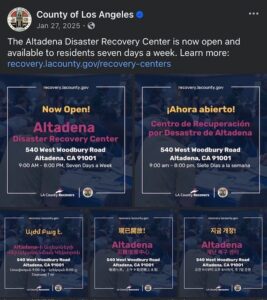
Whenever there was a new update, the team shared that information first in a brief sentence, then linked back to the website where people could find more details, Duran said. This happened for each new recovery center opening, route closure or changing route.
The microsite allowed the team to update details without rewriting the entire social narrative each time something shifted. Social posts could stay simple and consistent, while the site provided in-depth information.
“It really helped with adding credibility to the things that we were putting out on social media,” Duran said.
Build trust with repetition
During crisis, people sometimes encounter information out of order. A repeated link is not redundant to someone seeing it for the first time, Duran said.
By consistently sending people back to the same verified destination, the county reduced speculation and rumor escalation, she said. When a hashtag was trending, Duran’s team used it to guide people to the right resource.
“It was important to be clear, accurate and as transparent as possible,” Duran said. “People are trying to find this information quickly. If you’re not clear, misinformation fills those gaps very quickly.”.

This approach also works during moments of confusion, Duran said.
“There was a situation where people were trying to sign up for alerts,” Duran said. “They were confused and frustrated about how to do that.”
The team was able to respond in real time by reposting the link and clarifying that people could access alerts from the microsite.
“One of the things that we needed to do was make sure and amplify that people knew this is where you’re going to go to get alerts on an emergency,” she said. “This is the verified app. This is a verified website.”
Direct with honesty
Duran emphasized that people are not expecting perfection during a crisis. What they expect is reliable information with honesty and transparency.
“They are expecting you to be honest, clear and acknowledge what the impact is as we see it in real time,” she said.
A centralized destination lets your team share updates quickly without guessing or overexplaining.
“You don’t always need all the answers immediately,” Duran said. “But you need to show that awareness and that leadership and accountability just from the beginning. Build a place people can return to, then commit to sending them there again and again.”
Register here to learn more from Duran and other industry experts during Social Media Conference March 9-11 in Orlando, Florida.
Courtney Blackann is a communications reporter. Connect with her on LinkedIn or email her at courtneyb@ragan.com.
The post How LA County built its wildfire social strategy around a single source of truth appeared first on PR Daily.
[ad_2]
Source_link