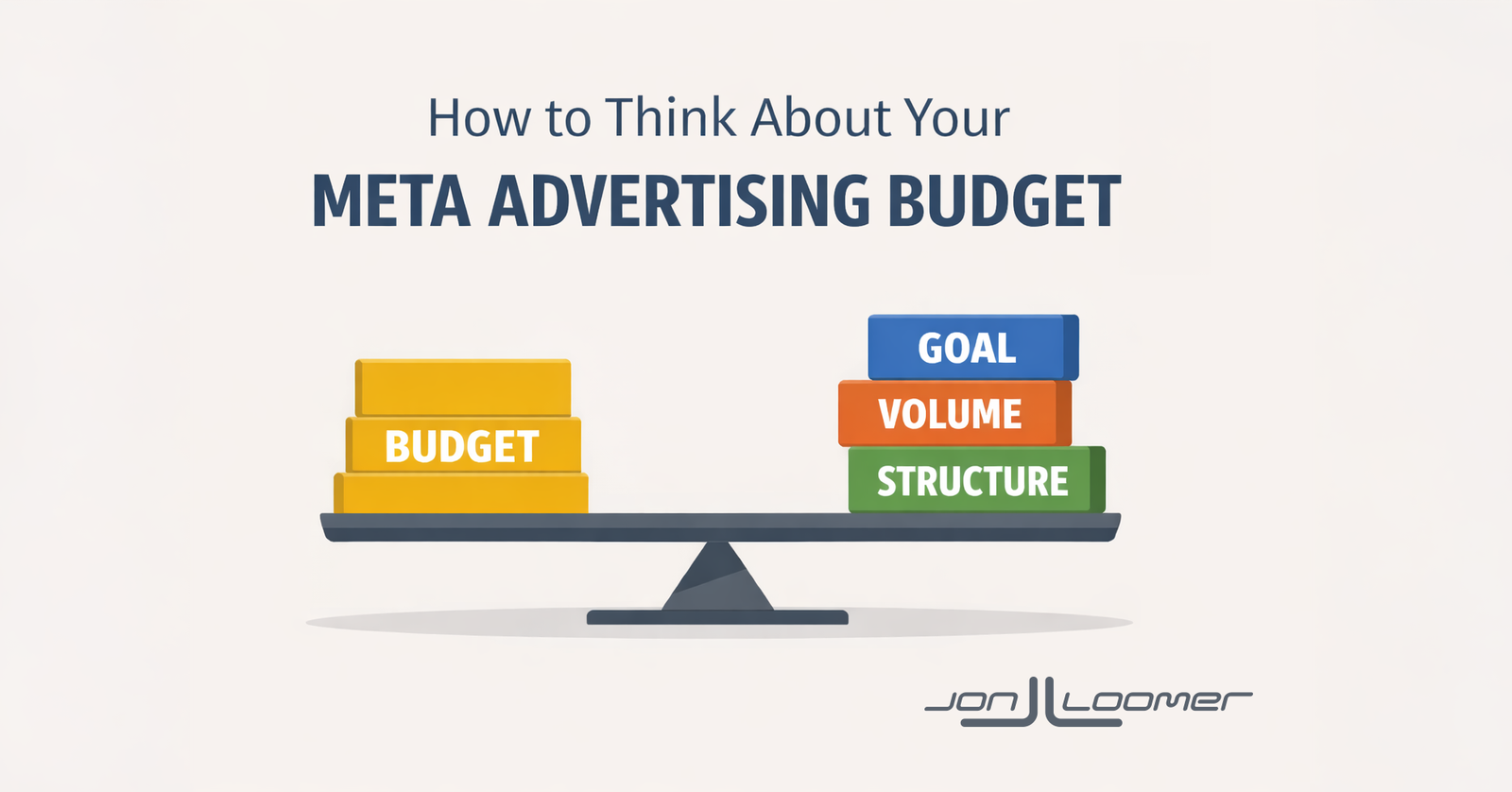
One of the most common questions I get from Meta advertisers is about budget. How much should you spend to get meaningful results?
There isn’t a universal answer. The right budget depends on your goal, your expectations, and how complicated you make your setup.
This exercise will help you think through what your ideal budget would be, based on your situation. That doesn’t mean you should change anything today. But it will help you see whether your current approach is inefficient or unnecessarily complex.
Let’s think this through…
1. What is Your Goal?
It all starts with your goal. There isn’t a generic budget that everyone should use for any situation. What you can accomplish with a given budget will depend on your goal.
Allow me to help you here. Prioritize some sort of conversion event. If not a purchase, it should probably be a lead.
While you can certainly have a goal of awareness, traffic, or engagement, and you can get “results” on very little spend, you will get what you pay for. In most cases, you won’t be paying for much.
2. What is the Expected Cost Per Goal Action?
This is where there may need to be an adjustment of expectations. This isn’t about what you hope your cost per goal action will be. Base this in reality.
If you’ve already been running ads, start with an average. But if you don’t have historical data to base this projection on, guess conservatively. For example: If you have a $100 product, assume that it will cost $100 to get a goal action — not because that’s what it will ultimately cost, but because it establishes a conservative expectation.
You will undoubtedly hear all kinds of success stories of high ROAS, and you may think that’s where you should start. But do not set your own expectations against someone else’s claimed experience. Results can be manipulated. Even if they’re true, good results often require plenty of fine tuning to get there.
But obviously, the expected cost to sell a $10 product will be far different than that of a $10,000 product. Be realistic.
Lead generation provides similar ranges. The cost to get someone to subscribe to your free thing will be far different than the cost to get a client lead for a realtor. The range for lead costs can be as low as $1 or as high as into the hundreds of dollars.
There’s an entirely separate conversation about what your cost per goal action needs to be for profitability. That’s your ultimate objective. And that shouldn’t only be based on the immediate return, but the value of this new lead or customer over months. But you can’t start there with your budget.
3. How Many Campaigns and Ad Sets Are Required?
This is where those who insist on complicated campaign strategies start seeing red. They created multiple campaigns for testing, audience segmentation, and who knows what else. These rules apply to all ad sets for a single goal.
How many ad sets for testing? How many for audience segmentation? Remarketing? Promoting different products? Different locations? Or whatever crazy goals you have?
Add up all of the ad sets. This will matter.
4. Calculate Your Budget
For now, let’s assume that you have an expected cost per goal action of $50. There’s an old rule of thumb of needing 50 optimized actions per week to exit the learning phase. While that isn’t a rigid requirement, and you can still have decent results without exiting learning, it’s still a good goal.
You need meaningful volume. Not only does that give Meta data to learn from, but the more results you get, the more predictable performance tends to be. So aiming for 50 optimized actions per week remains a good target.
With an expected cost per goal action of $50, that would mean $2,500 per week — or around $350 per day and $10,000 per month for a single campaign and ad set. Ranges are fine, these numbers don’t need to be exact.
If you decide to create multiple campaigns or ad sets for this goal, you’ll need to multiply that rate across ad sets. So if you set up three separate ad sets (regardless of whether they’re in the same campaign), that’s $1,050 per day and $30,000 per month.
You could reasonably lower that expectation if you’re using CBO (Advantage+ Campaign Budget, Campaign Budget, or whatever we’re calling it now). You should still want at least one of the ad sets to reach your goal action rate.
If your response is that you’ll just spend way less on a separate campaign for testing or audience segmentation, you’re missing the point. You’re not going to get meaningful data from a test if you’re spending very little on it.
5. Budget and Ad Volume
I’m often asked how budget should impact ad volume and vice versa. For the most part, it’s overthinking things.
You don’t generally need to worry about watering down results or hurting performance if you create too many ads. The main thing to remember is that we should have moved beyond trying to find the “best ad” by obsessing over the best combination of ad copy and creative. You will need countless good combinations to get great results.
Meta wants creative diversification. That doesn’t necessarily mean more ads, and you can create diverse ads without necessarily creating a lot of ads.
The bottom line is this: The higher your budget and greater your volume of impressions, the greater your flexibility for creating more ads. Assuming you have the resources, advertisers with higher budgets can benefit from generating more ads. Don’t create more ads for the sake of creating more ads (good ads still matter), but you are also likely to run into creative fatigue issues if variation is limited with a high budget.
On the flip side, those with lower budgets will have diminishing returns from creating more ads. There’s just not much benefit when a small budget is spread out over more variations.
6. Keep It Simple
If you ran these calculations and you’re shaking your head because they suggest you should be spending multiples of what you are right now, this is important. It doesn’t necessarily mean that you should be spending more. It might mean that things are way too complicated.
If you’re spending way below the calculated budget, simplify things. Create only one campaign and ad set. If you’re unable to generate meaningful data with a complex web of ad sets, see if you can get there by consolidating your budget with a single campaign and ad set.
And I know that sometimes there are legitimate reasons to create a separate ad set. But ask yourself whether each extra ad set is actually required. If not, scrap it.
And even after consolidating, it’s possible you won’t be able to get to 50 goal actions per week, per ad set. You have a couple of options:
1. Accept it and do nothing.
You’ve consolidated as much as you can. You can only get 30 goal actions per week. That might be just fine. If you can get to 50 in a week, great. But it doesn’t mean that you can’t get decent results with fewer than that. Just know that performance is likely to be unpredictable.
2. Optimize for a different goal action.
If you were hoping for purchases but can’t get enough volume with the budget you have, you may need to go for a cheaper goal action. I wouldn’t recommend optimizing for add-to-cart or initiate checkout conversion events. While it may be worth an experiment, it usually doesn’t go well. Instead, I’d focus on a lower-priced product or lead.
7. Don’t Spend Money You Don’t Have
Whenever someone asks me what their budget should be, I start with this exercise. But I always preface it with, “It’s not my money.”
This isn’t Monopoly. This is the real world. So if you’re running ads now, use this exercise to determine if you’re in a good budget range. If you’re not, see if you can get there by consolidating. Don’t spend more money than you’re comfortable spending.
If you haven’t started advertising, start with a more conservative budget. You’re going to waste money in the early going. You’ll learn from the results and get better along the way. As that happens, you can begin to spend more and be confident in those increases.
Just remember that increasing your budget isn’t a guarantee that you’ll get better results. But spending your budget more wisely without watering it down with multiple campaigns and ad sets will often improve performance.
Your budget isn’t just about how much you can spend. It’s about whether you’re giving Meta enough focus and volume to work with.
Your Turn
How do you approach setting your budget?
Let me know in the comments below!