[ad_1]
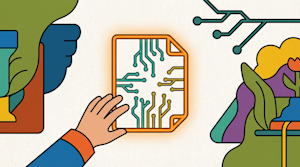
Tel Aviv-based startup Factify emerged from stealth today with a $73 million seed round for an ambitious, yet quixotic mission: to bring digital documents beyond the standard formats most businesses use — .PDF, .docx, collaborative cloud files like Google Docs — and into the intelligence era.
For Matan Gavish, Factify’s Founder and CEO, this isn't just a software upgrade—it is an inevitability he has been obsessed with for years.
"The PDF was developed when I was in elementary school," Gavish told VentureBeat. "The bedrock of the software ecosystem hasn't really evolved… someone has to redesign the digital document itself."
Gavish, a tenured professor of computer science and Stanford PhD, admits that his fixation on administrative file formats is an anomaly for someone with his credentials.
"It's a very uncool problem to be obsessed with," he says. "Given the fact that my academic background is AI and machine learning, my mom wanted me to start an AI company because it's cool. I'm not sure why I'm obsessed and then possessed by documents."
But that obsession has now attracted a sizeable seed round led by Valley Capital Partners and backed by AI heavyweights like former Google AI chief John Giannandrea.
The bet is simple the static rigidity of most digital files has limited their utility, and a better, more intelligent document that actually shares its edit history and ownership with users as intended, is not only possible — it's a multi-billion-dollar opportunity.
The history of digital documents
To understand why a seed round would balloon to $73 million, you have to understand the scale of the trap businesses are in. There are currently an estimated three trillion PDFs in circulation. "Some people see the PDF more than they see their kids," Gavish jokes.
The history of the digital document is not a linear progression where one format replaces another. Instead, it is a story of "speciation," where different formats evolved to fill distinct ecological niches: creation, distribution, and collaboration.
The era of files: Microsoft Word (1980s–1990s)
Digital documents began as isolated artifacts. In the 1980s, the "document" was inextricably linked to the hardware that created it. A file created in WordPerfect on a DOS machine was effectively gibberish to a Macintosh user.
Microsoft Word, which traces its lineage to the pioneering WYSIWYG editors at Xerox PARC, changed this by leveraging the dominance of the Windows operating system. By the 1990s, the binary .doc format became the default container for editable professional documents. However, these files were structurally complex "memory dumps" designed for the limited hardware of the time, often leading to corruption or privacy leaks where deleted text remained hidden in the file's binary data.
The era of digital 'stone': the PDF (1990s-2006)
The PDF did not originate as a tool for writing; it was a tool for viewing. In 1991, Adobe co-founder John Warnock penned the "Camelot Project" white paper, envisioning a "digital envelope" that would look identical on any display or printer.
Unlike Word files, which were malleable, PDFs were designed to be immutable. They used the PostScript imaging model to place characters at precise coordinates, ensuring visual fidelity. While adoption was initially slow, Adobe’s 1994 decision to release the Acrobat Reader for free established PDF as the global standard for "digital concrete"—the format of finality used for contracts, government forms, and archives.
The collaborative cloud docs era (2006-present)
In 2006, Google disrupted the model again by moving the document from the hard drive to the browser. Using "Operational Transformation" algorithms, Google Docs allowed multiple users to edit the same stream of text simultaneously.
This shifted the paradigm from "sending a file" to "sharing a link." While Google Workspace now claims over 3 billion users (mostly consumers and education), it fundamentally changed how we work—turning documents into living, collaborative processes rather than static artifacts.
The status quo: fragmentation
Despite these advances, the business world remains fragmented. We draft in Google Docs (the "Digital Stream"), format in Word (the "Digital Clay"), and sign in PDF (the "Digital Stone").
But this fragmentation has a cost. "The problem is not the document. It is everything around it," the company notes. "Once a PDF leaves your system, control is gone. Versions drift. Access is unclear. Nothing is visible."
Turning digital documents into intelligent infrastructure
Factify’s wager is that in the age of AI, this fragmentation is no longer just annoying—it is a critical failure. AI models need structured, verifiable data to function.
When an AI "reads" a PDF, it is essentially guessing, using optical character recognition to scrape text from what is effectively a digital photo.
"What we're dealing with here is a megalomaniac vision, but it's at the same time probably something that is inevitable," Gavish says.
Factify’s solution is to treat documents not as static files, but as intelligent infrastructure. In the "Factified" standard, a document carries its own brain. It possesses a unique identity, a live permission system, and an immutable audit log that travels with it.
"We wrote a new document format that supplants the PostScript," Gavish explains. "We created a new data layer that supports the document as a first class citizen… and it's always available inside the organization and potentially outside."
This distinction—between a File and an API—is the core of the company's pitch"
-
Files are liabilities: They accumulate, get lost, and can be stolen. "It goes back to a brick status," Gavish says. "Files are liabilities, if anything, because they just accumulate there, you have to guard them."
-
APIs are assets: A Factify document is an active object. You can ask it questions: "Who has seen you? When do you expire? Are you the most up-to-date version?"
'People don't change', but formats do
History is littered with formats that tried to replace the PDF (like Microsoft’s XPS). They failed because they demanded too much behavioral change from users. Gavish is keenly aware of this trap.
"When I talk to enterprise software entrepreneurs, I tell them the two laws to know about starting a company in enterprise software is that people don't care, and no one changes," he says.
To skirt this, Factify has built deep backwards compatibility. A Factified document can look exactly like a PDF, complete with page breaks and margins. Users don't need to learn a new interface to get value; they just need to solve a specific pain point—like an executive who wants to ensure an investment memo can’t be forwarded.
"All they have to tell their team is, 'Dear Chief of Staff, employment agreements and investment memoranda… are going to be Factified. The rest carry on,'" Gavish says. "They see immediate benefit… but then they discover that they've crossed the Rubicon."
What's next for Factify?
The capital from this round will be used to deepen the platform's core engineering—which Gavish describes as a "heavy engineering lift" requiring them to rebuild the document format, data layer, and application layer from scratch. The company is also establishing a major operational hub in Pittsburgh to support its U.S. expansion.
Ultimately, Factify isn't trying to build another collaboration tool like Google Docs. They are trying to build the immutable record of the future—the standard for "truth" in a digital world.
"The PDF… became a standard meaning I cannot file my taxes using any other format. This is how victory looks like," Gavish says. "We are creating a document standard that is not specific for health care or for insurance, but is just document as such."
For the three trillion static files currently sitting in cloud storage, the writing may finally be on the wall.
[ad_2]
Source_link