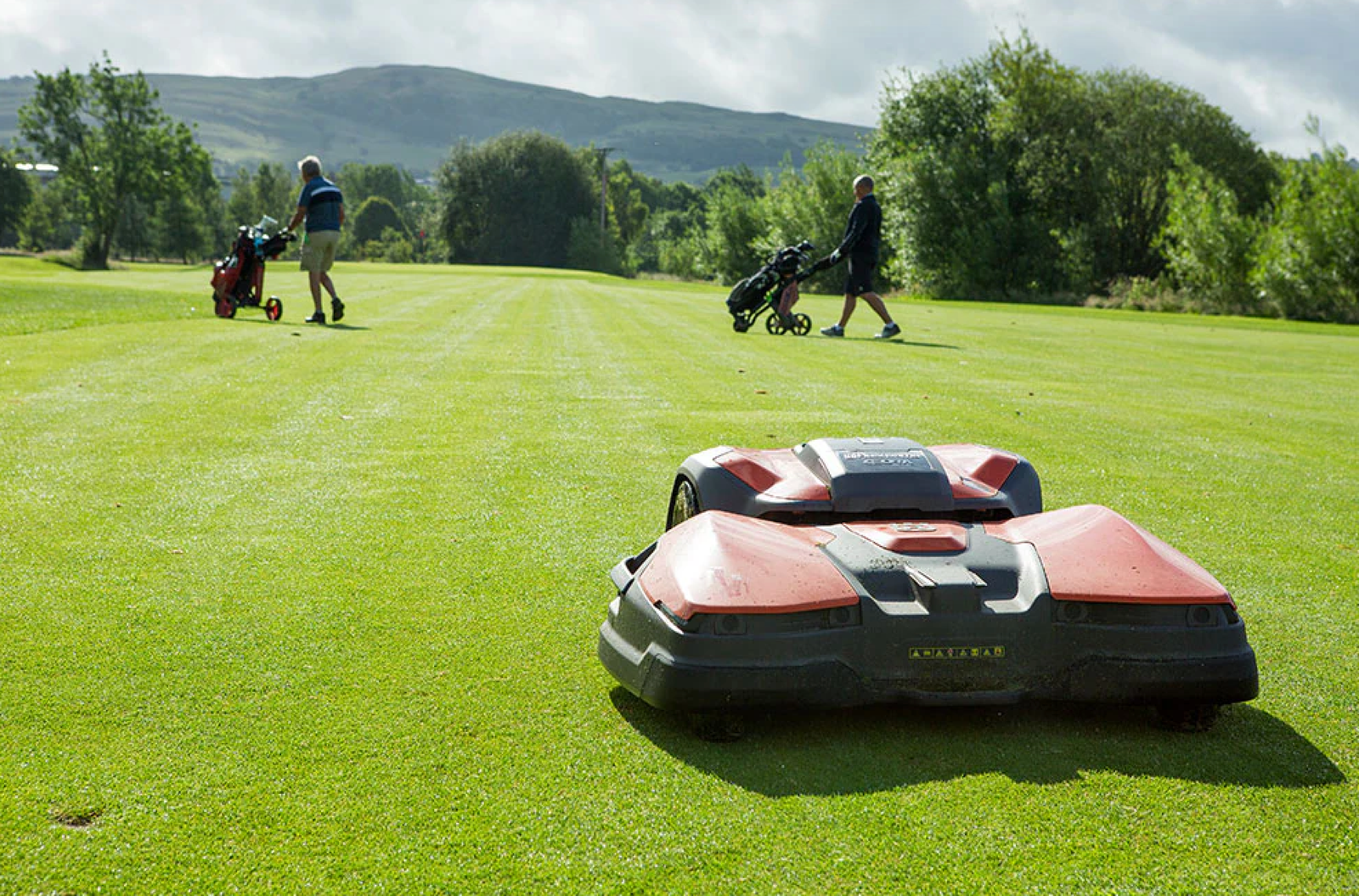
Picture a golf course at dawn. Traditionally, you’d hear the rumble of diesel engines as heavy mowers lumber across fairways, compacting soil and guzzling fuel. At Royal Porthcawl in South Wales, site of the 2024 Women’s British Open, something different happened. The fairways were cut overnight by a fleet of small, silent robots — the first time a major championship has been maintained this way.
This wasn’t a startup’s moonshot. It was the culmination of a 30-year journey by Husqvarna, a Swedish company founded in 1689 that once made muskets for the king. Today, the firm is methodically dismantling the very market it helped create — professional lawn care equipment — by replacing it with something radically simpler.
This article is part of Branding Strategy Insider’s newsletter. You can sign up here to get thought pieces like this sent to your inbox.
The story of how Husqvarna is navigating this transition offers a masterclass in self-disruption. It’s also a cautionary tale about why even companies that invent disruptive technologies often struggle to capitalize on them.
When Constraints Breed Innovation
The robotic mower revolution began with an absurd constraint. Three decades ago, a small team of engineers set out to create a solar-powered mower. With only 40 watts available (roughly the power of an old lightbulb), they couldn’t use a traditional cutting system. So they invented something entirely new: tiny razor blades that nibble grass daily rather than hacking it down weekly.
“That solar limitation forced them to invent a new cutting system,” explains Nick Rawson, VP of Strategy and Business Development at Husqvarna. “That cutting system, developed by Husqvarna engineers, has then become the basis for the entire robot mower industry, of which we’re the market leader.”
It’s a pattern I’ve seen repeatedly: breakthrough innovations often emerge not from unlimited resources but from creative responses to severe constraints. The team could easily have been killed off as a cost-saving measure. Instead, their solar mower experiment birthed an industry now worth billions.
The Innovator’s Dilemma, Playing Out in Real Time
Here’s where the story gets interesting and uncomfortable for Husqvarna’s core business. The company still makes traditional riding mowers and zero-turn machines – those large mowers that can literally turn on a dime. Its dealer network makes substantial money servicing these behemoths. Husqvarna’s robotic mowers threaten all of that.
“Dealers live and breathe the previous technology,” notes Yvette Henshall-Bell, Husqvarna’s President of its Forest and Garden division for Europe. “They want to protect that servicing, that aftermarket revenue. Whereas if they really thought about what the customer’s problems are and the Job to be Done… they would be looking at a completely different solution.”
This is my mentor Clayton Christensen’s innovator’s dilemma in vivid color. Robotic mowers don’t need oil changes. They don’t have filters to replace. They require different competencies — software and electronics instead of engines and hydraulics. For dealers accustomed to steady service revenue, this looks like a threat, not an opportunity.
Yet Husqvarna recognized something crucial: sustaining innovation (making better versions of existing products) won’t save them from disruption. Competitors are already automating zero-turn mowers. That’s not innovation; it’s “just making a better mousetrap,” as Henshall-Bell puts it. These large autonomous versions still require someone watching, still compact soil with their weight, and still burn fossil fuels.
Finding the Right Entry Point
Husqvarna’s path to market reveals a counterintuitive truth about new markets: the fastest route to mass adoption often runs through narrow segments first.
In residential markets, particularly in Sweden, where one in three households now owns a robotic mower, the company gradually built awareness. But for professional applications, golf courses emerged as the killer use case. Why? The problems were acute and visible: labor shortages, noise complaints, sustainability pressures, pesticide restrictions, and soil compaction that damages playing surfaces.
“Golf seems to be an application that has more challenges than we have addressed with this innovation,” Henshall-Bell explains. When the R&A (golf’s governing body outside North America) approved robotic mowers for championship play, it set a benchmark that the entire industry took notice of.
This mirrors a pattern I documented in my research on new market creation: footholds accelerate adoption. By dominating a narrow, high-visibility segment, companies create reference customers that make the broader market more receptive. Husqvarna now has 1,500 golf courses in Europe using their professional robotics. That’s a small fraction of total courses, but enough to shift perceptions industry-wide.
The Channel Challenge
Perhaps the thorniest challenge in creating new markets is channel strategy. Existing distributors are optimized for existing products. They know how to sell what they’ve always sold. Asking them to pivot is like asking a highway system to suddenly accommodate boats.
Husqvarna chose to work with its established dealer network despite the obvious tensions. “We as a company need to provide them with the tools, the digital tools, to be able to transform themselves,” Rawson explains. The company developed software that lets dealers remotely monitor entire fleets of robots, enabling proactive service that’s impossible with traditional equipment.
This dual approach — leveraging existing relationships while building new capabilities — requires delicate balancing. Push too hard on robotics, and you alienate dealers who provide most of your current revenue. Move too slowly, and startups capture the market. Husqvarna is supplementing dealer sales with direct online channels for smaller residential units, meeting customers where they are while protecting dealer relationships for complex commercial customers.
Learning From Adjacent Disruptions
When I asked Rawson and Henshall-Bell about the analogous industries they studied, construction equipment and precision agriculture emerged as key areas of reference. Both have undergone similar transformations, from competing on horsepower and dig depth to competing on data and connectivity.
“The whole industry is changing to what data you can get off the machines to provide better information to use your equipment more effectively,” Henshall-Bell notes. She spent 20 years in construction equipment and watched telematics revolutionize that industry.
The parallel to John Deere’s precision agriculture is particularly instructive. Both use RTK (real-time kinematic) GPS technology to position equipment with centimeter-level accuracy. Both generate massive amounts of data about operating conditions. Yet even Deere, with its agronomic expertise, seems stuck with that legacy in its mowing division, trying to automate existing machines rather than reimagining the solution.
“It is a brilliant business case for Christensen’s book,” Rawson reflects. “It could go straight in.”
As a marketer, your job is to compete. Compete differently with The Blake Project.
The Geography of Disruption
One striking aspect of Husqvarna’s journey: Europe has embraced robotic mowers far faster than North America. In Sweden, penetration is staggering. In the U.S., adoption lags substantially.
The explanation is cultural and structural. European homeowners typically maintain their own gardens. American homeowners often rely on landscaping services or homeowner associations that hire commercial providers. Moreover, Swedish lawns are often more compact than American ones, allowing small robotic mowers to cover them relatively quickly. The buying decision, value proposition, and path to market are different.
Interestingly, Husqvarna has flipped its strategy in North America, entering through high-end professional applications first — luxury golf courses, hotel complexes, and sports fields — then building residential awareness afterward. This flexibility in market entry strategy, adapting to local conditions rather than forcing a one-size-fits-all approach, exemplifies sophisticated new market development.
Unexpected Benefits
Perhaps most intriguing are the benefits Husqvarna didn’t anticipate. In Scotland, golf courses using robotic mowers now open far earlier in the season. The machines are so light that they don’t damage wet turf the way heavy equipment does. Some courses that could only open half their holes early in the season can now open fully.
“That’s solving another problem there that we never even imagined when we launched this,” Henshall-Bell marvels.
This is the magic of getting products into customers’ hands. You discover use cases and value propositions you never conceived. But it only happens if you’re willing to launch before you have everything figured out, learning from the market rather than in the lab.
The Long Game
Thirty years from conception to championship golf courses represents patience that most companies can’t muster. Quarterly earnings pressure, management turnover, and the allure of faster wins in core markets conspire against such persistence.
Yet Husqvarna’s robotics category already represents 16% of total sales. More importantly, it positions the company for a future where autonomous, sustainable, data-driven solutions replace yesterday’s machinery.
The lesson is that creating genuinely new markets, rather than launching new products into existing categories, requires different thinking. You need staged investment, tolerance for learning, focused entry strategies, careful channel management, and the courage to disrupt yourself before others do it for you.
“In a few years’ time, it will seem ridiculous that people are pushing mowers around,” Rawson predicts. When that future arrives, it won’t be because some startup swooped in with a clever idea. It will be because a 330-year-old company had the foresight to invent its future and the discipline to systematically build it, one fairway at a time.
Contributed to Branding Strategy Insider by Steve Wunker, Co-Author of AI and the Octopus Organization:
The Blake Project Can Help You Create A Brighter Competitive Future In The Jobs To Be Done Workshop
Branding Strategy Insider is a service of The Blake Project: A strategic brand consultancy specializing in Brand Research, Brand Strategy, Brand Growth and Brand Education
FREE Publications And Resources For Marketers
Post Views: 12