[ad_1]
Jan 26, 2026

The way organizations hire may reflect how well they fundraise, adapt, and grow.
Innovation rarely fails because of a lack of ideas.
It fails because some nonprofit organizations may not be able to move fast, align clearly, or adapt confidently to turn good ideas into results.
In fundraising, this gap shows up everywhere: promising campaigns that stall in execution, new channels that never quite scale, tools that are purchased but underutilized, and teams that feel perpetually stretched despite doing all the “right” things.
What’s often overlooked is where these constraints actually begin. They don’t start with a campaign. They don’t start with technology. They start much earlier, with how teams are built and how decisions are made. In other words, they start with hiring.
Context: Better Hiring System
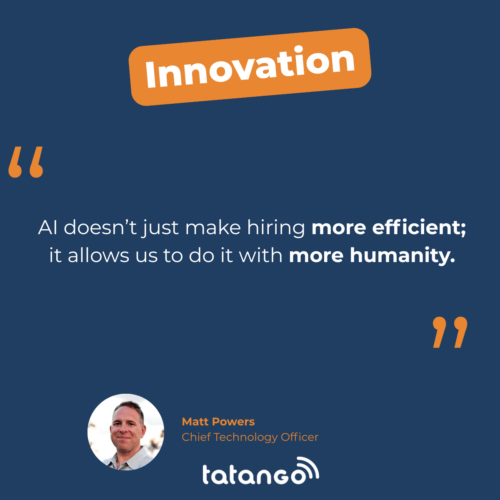
Our CTO, Matt Powers, recently shared a behind-the-scenes look at how Tatango redesigned our hiring approach using AI and systems thinking. The core idea was simple: keep standards high, treat candidates with respect, and remove the coordination drag that slows good teams down.
If you want the tactical view, you can read Matt’s post here here: Using AI to run a high-touch, high-signal hiring process.
Because innovative hiring doesn’t just produce a better hiring experience. It produces better outcomes across the organization, including fundraising performance and supporter trust.
Innovation Shows Up Late, But It Starts Early
Most organizations look for innovation downstream.
They look for it in dedicated brainstorming sessions, new tools, refreshed campaigns or bold initiatives designed to unlock growth. Those efforts can absolutely matter. But by the time innovation is expected to appear, the conditions for it have usually already been set.
Hiring is one of the earliest expressions of how an organization actually operates. It reveals:
- How decisions are made
- How feedback flows
- How clear expectations really are
- How comfortable the organization is with change
These signals don’t stay confined to hiring. They propagate.
An organization that hires slowly, inconsistently, or opaquely tends to struggle with speed and alignment later. One that hires with intention, clarity, and respect tends to move faster everywhere else, not because it rushes, but because it removes unnecessary friction.
Innovative outcomes are rarely accidental. They are the byproduct of systems designed to support good judgment at scale.
Hiring Is the First Connected Experience
Before someone collaborates with your team, or contributes to your mission, they experience your hiring process.
That experience quietly answers important questions:
- Do decisions here feel thoughtful or arbitrary?
- Is communication clear or fragmented?
- Does this organization respect people’s time?
- Does it follow through?
Those same questions are asked later by donors, partners, and supporters, even if they’re never articulated directly.
This is why hiring isn’t just an internal function. It’s a preview of how the organization behaves under real-world conditions.
When hiring is treated as a loose collection of tasks, it signals that coordination is optional and clarity will be figured out later. When it’s treated as a system, it signals that alignment and accountability matter from day one.
That signal shapes outcomes long after the role is filled.
 What Innovative Hiring Actually Produces
It’s tempting to think of innovative hiring as a shortcut to efficiency.
In reality, its value is much deeper and much more durable.
When hiring is modernized thoughtfully (including the use of AI where appropriate), it tends to produce a few critical capabilities:
Faster alignment.
Teams get on the same page earlier. Expectations are clearer. Decisions don’t linger because context is shared rather than scattered.
Better judgment.
When signal is captured cleanly and feedback loops are tight, teams spend less time debating anecdotes and more time evaluating substance.
Stronger ownership.
When processes are clear, responsibility becomes shared rather than deferred. People know what they’re accountable for and why.
More intentional communication.
Candidates, like donors, respond to clarity. When communication improves internally, it improves externally as well.
None of these outcomes require lowering standards. In fact, they make it easier to keep standards high without burning people out.
Where AI Fits, and Where It Doesn’t
AI’s role in innovative hiring is often misunderstood.
It doesn’t replace judgment. It doesn’t decide who gets hired. And it doesn’t remove the human element.
What it does do is make weak systems visible and strong systems scalable.
When applied intentionally, AI helps:
- Compress feedback cycles
- Reduce coordination overhead
- Preserve context across conversations
- Free people to focus on what actually matters: the interaction in front of them
If you want a concrete example of what this looks like in practice (and what we did not outsource to AI), our CTO breaks it down here:
How we used AI to support a high-touch hiring loop .
This distinction is important, because it mirrors how AI creates value in fundraising. AI doesn’t replace relationships. It strengthens the systems that support them.
Organizations that treat AI as a shortcut tend to be disappointed. Organizations that treat it as infrastructure, something that supports clarity, consistency, and learning, tend to see compounding returns.
Why This Matters for Fundraising Outcomes
Modern fundraising is fundamentally a systems challenge.
It requires teams to:
- Respond quickly to supporter behavior
- Coordinate across tools and channels
- Make decisions with incomplete information
- Build trust at scale without losing humanity
These are not marketing problems or technology problems. They are organizational capability problems.
Teams that can do this well usually share a few traits:
- They think in systems, not silos
- They communicate clearly under pressure
- They learn from every cycle
- They adapt without losing focus
Those traits don’t appear magically during campaign planning. They are cultivated, starting with how people are hired, onboarded, and empowered to make decisions.
Innovative hiring doesn’t guarantee innovative fundraising. But misaligned hiring almost guarantees limitations later.
The Trust Line
One of the strongest parallels between hiring and fundraising is trust.
Candidates don’t judge organizations solely on outcomes. They judge them on experience. So do donors.
Trust is built through:
- Timely, thoughtful communication
- Clear expectations
- Transparency
- Follow-through
When hiring systems support these behaviors, they become part of the culture rather than isolated acts of goodwill.
The same principle applies externally. Supporters feel when an organization is well-run. They feel when communication is intentional rather than reactive. They feel when systems are designed to respect them.
Trust doesn’t scale through effort alone. It scales through systems.
Innovation Is a Behavior, Not a Budget Line
One of the most persistent myths about innovation is that it can be purchased later.
That it’s something organizations can add once the right tool is selected or the right initiative is approved.
In reality, innovation is a behavior, and behaviors are reinforced long before outcomes are visible.
Hiring is one of the earliest places where those behaviors are encoded:
- How much ambiguity is tolerated
- How feedback is given and received
- How learning is prioritized
- How people are empowered to act
AI can amplify these behaviors, but it can’t invent them.
Organizations that want innovative outcomes have to design for them upstream.
Closing: Start with the System
Hiring isn’t just about filling roles. It’s about shaping what an organization is capable of becoming.
Innovative hiring matters not because it’s faster or more efficient, but because it builds teams that can adapt, align, and execute in environments that are increasingly complex.
That capability shows up everywhere: in fundraising performance, in donor trust, and in how organizations respond when conditions change.
AI didn’t change what matters. It changed what’s possible, when systems are designed with intention.
If you want innovative outcomes, don’t start with the campaign.
Start with the system.
- Start with how you hire.
- Start with how you build trust internally.
- Start with how you create clarity before speed.
Because when systems work, people do their best work.
And when people do their best work, impact follows.
[ad_2]
Source_link