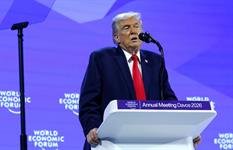
What a curious week at the World Economic Forum in the mountains of the small ski town of Davos, Switzerland.
As interim co-chair and BlackRock CEO Larry Fink noted in his opening address, will anyone outside the room in which he was speaking care about the largest gathering of global leadership since COVID?
Fink continued: “Because if we’re being honest, for many people this meeting feels out of step with the moment: elites in an age of populism, an established institution in an era of deep institutional distrust.”
It seems a long way away from the roots of the World Economic Forum as a platform for discussion about the “Davos spirit” and an event based on the concept of stakeholder capitalism.
For most attendees, however, there was only one game in town. As Stephen Kehoe, EVP, chief corporate affairs officer at PepsiCo, noted on Wednesday evening having witnessed President Trump’s speech in the official conference centre: “There was a real held-breath feeling in Davos this week — the Congress Centre wasn’t a forum, it was a trading floor.
“Greenland dominating the debate cycle was the tell: policy, markets and power are now inseparable, and geoeconomics is where the real contest is playing out. Rarely has Davos felt so alert and so exposed.”
In this context, the positive market reaction to Trump’s so-called “framework” of a Greenland deal, a drawback from tariff threats on European nations and lack of an immediate threat to Danish sovereignty over the autonomous nation potentially rich in rare earth minerals was telling. The markets liked what they heard.
This year, you can guarantee most people will have seen clips from President Trump’s rambling speech to the conference on Wednesday, although few could sit through the whole thing, including many who chose to leave the congress hall before Trump had finished speaking. People can make up their own minds as to whether that is a good or bad look for Brand USA abroad as it nears its 250th anniversary.
But there were almost 1,000 company CEOs and chairs in attendance at Davos, as well as 65 global leaders (including one in particular who was top of mind for everyone).
If you take a conservative view, at least half of this cohort would be accompanied by their heads of communications and corporate affairs, so it’s become a must-attend for PR pros and a validation of the value they can add to their organisations. If the Cannes Lions International Festival of Creativity is all about marketers, creatives, media folk and consumer PR pros, Davos is the purview of the high-end consultants and the corporate affairs community.
First-time Davos attendee J. J. Carter, CEO of FleishmanHillard, said: “With trade conflicts and wars thundering on, there is a palpable sense of urgency this year — but also a refreshing openness to the idea that business and government are not destined for a zero-sum future.
“Big problems demand big tents. Even as political and trade winds tilt toward nationalism, there remains broad acknowledgment that industry and government must function together if society is to move forward.”
He noticed that “decisiveness is no longer the constraint, credibility is.”
“Leaders know they need to move faster, pivot more often, and make bolder bets,” he added. “What’s holding many organizations back isn’t strategy — it’s whether the audiences that matter most understand the context for change, trust the rationale behind it, and know what to do next.”
In that context, Carter believes the strongest organizations recognize communication as the bridge between that credibility gap.
Elsewhere, AI was an unsurprisingly ubiquitous topic of conversation along the Promenade and in the hundreds of curated conversations taking place around town.
Omnicom PR CEO Chris Foster said: “The conversation on AI has matured beyond theoretical concerns to practical deployment, with multiple AI narratives emerging in parallel; including platforms and infrastructure, talent and skills, energy and sustainability, and enterprise transformation. Watching this evolution, and exchanging lessons across sectors, underscored how quickly experimentation is turning into execution.”
Foster was encouraged to see so many PR and public affairs firms present in Davos, where he believes they belong, helping business leaders navigate complexity, reputation, and risk.
At Edelman’s Trust Barometer launch, International Rescue Committee CEO and former contender for leadership of the U.K.’s Labour Party, David Miliband, suggested every company now needed a foreign policy unit to help it navigate geopolitical and global economic uncertainty. And it was difficult to argue with this contention as the week’s events progressed.
As Foster concluded: “The most meaningful discussions focused not just on diagnosis, but on collective responsibility — how institutions, companies, and leaders must engage more actively in shaping solutions for an increasingly fragmented world.”
From a pure PR industry point of view, that is the nub of the matter. If your brand, company or agency is serious about doing the best for your customers, employees, investors and other stakeholders, you have to be here.