• About Us
  • Disclaimer
  • Contact Us
  • Privacy Policy
Tuesday, June 9, 2026
mGrowTech
No Result
View All Result
  • Technology And Software
    • Account Based Marketing
    • Channel Marketing
    • Marketing Automation
      • Al, Analytics and Automation
      • Ad Management
  • Digital Marketing
    • Social Media Management
    • Google Marketing
  • Direct Marketing
    • Brand Management
    • Marketing Attribution and Consulting
  • Mobile Marketing
  • Event Management
  • PR Solutions
  • Technology And Software
    • Account Based Marketing
    • Channel Marketing
    • Marketing Automation
      • Al, Analytics and Automation
      • Ad Management
  • Digital Marketing
    • Social Media Management
    • Google Marketing
  • Direct Marketing
    • Brand Management
    • Marketing Attribution and Consulting
  • Mobile Marketing
  • Event Management
  • PR Solutions
No Result
View All Result
mGrowTech
No Result
View All Result
Home Al, Analytics and Automation

Black Forest Labs Releases FLUX.2 [klein]: Compact Flow Models for Interactive Visual Intelligence

Josh by Josh
January 16, 2026
in Al, Analytics and Automation
0
Black Forest Labs Releases FLUX.2 [klein]: Compact Flow Models for Interactive Visual Intelligence


Black Forest Labs releases FLUX.2 [klein], a compact image model family that targets interactive visual intelligence on consumer hardware. FLUX.2 [klein] extends the FLUX.2 line with sub second generation and editing, a unified architecture for text to image and image to image, and deployment options that range from local GPUs to cloud APIs, while keeping state of the art image quality.

From FLUX.2 [dev] to interactive visual intelligence

FLUX.2 [dev] is a 32 billion parameter rectified flow transformer for text conditioned image generation and editing, including composition with multiple reference images, and runs mainly on data center class accelerators. It is tuned for maximum quality and flexibility, with long sampling schedules and high VRAM requirements.

READ ALSO

NVIDIA cuTile Python Tutorial: Building Tiled GPU Kernels for Vector Addition, Matrix Addition, and Matrix Multiplication in Colab

ClawHub Security Signals: A Coding Guide to End-to-End Security Signal Analysis and Verdict Classification on the AI Skills Dataset

FLUX.2 [klein] takes the same design direction and compresses it into smaller rectified flow transformers with 4 billion and 9 billion parameters. These models are distilled to very short sampling schedules, support the same text to image and multi reference editing tasks, and are optimized for response times below 1 second on modern GPUs.

Model family and capabilities

The FLUX.2 [klein] family consists of 4 main open weight variants through a single architecture.

  • FLUX.2 [klein] 4B
  • FLUX.2 [klein] 9B
  • FLUX.2 [klein] 4B Base
  • FLUX.2 [klein] 9B Base

FLUX.2 [klein] 4B and 9B are step distilled and guidance distilled models. They use 4 inference steps and are positioned as the fastest options for production and interactive workloads. FLUX.2 [klein] 9B combines a 9B flow model with an 8B Qwen3 text embedder and is described as the flagship small model on the Pareto frontier for quality versus latency across text to image, single reference editing, and multi reference generation.

The Base variants are undistilled versions with longer sampling schedules. The documentation lists them as foundation models that preserve the complete training signal and provide higher output diversity. They are intended for fine tuning, LoRA training, research pipelines, and custom post training workflows where control is more important than minimum latency.

All FLUX.2 [klein] models support three core tasks in the same architecture. They can generate images from text, they can edit a single input image, and they can perform multi reference generation and editing where several input images and a prompt jointly define the target output.

Latency, VRAM, and quantized variants

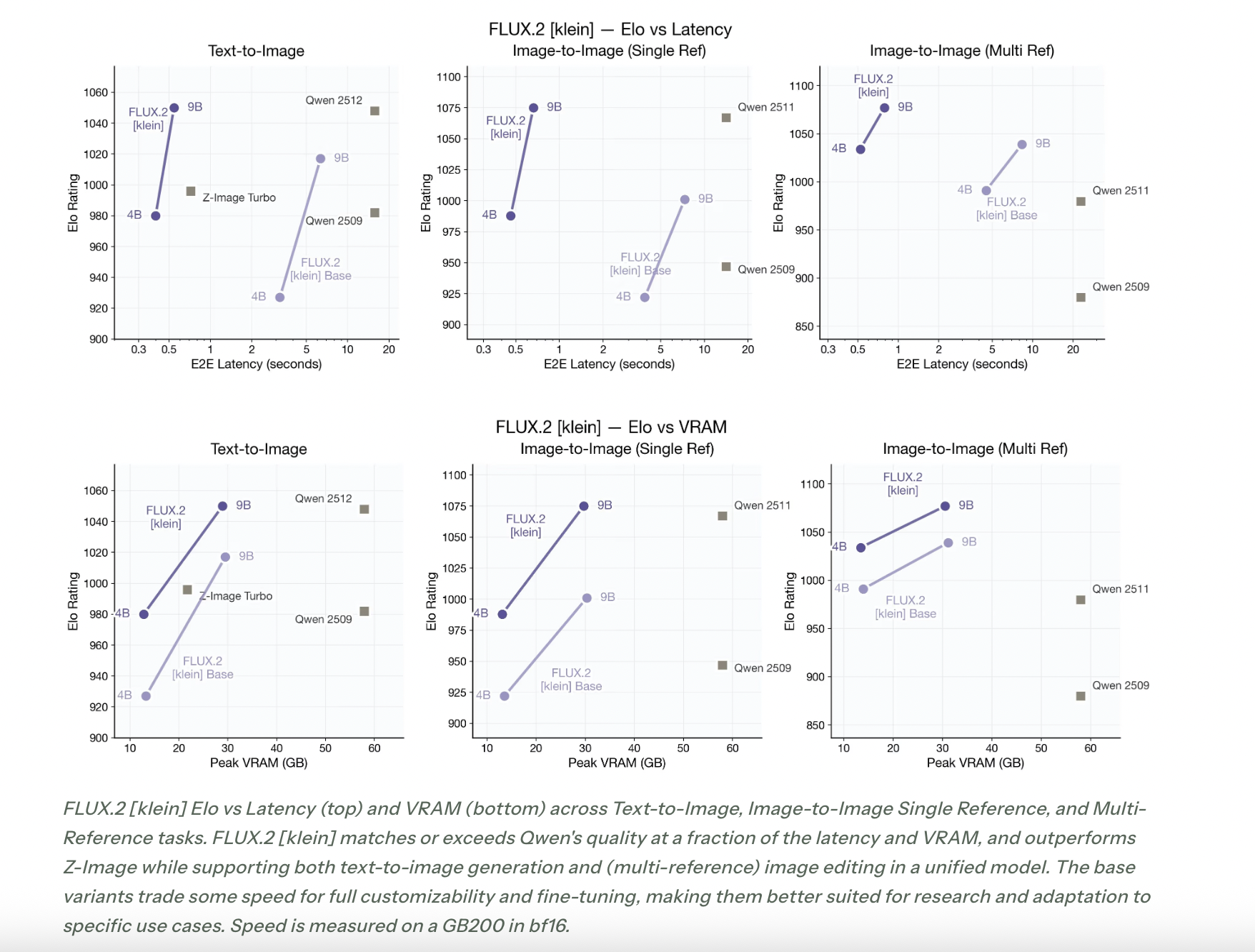
The FLUX.2 [klein] model page provides approximate end to end inference times on GB200 and RTX 5090. FLUX.2 [klein] 4B is the fastest variant and is listed at about 0.3 to 1.2 seconds per image, depending on hardware. FLUX.2 [klein] 9B targets about 0.5 to 2 seconds at higher quality. The Base models require several seconds because they run with 50 step sampling schedules, but they expose more flexibility for custom pipelines.

The FLUX.2 [klein] 4B model card states that 4B fits in about 13 GB of VRAM and is suitable for GPUs like the RTX 3090 and RTX 4070. The FLUX.2 [klein] 9B card reports a requirement of about 29 GB of VRAM and targets hardware such as the RTX 4090. This means a single high end consumer card can host the distilled variants with full resolution sampling.

To extend the reach to more devices, Black Forest Labs also releases FP8 and NVFP4 versions for all FLUX.2 [klein] variants, developed together with NVIDIA. FP8 quantization is described as up to 1.6 times faster with up to 40 percent lower VRAM usage, and NVFP4 as up to 2.7 times faster with up to 55 percent lower VRAM usage on RTX GPUs, while keeping the core capabilities the same.

Benchmarks against other image models

Black Forest Labs evaluates FLUX.2 [klein] through Elo style comparisons on text to image, single reference editing, and multi reference tasks. The performance charts show FLUX.2 [klein] on the Pareto frontier of Elo score versus latency and Elo score versus VRAM.The commentary states that FLUX.2 [klein] matches or exceeds the quality of Qwen based image models at a fraction of the latency and VRAM, and that it outperforms Z Image while supporting unified text to image and multi reference editing in one architecture.
https://bfl.ai/blog/flux2-klein-towards-interactive-visual-intelligence

The base variants trade some speed for full customizability and fine tuning, which aligns with their role as foundation checkpoints for new research and domain specific pipelines.

Key Takeaways

  • FLUX.2 [klein] is a compact rectified flow transformer family with 4B and 9B variants that supports text to image, single image editing, and multi reference generation in one unified architecture.
  • The distilled FLUX.2 [klein] 4B and 9B models use 4 sampling steps and are optimized for sub second inference on a single modern GPU, while the undistilled Base models use longer schedules and are intended for fine tuning and research.
  • Quantized FP8 and NVFP4 variants, built with NVIDIA, provide up to 1.6 times speedup with about 40 percent VRAM reduction for FP8 and up to 2.7 times speedup with about 55 percent VRAM reduction for NVFP4 on RTX GPUs.

Check out the Technical details, Repo and Model weights. Also, feel free to follow us on Twitter and don’t forget to join our 100k+ ML SubReddit and Subscribe to our Newsletter. Wait! are you on telegram? now you can join us on telegram as well.


Michal Sutter is a data science professional with a Master of Science in Data Science from the University of Padova. With a solid foundation in statistical analysis, machine learning, and data engineering, Michal excels at transforming complex datasets into actionable insights.



Source_link

Related Posts

NVIDIA cuTile Python Tutorial: Building Tiled GPU Kernels for Vector Addition, Matrix Addition, and Matrix Multiplication in Colab
Al, Analytics and Automation

NVIDIA cuTile Python Tutorial: Building Tiled GPU Kernels for Vector Addition, Matrix Addition, and Matrix Multiplication in Colab

June 9, 2026
ClawHub Security Signals: A Coding Guide to End-to-End Security Signal Analysis and Verdict Classification on the AI Skills Dataset
Al, Analytics and Automation

ClawHub Security Signals: A Coding Guide to End-to-End Security Signal Analysis and Verdict Classification on the AI Skills Dataset

June 8, 2026
Microsoft AI Introduces MAI-Transcribe-1.5: 2.4% WER on Artificial Analysis, Best-in-Class FLEURS Accuracy, and Up to 5x Faster Long-Audio Transcription
Al, Analytics and Automation

Microsoft AI Introduces MAI-Transcribe-1.5: 2.4% WER on Artificial Analysis, Best-in-Class FLEURS Accuracy, and Up to 5x Faster Long-Audio Transcription

June 8, 2026
Building Reflective Prompt Optimization with GEPA: Multi-Component Prompts, Structured Feedback, and Held-Out Validation
Al, Analytics and Automation

Building Reflective Prompt Optimization with GEPA: Multi-Component Prompts, Structured Feedback, and Held-Out Validation

June 7, 2026
Best 21 Low-Code and No-Code AI Tools in 2026
Al, Analytics and Automation

Best 21 Low-Code and No-Code AI Tools in 2026

June 7, 2026
Tod Machover receives George Peabody Medal for contributions to music and technology | MIT News
Al, Analytics and Automation

Tod Machover receives George Peabody Medal for contributions to music and technology | MIT News

June 6, 2026
Next Post
Claude Code, explained: why this AI tool has tech people freaking out

Claude Code, explained: why this AI tool has tech people freaking out

POPULAR NEWS

Trump ends trade talks with Canada over a digital services tax

Trump ends trade talks with Canada over a digital services tax

June 28, 2025
15 Trending Songs on TikTok in 2025 (+ How to Use Them)

15 Trending Songs on TikTok in 2025 (+ How to Use Them)

June 18, 2025
Communication Effectiveness Skills For Business Leaders

Communication Effectiveness Skills For Business Leaders

June 10, 2025
App Development Cost in Singapore: Pricing Breakdown & Insights

App Development Cost in Singapore: Pricing Breakdown & Insights

June 22, 2025
Comparing the Top 7 Large Language Models LLMs/Systems for Coding in 2025

Comparing the Top 7 Large Language Models LLMs/Systems for Coding in 2025

November 4, 2025

EDITOR'S PICK

How to Book the Top 9 Keynote Speaking Topics for 2026: The Ultimate Planner’s Guide

How to Book the Top 9 Keynote Speaking Topics for 2026: The Ultimate Planner’s Guide

February 26, 2026
How Often Should You Post on Instagram in 2025? What Data From 2 Million Posts Tells Us

How Often Should You Post on Instagram in 2025? What Data From 2 Million Posts Tells Us

August 14, 2025

Can a Small Language Model Predict Kernel Latency, Memory, and Model Accuracy from Code? A New Regression Language Model (RLM) Says Yes

October 4, 2025
Dfinity launches Caffeine, an AI platform that builds production apps from natural language prompts

Dfinity launches Caffeine, an AI platform that builds production apps from natural language prompts

October 15, 2025

About

We bring you the best Premium WordPress Themes that perfect for news, magazine, personal blog, etc. Check our landing page for details.

Follow us

Categories

  • Account Based Marketing
  • Ad Management
  • Al, Analytics and Automation
  • Brand Management
  • Channel Marketing
  • Digital Marketing
  • Direct Marketing
  • Event Management
  • Google Marketing
  • Marketing Attribution and Consulting
  • Marketing Automation
  • Mobile Marketing
  • PR Solutions
  • Social Media Management
  • Technology And Software
  • Uncategorized

Recent Posts

  • 5 Active Directory Misconfigurations That Still Lead to Domain Compromise in 2026
  • NVIDIA cuTile Python Tutorial: Building Tiled GPU Kernels for Vector Addition, Matrix Addition, and Matrix Multiplication in Colab
  • See the top Google Trends searches for the 2026 NBA Finals
  • LinkedIn Crossclimb Answer Today for June 8, 2026 (Puzzle #769)
  • About Us
  • Disclaimer
  • Contact Us
  • Privacy Policy
No Result
View All Result
  • Technology And Software
    • Account Based Marketing
    • Channel Marketing
    • Marketing Automation
      • Al, Analytics and Automation
      • Ad Management
  • Digital Marketing
    • Social Media Management
    • Google Marketing
  • Direct Marketing
    • Brand Management
    • Marketing Attribution and Consulting
  • Mobile Marketing
  • Event Management
  • PR Solutions