[ad_1]
Social media shifts every year — with new features, algorithm changes, and more competition for attention. And a lot of it is beyond your control not what the algorithm prioritizes, nor what goes viral, nor how people respond to your content.
However, you’re in luck: even with so much outside your influence, two actions you can do, remain reliable for growth: showing up consistently and engaging with the people who show up for you.
In this guide, we’ll break down why these two actions matter, how to strengthen each aspect, and the additional layers, like how often to post, when to post, and what formats to prioritize, that can help you accelerate your results in 2026.
Engagement and consistency: The winning combo
Across millions of posts and hours of analyses, Buffer’s research shows that these two behaviors — consistency and engagement — are the biggest drivers of long-term growth. They’re simple, repeatable, and (most importantly) entirely in your hands.
Let’s get into how to combine them to grow as a creator in 2026.
Consistency
In our study on the impact of consistency, which examined 26 weeks of posting behavior across more than 100,000 Buffer users, the creators who performed best weren’t posting every day or chasing extreme volume. They were simply showing up regularly.
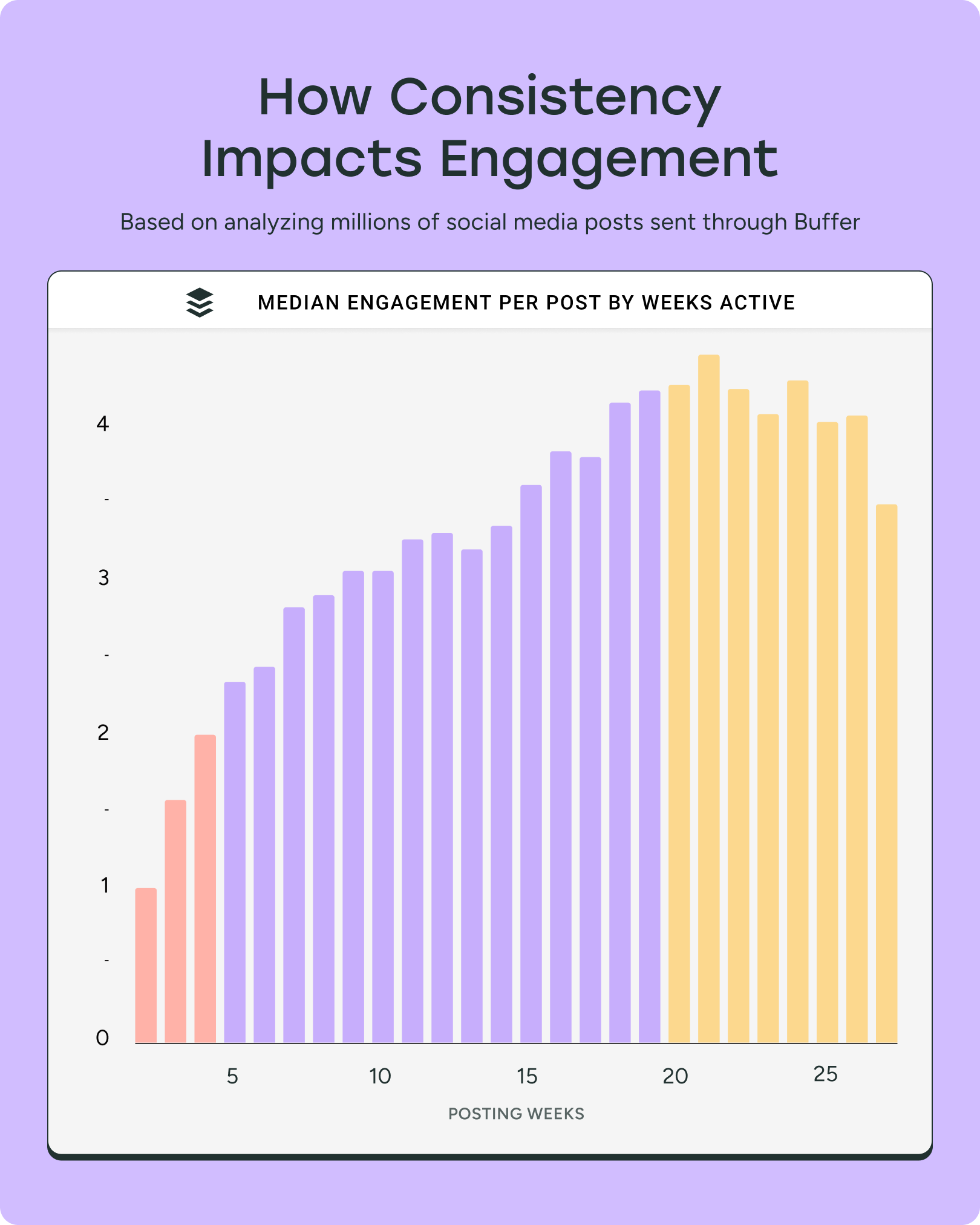
Creators who posted in 20 or more weeks out of the 26-week window saw around 450% more engagement per post compared to creators who posted in 4 weeks or fewer.
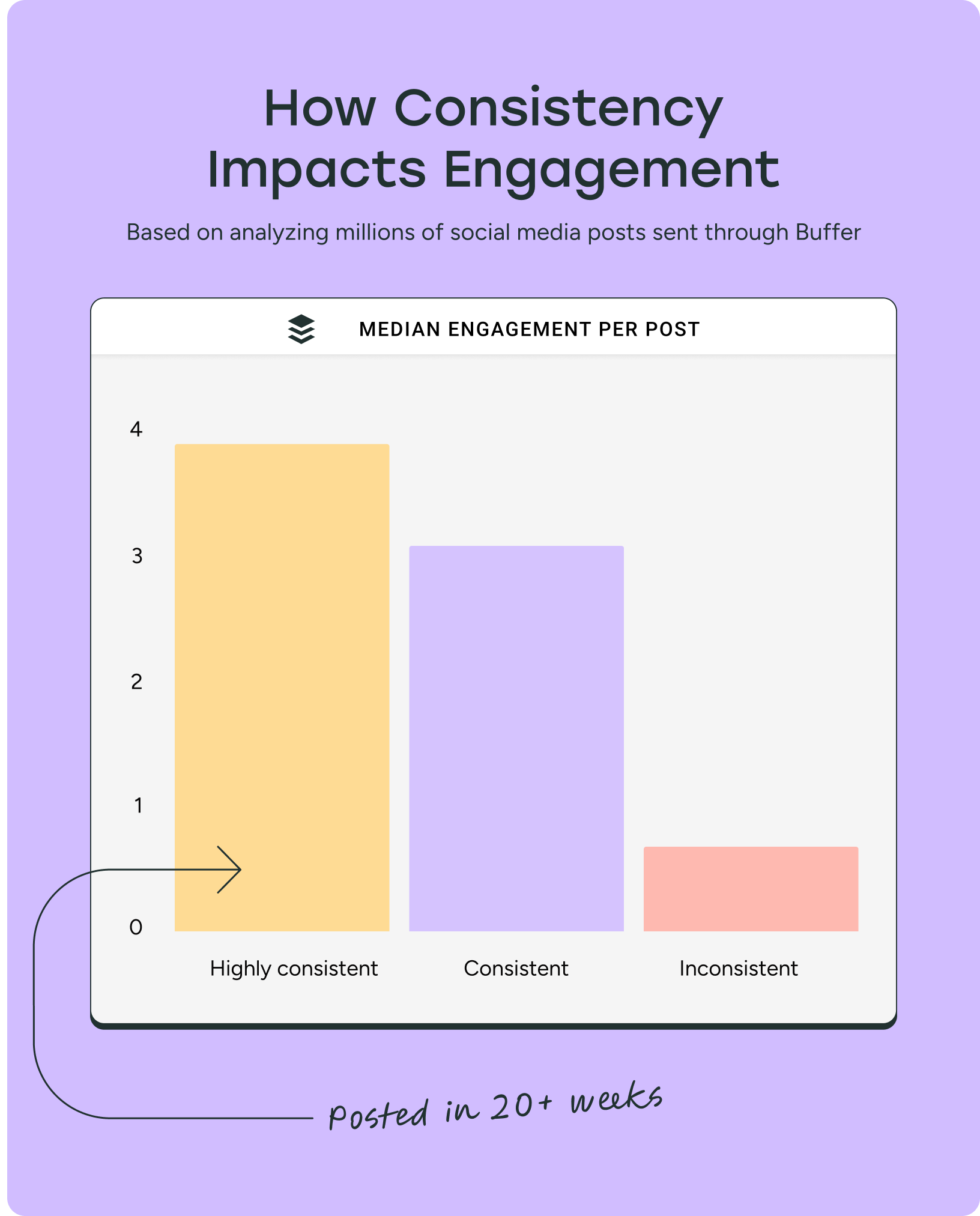
Even the “moderately consistent” group saw a huge lift. Posting in 5–19 weeks (less than half the period) still delivered around 340% more engagement per post than sporadic posting.
The takeaway here is simple but powerful:
⚡ You don’t need a perfect schedule — you just need a sustainable rhythm.
The study also suggest that posting consistently over 20 weeks can lead to the highest levels of engagement, but beyond that, there may be diminishing returns. In other words, you don’t have to sustain intensity forever; you just need enough steady weeks to build momentum.
Why does consistency matter so much?
- Algorithms reward stable posting behavior. We have deep-dive data on that shows this to be true for LinkedIn, Instagram, and TikTok.
- Audiences come to expect regular posts from you, which can keep you top of mind (and top of feed!)
- You create more opportunities for one good post to break out
- Your confidence, your content skills, and your understanding of your audience grow as the habit locks in
Now yes, consistency is great, but it’s often easier said than done. Some practical ways to stay consistent without burning out:
- Start with one non-negotiable posting day per week
- Keep a lightweight content bank or swipe file (screenshots, notes, half ideas). I use Buffer to gather my ideas.
- Use scheduling to cover low-energy weeks
- Follow a simple weekly loop: publish → reply → review → repeat
- Take breaks. One off day or week won’t undo months of momentum
Consistency is simply showing up often enough for growth to compound — and the data makes clear just how much impact that has.
Engagement
If consistency gives you a system, engagement is the conversation engine that keeps it going.
Replying to comments is one of the simplest ways to grow on social (and one of the most overlooked).
Most creators focus on getting engagement, but the real unlock is what happens after you hit publish. When you respond to the people commenting on your content, you’re sending a strong signal to both your audience and the platform.
Buffer’s data makes this hard to ignore. In our study analyzing nearly 2 million posts, replying to comments was associated with a clear, measurable performance lift across all major platforms. The gains vary, but the pattern is universal:
- Threads: up to 42% higher engagement
- LinkedIn: around 30% higher engagement
- Instagram: around 21% higher engagement
- Facebook: around 9% higher engagement
- X (formerly Twitter): around 8% higher engagement
- Bluesky: around 5% higher engagement
That’s the kind of lift creators can often spend months chasing through trends, formats, and posting hacks. And it can be unlocked by simply talking to the people already talking to you.
Why does this work so well?
Replies create more comments. More comments send stronger quality signals. Those signals keep your post alive in the feed for longer.
It’s a loop: you invest a few minutes responding, and the algorithm amplifies the conversation.
But my personal theory is that replying taps something we take for granted about social media: connection.
When someone comments, and you reply, you experience a tiny moment of connection. And those moments compound into trust, recognisability, and a growing base of people who come back to your content again and again.
A practical way to make engagement part of your workflow:
- Protect the first hour after you post for replies. Learn more about how to do this by getting into Creation Mode.
- Do a second check 24 hours later (platforms continue pushing resurfaced content)
- Ask follow-up questions to keep conversations going
- Turn repeated questions into new posts. This is a big part of my content creation process and an everlasting loop of new ideas.
- Treat your comment section as part of your content, not an optional extra
While these things might usually be hard to integrate into your process, Buffer’s new Community feature makes it much, much easier. You can see comments from Instagram, Facebook, Threads, Bluesky, X, and LinkedIn in a single dashboard.
And with the Comment Score feature, you can get your dopamine hits from something that actually helps you grow.
Additional things to help you grow
Consistency and engagement will get you further than anything else. Once you’ve nailed those factors, the next step is layering in smarter choices about how often you post, when you post, and what you post.
These are optimization levers that can sharpen your strategy and fuel your growth once the foundations are in place.
How often to post
Posting frequency varies wildly by platform, but our research provides a clear baseline for what to aim for in 2026.
TikTok
Moving from one post per week to two to five posts per week leads to a strong lift in views per post.
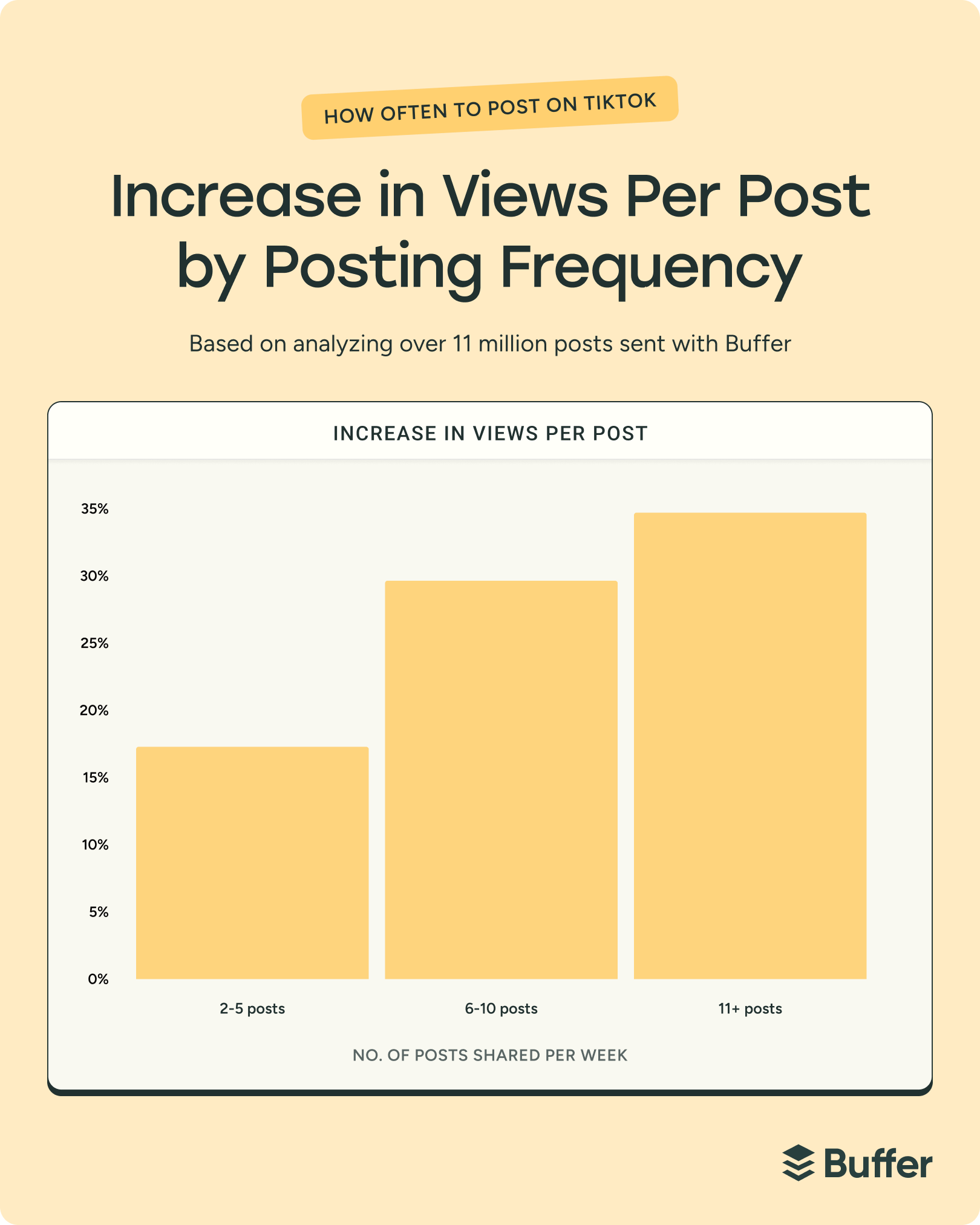
If you have more capacity, posting six to ten times per week increases performance even further, with additional gains at eleven or more posts per week. Just remember that: returns start to flatten as you go higher and overwhelming yourself doesn’t serve anyone. Stick to what’s sustainable for you.
A minimum of one to two posts per week keeps you visible, but real growth begins around three to five posts per week.
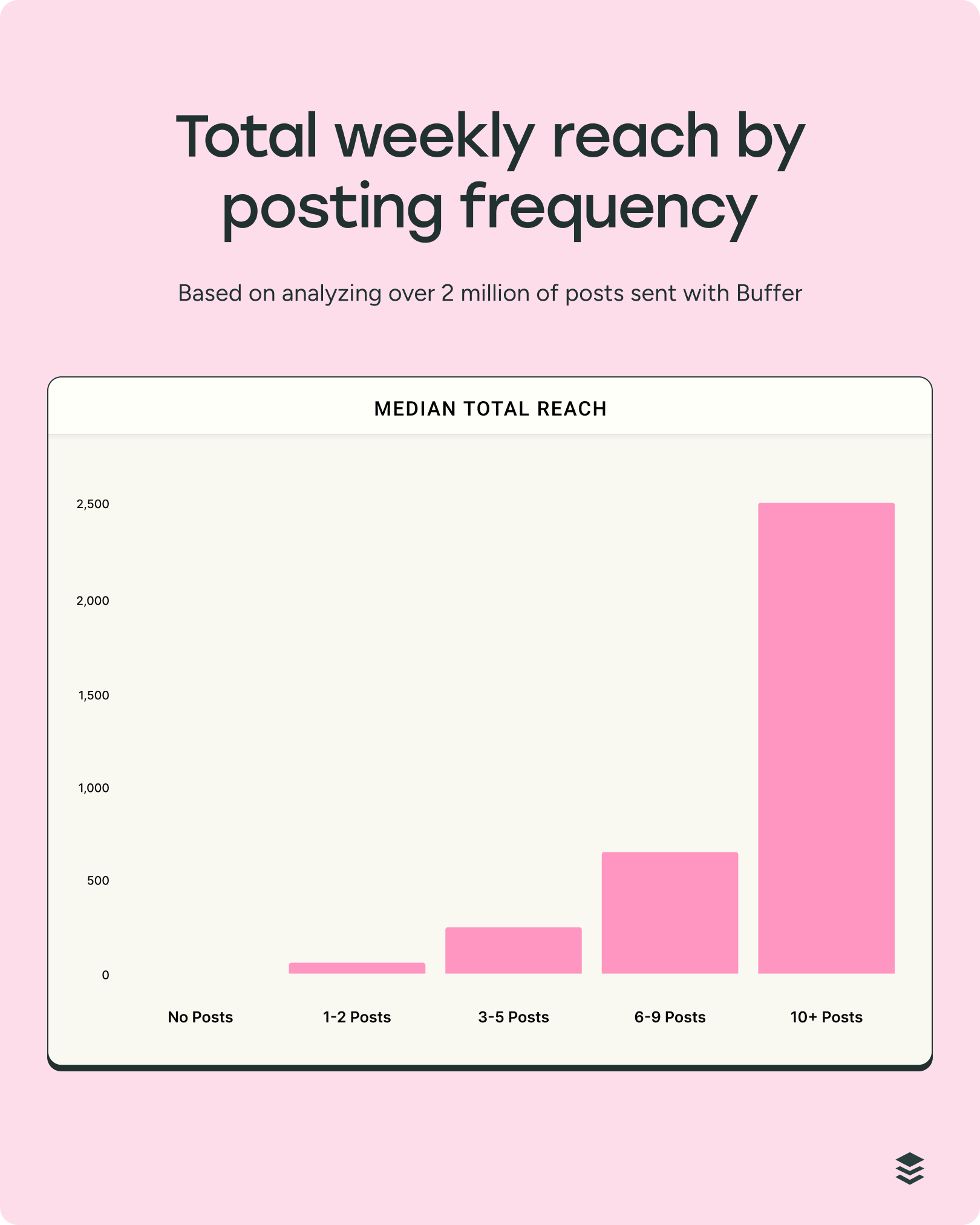
At six to nine posts per week, creators see significantly faster follower growth and higher reach per post.
Posting ten or more times per week can accelerate that even further, but it requires systems and stability to avoid burnout.
LinkedIn rewards creators who show up more frequently, with the highest gains coming when you go from one post a week to between two and five posts per week.
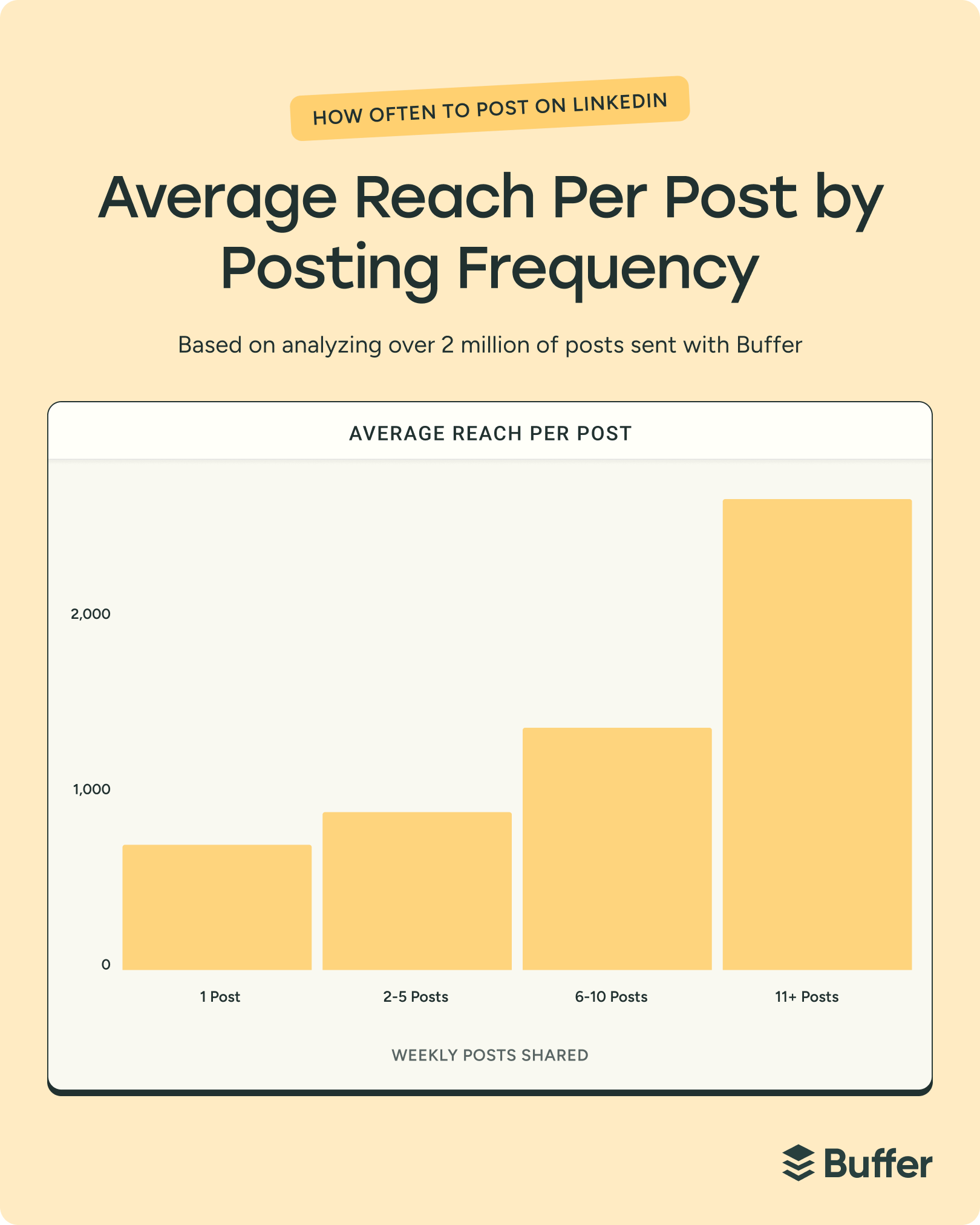
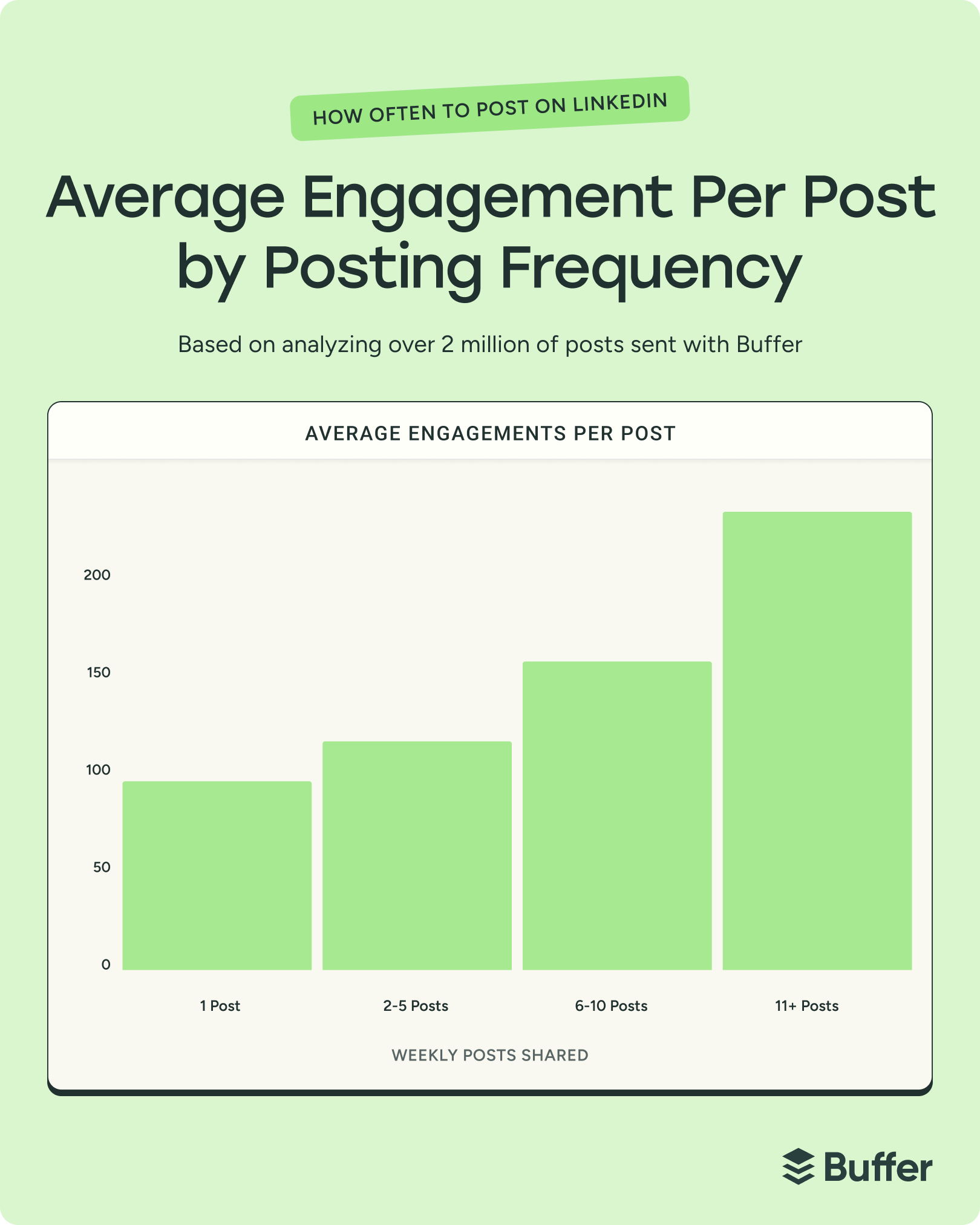
Moving into the six to ten posts per week range leads to even more noticeable lifts in impressions and engagement.
And posting eleven or more times per week generates the strongest results, but, of course, only if your ideas and quality can keep pace.
When to post
When you’re already showing up consistently and replying to your audience, timing becomes a another way to sharpen your performance. It can give your content an extra boost in visibility and reach.
Here’s a cheat sheet to follow:
- Best time to post on Facebook: 5 a.m. – 7 a.m. on weekdays
- Best time to post on Instagram: 3 p.m. – 6 p.m. on weekdays
- Best time to post on LinkedIn: 7 a.m. – 4 p.m. on weekdays
- Best time to post on TikTok: 4 p.m. – 7 p.m. on weekdays
- Best time to post on YouTube: 3 p.m. – 5 p.m. on weekdays
- Best time to post on X/Twitter: 8 a.m. – 10 a.m. on weekdays
- Best time to post on Threads: 7 a.m. — 9 a.m. on weekdays
⚡ For deeper analysis, check out The Best Time to Post on Social Media in 2025: Times for Every Major Platform
Timing, of course, varies by many factors and ultimately the best time to post is your best time, based on your data. If you want to integrate it timing into your workflow, consider trying out the following tips:
- Choose one or two platforms to focus on and schedule posts during the recommended time windows.
- Run an experiment over 4 to 6 weeks: publish at those slots, then compare reach and engagement vs other times you’ve tried.
- Once you identify your personal “sweet-spot”, make it part of your weekly workflow.
Don’t compromise consistency or engagement just to chase the perfect time — timing helps amplify good content, it doesn’t rescue weak content.
What to post
Formats matter, because different platforms reward different kinds of content — and the data shows that choosing the right format can make a real difference.
TikTok
On TikTok, video still reigns supreme. While carousels and text posts are gaining ground, short-form video remains the strongest driver of views and engagement.
Building your muscle in clips, edits, and attention-grabbing hooks pays off here.
Recommended formats:
- Short-form videos (15–90 seconds) optimized for grabbing attention
- Repurposed commentary or trending audio
- Text overlayed on short clips
Instagram is a mix of formats — but here are the standout winners: Reels for reach; carousels for interaction; photo posts when you have strong visuals.
Recommended formats:
- Reels that work with, not fight, the algorithm (short, punchy, mobile-first)
- Carousels that invite swipe-throughs, save-worthy moments, and commentary
- Image posts + strong caption if you have a clear visual + story to tell
LinkedIn rewards content that provides value, starts conversations, or shares professional insight. Posts that tap into learning, reflection, or community do best.
Recommended formats:
- Short videos (1–3 minutes) sharing insights, lessons, or stories. LinkedIn is big on video right now, so take advantage of the algorithm boost
- Text-based posts (opinion, reflection, question) that invite comment
- Carousel/image posts when you’re breaking down a concept visually
Facebook/X (formerly Twitter)/Threads
Each platform has its own nuances, but the general pattern holds: content that sparks conversation, uses the native format, and respects the platform’s rhythm works better than simply cross-posting.
Recommended formats:
- On Facebook: native video + link + commentary; live formats remain underused
- On X: short text-threads, quick reaction posts, video/gif based on topic
- On Threads: conversation starter posts, textual commentary, layered with visuals or questions
How to use formats strategically
- Audit your past posts: Which formats got the most reactions, saves, or comments?
- Choose two formats per platform to focus on this next month (one “safe” and one “experiment”).
- Ensure each post has one clear content goal: to provoke a comment, drive a save, or spark a share.
- Let your engagement and consistency system absorb the new format — focus first on quality, then scale.
- Don’t chase every “new format” trend if it derails your consistency or reply habit. Format amplifies — it doesn’t substitute.
✨ Discover more about content formats across social platforms in Data Shows Best Content Format on Social Platforms in 2025: Millions of Posts Analyzed
How to use this framework
The goal isn’t to “level up” as fast as possible — it’s to grow in a way that matches your energy, your niche, and your capacity.
No matter where you fall, the two actions that carry you forward — consistently showing up and actively engaging — stay the same. Everything else is about refining, sharpening, and scaling.
Commit to making consistency and engagement non-negotiables in your creative workflow, and we’ll see you (and your incredible results) in 2026!
[ad_2]
Source_link