Leadership is shaped by how well a leader adapts to the people, pressures, and priorities in front of them. The most effective leaders are those who understand their default tendencies, recognize alternative approaches, and intentionally adjust their style.That’s why leadership styles matter. Each one reflects a different philosophy of decision-making, communication, and team engagement.
What is the most effective leadership style?
The most effective leadership styles are transformational and democratic. Transformational leadership inspires innovation and vision. Democratic leadership encourages participation and trust. Both styles improve engagement, performance, and long-term success.
As companies increasingly turn to leadership training providers to build customized development programs, a clear grasp of these styles becomes the foundation for more targeted, effective coaching. In this guide, we’ll examine 10 widely recognized leadership styles and explore how each one functions in practice, so you can lead more effectively and build leaders who do the same.
TL;DR: Everything you need to know about leadership styles
- Why are leadership styles important? They affect team motivation, morale, communication, output, and your effectiveness as a leader. Understanding and applying them leads to better alignment and stronger leadership impact.
- What are the 10 main leadership styles? The core styles are: autocratic, bureaucratic, charismatic, coach, democratic, laissez-faire, servant, transactional, transformational, and visionary.
- How can I apply different leadership styles in practice? Build self-awareness, choose a core style, remain flexible, match your style to the situation, and solicit feedback.
- What’s the difference between a primary style and flexibility? Your primary leadership style fosters consistency and trust, while flexibility enables you to adjust according to the context.
Why is understanding leadership styles key to effective management?
Leadership styles are more than personal preferences. They’re management strategies with real consequences. The way a leader directs, motivates, and supports their team affects everything from day-to-day productivity to long-term employee retention.
By understanding different leadership styles, managers can identify the approach that best fits their team’s needs, the company culture, and the challenges at hand. This awareness enables more adaptive and intentional leadership, rather than relying on instinct or habit.
For organizations investing in leadership training, clearly defined styles offer a foundation for structured development. Training programs become more effective when they’re tailored to enhance a leader’s strengths, address their blind spots, and equip them with alternate styles to use when the situation calls for it.
When leaders align their style with both individual and organizational goals, the results are tangible: higher engagement, improved communication, stronger collaboration, and better performance across the board.
What are the 10 most common leadership styles?
Over the years, different researchers have discovered many leadership styles. Every style exemplifies how you would engage in a typical situation. It also has possible pros and cons and information on when it is best.
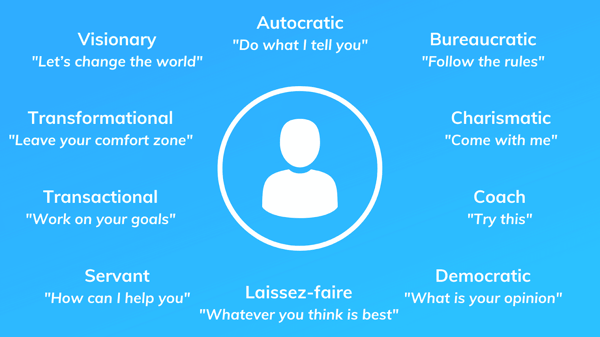
1. Autocratic
As an autocratic leader, you are more of a ruler than a leader. You have complete authority over your team and the decisions being made. Team members are not encouraged to provide input because you make the decisions. There is a strict hierarchy in which you come first, and your team must follow. People often negatively perceive this style, describing these leaders as bossy.
Example: You change the working hours of your entire team without asking for input on what your team wants.
- Pro: You can make decisions fast and strategically. Your team will be relieved from responsibilities and potentially be less stressed.
- Con: This style is difficult for people who want to bring in their ideas and think creatively. Your team may be bothered because they feel unheard and left out.
- Best for: This style may come in handy during crises and other situations when you must make quick decisions. It may also be helpful when you are the only experienced person on the team. If you use this style, tell team members you still respect them.
2. Bureaucratic
Bureaucratic means that your team must follow clear guidelines, processes, and systems. These structures are usually well-documented; the company or predecessor defined many of them. A bureaucratic leader will make it clear to everyone how to work and what he or she expects from the team. There is a defined list of responsibilities and how you make your decisions.
Example: Your team suggested a more efficient way to work. You checked your guidelines, but the suggestions do not fit.
- Pro: You make decisions based on structures. These structures mean stability for your team. Furthermore, individual team members do not depend on your subjectiveness since you make decisions based on specific rules.
- Con: This style is negative for innovation and freedom, which can demotivate your team. That results in high barriers and difficulties when change is needed.
- Best for: This leadership style may be helpful when you work in a high-risk environment, such as health or finance. It may also be valuable for team members who perform routine tasks.
3. Charismatic
Your strength is your charisma. You can persuade others of your ideas and opinions, and your emotional intelligence is usually high. That means you understand your team’s needs and emotions well and can truly connect with them. This puts you in a position where you can follow your vision, and others follow and trust you naturally.
Example: You frequently use your charisma to convince others that your ideas are the best.
- Pro: Your team members tend to identify themselves with your personal qualities and traits. Because of that, you motivate and inspire your team members. That can make leadership very effective.
- Con: If your people skills aren’t high enough, there is a tendency for your team members to turn away because the focus is mostly on you. There is also the risk that you unconsciously or consciously influence others negatively.
- Best for: You may use this leadership style when you work on a big vision or want to unite a great team if you are charismatic.
4. Coach
This leadership style focuses on building a great team with strong individual skill sets. Typically, these kinds of leaders have experience with executive coaching. When applying this style, you communicate with your team members very often. You want to determine how your team can work together at its best. The expectation is that you want people to try new things and develop themselves to unlock their potential. You see yourself as a leader who can push them in the right direction rather than just providing tasks.
Example: You frequently have one-on-one sessions with a focus on the growth of the individual.
- Pro: Your team members have the opportunity for personal and professional development. New ideas are welcome, and your team feels valued. However, you can still make final decisions yourself.
- Con: The coaching leadership style might be ineffective since it focuses heavily on your team members and less on goals and vision. You also risk making team members feel micromanaged.
- Best for: This style may work for you when you work with people who seek opportunities to develop and grow. It may be beneficial when your main focus is building a team that works well together. Be aware not to micromanage others.
5. Democratic
In this style of leadership, the key is that your team’s opinion matters. You encourage the ideas and opinions of every team member, and they matter equally. In the end, you may make decisions together in the group or keep the final call by yourself. Open communication is key, and everyone should feel part of the team.
Example: Whenever you make an important decision, schedule a team meeting to discuss it first.
- Pro: This style allows creativity and helps employees grow and develop. Everyone feels appreciated and motivated to contribute. This boosts morale and overall job satisfaction among team members.
- Con: Making decisions usually takes longer. Perhaps it’s unnecessary for everyone to be part of the decision-making process all the time. Your team members can also experience a lack of clear direction.
- Best for: This style may work well for you when you deal with a workforce that is at least somewhat experienced. It’s also helpful when you want to bring everyone on board and build trust in you and the team.
6. Laissez-faire (laid-back)
With this style of leadership, you encourage your team to use their freedom to figure things out for themselves. Once you set a goal, try to stay out of the way and only intervene when necessary to resolve issues. Sometimes, you do not even set goals or take a step. Instead, you may let the team solve problems on their own. As this kind of leader, you see yourself as the person who guides the team towards a vision or goal.
Example: Your team solely decided to work on a specific task. You weren’t involved in the decision-making process. You’re aware of the task they’re working on and are monitoring only.
- Pro: This style fosters creativity, freedom, and self-ownership. It also makes team members feel respected and trusted. This style may give you more freedom to focus on your vision and goals.
- Con: On the other side, this style can foster rivalry, chaos, and frustration. Without a clear direction, a team member can become an unofficial team leader. Respectively, you can lose your authority within the team.
- Best for: This style may work best for you if your team is very experienced, highly motivated, and doesn’t require much supervision. Make sure to set clear goals and to monitor performance.
7. Servant
While your team is there to serve the company, you are there to serve your team. Your main job is solving your team’s problems and making sure your team has everything they need to work productively. On the other hand, your focus is not on unlocking potential. You prioritize the needs of your team and put your own needs in the second position.
Example: You always ask your team members how you can help and put your efforts into removing obstacles.
- Pro: The team has a very positive morale, and everyone feels empowered. The team’s performance and loyalty towards you should be high.
- Con: This style can lead to low authority and unclear directions. It’s also challenging to maintain this leadership style when facing a crisis or working with tight deadlines.
- Best for: The servant leadership style may be best for you when you have a diverse team. It may also be helpful in an inexperienced team that needs a lot of attention and guidance.
8. Transactional
In transactional leadership, achievements and failures play a central role. Everyone knows what needs to be done, why that needs to be done, and to what standard. You reward your team members for doing precisely the work you expect them to do. On the other hand, you punish team members if they don’t fully meet the expectations you set.
Example: You talk to your team and ask detailed questions to determine whether everyone is on track, and you punish them if they are not by rejecting their days off.
- Pro: Rewarding or punishing team members based on your predetermined goals sets clear expectations and roles. You can make quick decisions without others’ input.
- Con: New ideas and creativity are difficult to generate because of the clear expectations. This can also lead to a bare minimum approach from your team members, who might feel demotivated by your leadership style.
- Best for: This style is ideal when evaluating team members solely based on their performance. You may want to use it when your team is already motivated and has the necessary expertise.
9. Transformational
The transformational leadership style is about getting out of the comfort zone. First, you set clear goals that your team members need to achieve. Over time, you keep setting higher goals. While you do so, you encourage everyone to find better ways to do their job and to challenge the status quo. In this style, mission and vision play a key role.
Example: When you notice your team is just doing fine, you already think of what you can change to improve.
- Pro: Communication, transparency, and productivity are high. There is also ample room for new ideas and creativity. Team members feel satisfied with the constant growth opportunities.
- Con: This style can also lead to dissatisfaction when you don’t give enough guidance or when change is only happening for the sake of change. Your team may not want to learn new things if you lack proficiency.
- Best for: When personal and business growth is your goal, use this leadership style. It may be helpful to encourage confidence in you and the team members.
10. Visionary
The visionary leadership style is also referred to as the authoritative leadership style. As a visionary leader, you constantly spread your vision and explain your thinking often. Your focus is not on giving instructions. You preferably want team members to follow you, and you lead by example. Furthermore, you clearly understand what challenges you must overcome to reach your vision.
Example: You repeatedly talk about the vision of the company and its impact on the current status quo.
- Pro: Your clear vision and constant communication lead to clarity and alignment. The vision itself can also be very inspiring and motivating for your team members.
- Con: Focusing only on the vision can lead to a lack of empathy and guidance. If you cannot communicate your vision clearly, this can eventually lead to mistrust and confusion.
- Best for: When you work on something innovative and move towards a bigger goal, this leadership style may be suited for you. It may also be helpful if you want to attract great talent that shares your vision.
How can you use different leadership styles effectively?
Leadership styles show how you can act and interact with your team members. However, there are different individuals, situations, goals, and companies. In a practical world, choosing one leadership style and sticking to it always will make you a less effective leader.
Here’s a step-by-step framework for using multiple leadership styles with confidence:
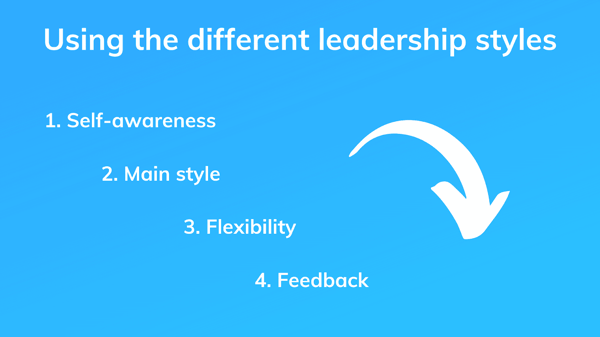
1. Build self-awareness
Start by understanding your default style. First, you need to know yourself and all your strengths and weaknesses. Take note of how you typically make decisions, handle feedback, and delegate responsibility. By comparing yourself with the different styles, you will determine which ones suit you more naturally and which don’t. Tools like 360° feedback or leadership assessments can help identify patterns and blind spots.
2. Choose a primary style
While flexibility is critical, having a single core leadership style creates consistency and fosters trust. Your primary style is the one that aligns most closely with your strengths, values, and the culture of your organization. For example, if you’re naturally empathetic and collaborative, servant or coaching leadership may come most easily to you.
Choosing a primary style doesn’t mean you’re locked into it; it means your team knows what to expect from you most of the time. This consistency makes you more predictable in a good way: people know how to work with you, what you value, and how you make decisions.
3. Develop style agility
Once you’ve established a primary leadership style, the next step is building flexibility. No single style works in every situation, and clinging to one approach can become a liability. Style agility refers to having the awareness and skill to adjust your behavior in response to changing circumstances.
For instance, a democratic leader who thrives on collaboration may need to take a more autocratic approach during a time-sensitive crisis. Likewise, a transactional leader might need to adopt a more transformational mindset when managing a major organizational change. The key is knowing the strengths and trade-offs of each style and being able to deploy them consciously, not reactively.
4. Seek feedback and course-correct
Ask your team directly: “What’s working in how I lead? What’s getting in the way?” You might learn that what feels like empowerment to you comes off as hands-off disengagement to them. Or that your attempts at clarity are being interpreted as micromanagement. Feedback loops, through one-on-ones, pulse surveys, or informal check-ins, help you fine-tune your approach. They also reinforce psychological safety, showing your team that you’re open to growth and that leadership isn’t static.
Frequently asked questions about leadership styles
Got more questions? We have the answers.
Q1. Can a leader use more than one leadership style?
Yes. Effective leaders often switch between different styles depending on the situation, team maturity, and organizational goals. This flexibility is known as leadership agility.
Q2. How do I know which leadership style I use?
You can assess your leadership style through feedback from peers and team members, leadership self-assessments, or 360-degree reviews. Your default decision-making and communication patterns often reveal your dominant style.
Q3. What leadership style is most effective for managing remote teams?
Coaching, servant, and visionary leadership styles tend to work well in remote environments, as they emphasize trust, clear direction, and strong communication.
Q4. Can leadership styles change over time?
Yes. Leaders often evolve their styles as they gain experience, receive training, or face different organizational challenges. Leadership development programs often aim to build flexibility and adaptability.
Q5. How do leadership styles affect employee performance?
Leadership styles shape how employees feel about their work, their manager, and the company. Supportive styles like coaching or transformational leadership can boost motivation, innovation, and retention. In contrast, overly directive styles may lead to disengagement or reduced creativity, especially in autonomous teams.
Lead with authenticity
Leadership is never static. The most successful leaders aren’t locked into a single style. They know themselves well enough to lead with consistency, and they understand others well enough to adapt when needed.
Understanding leadership styles is a foundational step in building stronger, more resilient teams. For organizations, it serves as the starting point for designing leadership training that delivers a measurable impact.
Choose your core style with intention. Learn the others with curiosity. Lead in a way that makes space for both structure and growth.
Ready to take your leadership to the next level? Read our exclusive interview with HubSpot CEO Yamini Rangan on leadership.
This article was originally published in 2024. It has been updated with new information.